
For 16-year-old twins Sura and Surjit Singh Rajkumar, the journey to Guwahati began with something neither had experienced before: a flight.
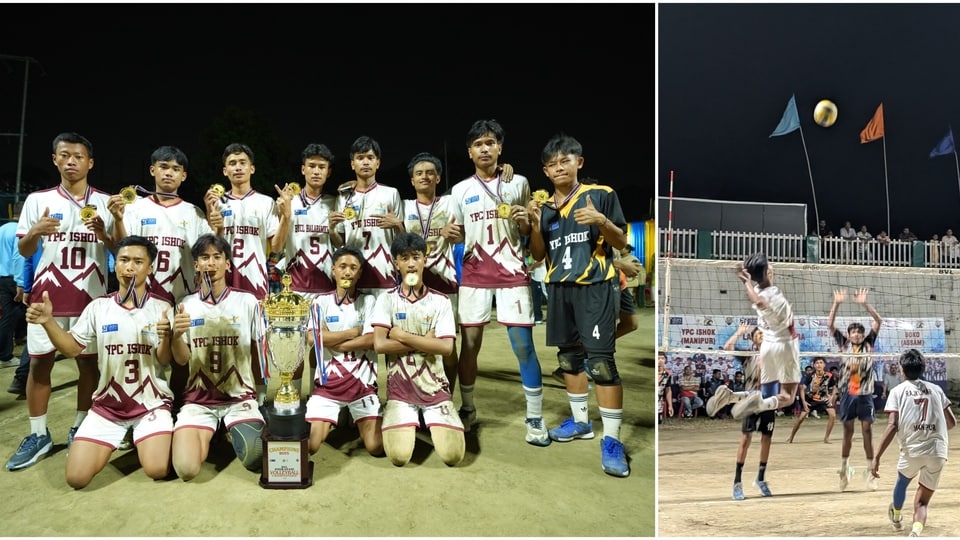
Growing up in Ishok village in Manipur’s Bishnupur district, the brothers had spent much of their childhood on volleyball courts, watching village seniors play and dreaming of one day representing India. Their first flight, however, came with considerable apprehension.
Their families were worried about sending them away, particularly against the backdrop of the ethnic violence that has gripped Manipur for more than three years.
When the boys eventually returned, they did so as champions of the Brahmaputra Volleyball League (BVL) Interstate Championship. The Manipur boys’ team, representing YPC Ishok Village, defeated Assam 3-1 in the final on October 4. The Manipur girls’ team, BYCL Balaramkhul – also representing a village in Bishnupur – finished third.
For coach and team coordinator Beda Konsam, the journey had begun long before the tournament, on village courts where volleyball continued to be played even as conflict threatened to narrow the possibilities available to an entire generation and region.
“Out of the 15 districts in Manipur, we can travel within the valley areas. But we cannot go into the remaining 91% in the hills. We have to stay within our 9% area,” Beda told HT, describing the restrictions on movement that have complicated everyday life.
The ethnic violence that erupted in May 2023 between the Meitei and Kuki-Zo communities has displaced nearly 60,000 people, claimed more than 350 lives, destroyed homes and fractured relationships. Fresh cycles of violence have followed, including renewed Naga-Kuki-Zo clashes in the hill districts in 2026.
For young, aspiring athletes, too, the consequences have been devastating. Training and competition require travel, facilities, financial support and regular interaction with teams from other regions. In Manipur, each of these has become more difficult.
Beda, a former national-level volleyball player, began working to create a grassroots pathway for young players after seeing the community-led model developed in Assam by former India captain Abhijit Bhattacharya through the BVL.
“We also saw that in Japanese volleyball, many of the current stars in the world started playing from Under-12 or Under-10. We thought that in Manipur, where people say there is sporting talent, we should also show something in volleyball to the whole of India,” he said.
“Most of the children who play sports here come from poor or financially unstable families. My motivation to them was to focus on their work and their dreams. If a child plays sport, they develop discipline and can eventually get a job in the Army,” he said.
There was a time when his academy brought together Naga, Kuki and Meitei players for training. After the conflict erupted, communities were divided and players from different areas could no longer travel as freely as before. Some lost their homes; others lost access to opportunities such as Army recruitment trials and tournaments organised by central forces.
Yet, for many young athletes in Manipur, the aspiration remains a government or defence job. Beda says that when he asks children what they want to become, the overwhelming answer is to join the Army. Others hope to become physical education teachers or coaches.
The Rajkumar twins are no different, and volleyball has already taken them some distance towards their dreams. Their father is a farmer and their mother a homemaker. The brothers began playing volleyball before they turned seven, inspired by senior players in their village. Now 16, they have represented Manipur at the national level and were part of the state’s Under-17 gold-medal-winning squad. One plays as a middle blocker, the other as an attacker. Both stand around six feet tall, an advantage in a sport where height can make a significant difference.
“We (in Manipur) are a bit short in height, but still, we have big dreams,” Beda said with a laugh.
In Bishnupur, training takes place in the evenings, after school. For more advanced preparation, NIS-certified coaches are brought in. Ahead of the BVL tournament, the team underwent an intensive month-long camp.
“The main problem is commuting. Expenses have increased a lot, and commodities are expensive… even deliveries from Amazon or Flipkart are not coming through. Everything we buy is costlier,” Beda said.
Even a road journey to Guwahati was considered too risky because of blockades and uncertainty along the highways. The organisers – Dani Sports Foundation and BVL – eventually arranged flight tickets for the Manipur contingent.
Founded in 2020, the BVL has taken low-cost grassroots volleyball to young players across states including Manipur, Jammu and Kashmir, Jharkhand and Odisha.
“When you give them a ball to play with, the environment changes,” Bhattacharya told HT. “It only requires two bamboo poles, a net, and two balls.”
“Initially, parents didn’t understand. Their only concern was, ‘will this ruin their studies?’ But now parents come to our centre in-charges and say, ‘Save my child. They got off track… please take them back on the ground.’”
For Beda, developing the girls’ game is an important priority. He hopes to organise 15-day training camps led by NIS-certified coaches for village teams next year.
Despite the challenges, volleyball in Manipur has become a space where children can build friendships, find routine and a sense of structure at a time when so much else remains uncertain. The sport has also woven itself into village life, with tournaments organised around festivals, birthdays and memorial occasions.
In a state where conflict has restricted the horizons of so many young, ambitious lives, open volleyball courts are offering something increasingly precious: the hope of a better future.