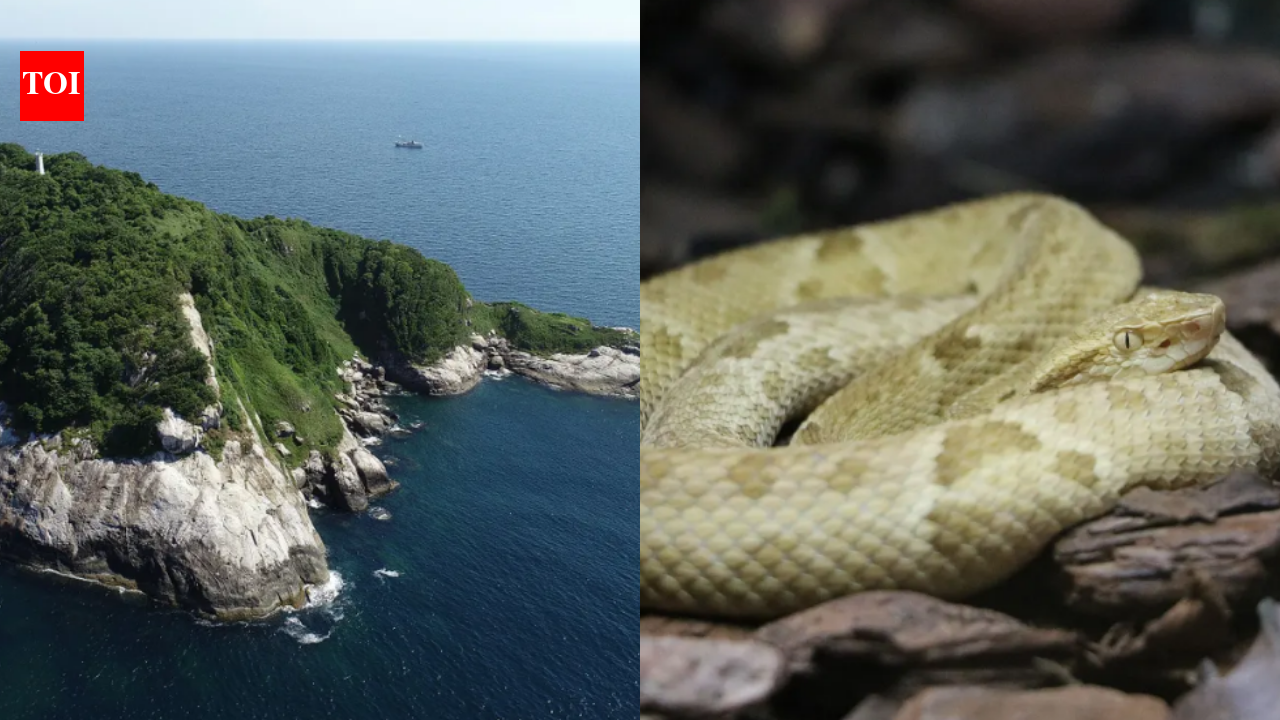
Snakes are scary, venomous creatures found across the globe. Encountering even one of these slitherers sends chills down a person’s spine.But what if there was an island just full of these highly venomous creatures?This is not just a fantasy tale; about 90 miles off the coast of São Paulo, Brazil, is located on an island that looks just as beautiful and yet is completely off-limits.From a boat, Ilha da Queimada Grande looks like any other patch of Atlantic rainforest with dense green cover and a rocky shoreline that seems worth exploring, but it is completely off-limits as the island is home to thousands of golden lancehead vipers, among the deadliest snakes on the planet, all packed into a space of under half a square kilometre.Popularly known as Snake Island and home to the deadly snake species, the Golden Lancehead is so isolated that it evolved venom unlike anything else on Earth.
How did the snakes reach the island?
Around 11,000 years ago, rising sea levels after the last ice age separated Ilha da Queimada Grande from mainland Brazil, trapping a population of snakes on the newly formed island, according to a study published in the National Library of Medicine. With no way back to the mainland, this isolated group began evolving along its own path, cut off from the rest of their species for thousands of generations. Over time, that isolation changed their behaviour and their biology, eventually giving rise to an entirely new species found nowhere else on Earth.
Why the venom became so unusually potent
Stranded on an isolated piece of land, with no ground-level prey, the snakes had to adapt to hunting migratory birds passing through the island’s canopy. Since a bitten bird could simply fly off before the venom worked and be lost forever, the snakes evolved venom several times more potent than that of their mainland relatives, strong enough to immobilise prey almost instantly.That same venom, while essential for the snake’s survival, is also what makes an encounter with a golden lancehead so dangerous to humans, capable of causing severe tissue damage in a short span of time.
How dangerous a bite really is
A golden lancehead’s venom can cause kidney failure, internal bleeding, and severe tissue damage, and bites carry a real risk of death even with prompt medical treatment, according to Smithsonian Magazine. This is why Brazilian authorities strictly limit access to the island, requiring a licensed doctor to be present on any officially sanctioned visit. The lancehead genus this snake belongs to is already responsible for the vast majority of snakebites reported across Brazil, which gives some sense of how seriously researchers and officials treat the risk here.
Why the island is closed to the public
Ilha da Queimada Grande has been off-limits to civilians since the Brazilian Navy shut it down in the 1920s, not long after it stopped needing a resident keeper for its now-automated lighthouse.Today, access is granted only to naval personnel doing lighthouse maintenance and to scientists with special research permits. It’s one of very few places in the world where an entire island has essentially been reserved for a single dangerous species, largely to keep both the snakes and any curious visitors safe from each other.
It is a critically endangered species worth protecting
Despite having a fearsome reputation, the Golden Lancehead is officially critically endangered, and its population has reportedly dropped by nearly half over the last 15 years due to habitat disturbance, disease, and illegal wildlife trafficking.