
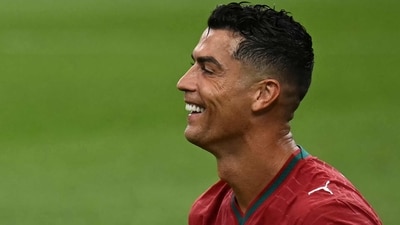
Cristiano Ronaldo did not just score twice. He delivered a statement.
Portugal arrived at their Group K match against Uzbekistan under pressure after a frustrating 1-1 draw against DR Congo had left questions around their sharpness, balance and, inevitably, Ronaldo’s place in the starting XI. At 41, every subdued performance from the Portugal captain now becomes a debate. Every missed chance becomes evidence for those who believe the team must finally move on. Every quiet night is treated like the beginning of the end.
Against Uzbekistan in Houston, Ronaldo answered in the language he has always trusted most – goals.
Portugal won 5-0, but the night belonged to the image that followed the result as much as the result itself. After the match, Ronaldo was seen walking away and shouting, “I’m back, I’m back.” It was not subtle. It was not designed to be. This was Ronaldo turning a routine group-stage win into a personal declaration.
Ronaldo turns pressure into performance
The performance itself had the old Ronaldo fingerprints all over it. He opened the scoring early, arriving in the six-yard box to turn in Joao Cancelo’s delivery and give Portugal the release they badly needed. It was a classic striker’s goal, simple only because of the timing, movement and hunger behind it.
That goal also carried history. Ronaldo became the first footballer to score in six different World Cups, extending a legacy that began in 2006 and is still somehow alive two decades later. It also ended his long wait for a goal at a major international tournament, a drought that had added to the noise around him after Portugal’s opener.
But Ronaldo was not done. Before half-time, he scored again, finishing after being played into space and helping Portugal take full control of the match. There was even a near-hat-trick moment before the break, with Abdukodir Khusanov clearing his effort off the line.
The broader Portuguese performance helped, of course. Nuno Mendes scored a fine free-kick, Khusanov later turned into his own net, and Rafael Leao added the fifth late on. Bruno Fernandes, Cancelo and Mendes gave Portugal more width, tempo and service than they had shown in the opening game. This was a far more functional attacking display from Roberto Martinez’s side.
Yet Ronaldo remained the headline because the story around him was bigger than the scoreboard.
For Portugal, this was a necessary win. For Ronaldo, it felt like a personal reset. His movement was sharper inside the box. His finishing was calmer. His presence forced Uzbekistan to defend deeper and gave Portugal a clear focal point. He was not everywhere, and he did not need to be. He was where the match demanded him to be.
That is why the post-match cry mattered.
Also Read: Kylian Mbappe joins Klose and moves past Ronaldo: Are we watching football’s greatest ever striker?
“I’m back, I’m back” was not just celebration. It was defiance. It was aimed at the doubts that had followed him into the match. It was a reminder that even at this stage of his career, Ronaldo still sees criticism as fuel rather than burden.
The line will travel because it fits the Ronaldo myth perfectly: the ageing superstar, written off again, responding with goals again, then making sure the world heard him again.
Portugal’s tougher tests are still ahead, and one big performance against Uzbekistan will not settle every debate about how far Ronaldo can carry this team. But on this night, he gave Portugal goals, gave the tournament a moment, and gave his critics the answer he wanted them to hear.
Cristiano Ronaldo walked away shouting, “I’m back.” And for one night at least, it was impossible to argue.