
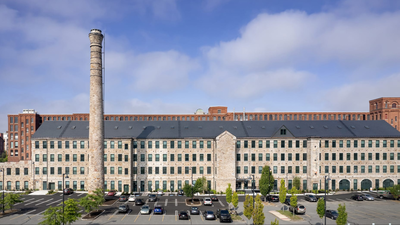
A 170-year-old stone mill that once made water turbines and machinery during New England’s industrial boom has completed a $53 million (£41 million) historic restoration. The building has reopened as an 86-unit residential complex offering homes at different price levels in Lawrence, Massachusetts. Built in 1848 by industrialist Abbott Lawrence along the Merrimack River, the 150,000-square-foot building sat empty for decades. According to case study documents published by the US National Park Service, the historic property has now been turned into Stone Mill Lofts. Of its 86 apartments, 69 are set aside as affordable housing for lower-income households. The project was funded through a mix of federal and state historic tax credits, along with Low Income Housing Tax Credits. The cost of work that qualified for rehabilitation funding came to about $44 million, within the total project budget of $53 million.
Mixed-income housing and community facilities
The newly opened complex offers homes for people at different income levels. Of the 69 affordable apartments, 58 are reserved for low-income residents, while 11 are set aside for very low-income individuals and families. The remaining 17 apartments are rented at market rates. The renovated homes retain many of the mill’s original features, including exposed stone walls, timber ceilings and wide wooden floors. According to National Park Service records, the property also offers several shared facilities for residents:
- A community lounge and shared kitchen
- Work-from-home pods and a fitness centre
- An indoor children’s playroom and bicycle storage
- Storage lockers for residents and an outdoor patio
- An educational exhibit about the mill’s industrial history
Flood defense and modern energy conversion
Since the mill stands right beside the Merrimack River, developers had to deal with serious flood risks during the renovation. Contractors raised the building’s entire ground floor by 12 inches, lifting the indoor living areas above the designated floodplain. Engineering teams also updated the 19th-century building to meet modern environmental standards. Project notes from the National Park Service describe the property as one of the first fully electric multi-family residential developments in Massachusetts. The building uses electric heat pumps and energy recovery ventilation to control indoor temperatures while helping lower utility costs. Builders also installed replacement windows with three layers of glass, high-efficiency air filters and thick insulation throughout the exterior stone walls. These changes have turned the historic industrial building into an energy-efficient residential complex.