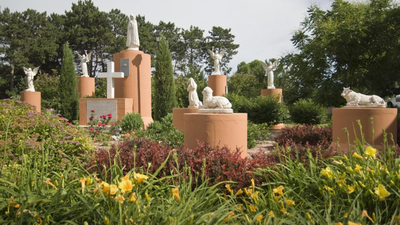
A small roadside monument beside US Highway 34 in rural Nebraska carries the memory of a survival story that began inside the barracks of Dachau concentration camp. The Our Lady of Fatima Shrine, located on the grounds of St. Germanus Catholic Church in Arapahoe, was built to fulfil a solemn promise made by Father Henry J. Denis. Imprisoned by Nazi forces during the Second World War and subjected to deadly medical experiments, the Polish military chaplain vowed that if he survived the concentration camp, he would build a public shrine dedicated to the Blessed Mother. Details documented by Visit Nebraska and published by the Catholic Diocese of Lincoln describe how the priest survived years of imprisonment, medical experiments and near-fatal roll calls before moving to the United States and building the monument.
Wartime arrest and the horrors of Dachau
Born in Poland and ordained in 1936, Father Denis was serving as a chaplain in the Polish Army when Nazi forces invaded in September 1939. German troops arrested him soon after the invasion, beginning a series of transfers through concentration camps, including Buchenwald, before he was sent to Dachau in 1942. Historians and diocesan records say Dachau became the main camp for Christian clergy. Of the 1,773 Polish priests sent there, fewer than half survived. Clergy were banned from holding religious services, celebrating Mass or carrying religious items, with violations punishable by death. In a 1971 interview preserved by the Diocese of Lincoln, Father Denis described the strict rules imposed on priests: “For us, the offering of the Mass, confessions and reciting the rosary – all this was prohibited under the penalty of death. Two Austrian priests were caught praying the rosary, they were killed on the spot.” To continue praying, Father Denis counted his prayers silently on his fingers while carrying out forced labour.
Medical experiments and the call to roll call
Conditions became even worse in 1944 when Nazi doctors chose Father Denis for medical experiments on prisoners. For five months, doctors repeatedly infected him with malaria as part of research into tropical diseases. Many prisoners subjected to the same experiments died from the disease or from later lethal injections. Father Denis watched fellow prisoners die as the experiments continued. The key moment came on 7 October 1944, during the Feast of the Holy Rosary. Rain and cold winds swept through the camp as SS guards held a long morning roll call, shouting at and beating prisoners while checking every inmate. Recalling that morning in memoirs kept by the shrine, Father Denis wrote: “It was a cold, windy and rainy morning. There was a long, long roll call and prolonged counting. There were many corpses on that day, and all the dead had to be brought and placed in line with those who were alive. There was a lot of shouting, cursing, kicking and clubbing.”While marching to his work detail, a fellow German priest asked Father Denis why camp commanders had called his name and identification number over the loudspeakers. Failing to report when called meant certain death. “My blood stopped to circulate,” Father Denis recalled. “To be called and not to report at once – that’s death, and death flashed in my mind as never before. Oh, what excruciating hours.” When the workers returned to the camp that evening, guards did not look for him or call his number again. Instead, another priest prisoner, Father Francis Dachtera, reported to the SS block in his place and never returned. Realising that he had survived because of an error or unusual circumstance, Father Denis promised to build a shrine to Mary if he lived to see liberation.
Freedom and the journey to Nebraska
American forces liberated Dachau on 29 April 1945. Weak from malaria and starvation, Father Denis spent months recovering in Europe. While recovering in Italy, he began sharing religious images of Our Lady of Częstochowa. This eventually brought him into contact with officials from the Diocese of Lincoln in Nebraska, who were looking for priests to serve rural parishes. Father Denis moved to the United States and served several small Nebraska communities before becoming pastor of St. Germanus Church in Arapahoe in 1949. After arriving in Furnas County, Father Denis first focused on his parish before raising money for the promise he had made during the war. To build the monument, he sought help from across North America and Europe, receiving building materials, stones and financial support from 43 American states, Canada and European donors.
Construction of the roadside sanctuary
Dedicated in August 1956, the Our Lady of Fatima Shrine recreates the 1917 Marian apparitions reported in Fatima, Portugal. The open-air site has a central, life-sized statue of Our Lady of Fatima with her head bowed and hands folded. It is flanked by statues of the three shepherd children, Lucia, Francisco and Jacinta, along with sculpted farm animals. An altar in front of the main statue carries an inscription explaining the site’s history and purpose: “TO THE IMMACULATE MOTHER OF GOD AND OUR HEAVENLY FATHER / OUR LADY OF FATIMA / WITH HOPE AND PRAYER FOR PEACE / REV. HENRY J. DENIS AND HIS FRIENDS OF ALL FAITHS / 1956 / E PLURIBUS UNUM”. Stone angels holding trumpets stand beside the altar, symbolising freedom and remembering those who died in wartime atrocities. Walking paths around the shrine were later expanded to include a Rosary Walk through native landscaping beside the historic 1885 wooden parish church. The shrine remains open to travellers, pilgrims and local visitors, serving as a quiet reminder of survival and a promise kept across two continents.