While conducting experiments on the vaporisation of carbon atoms in 1985, chemists Harold Kroto, Robert Curl, and Richard Smalley obtained surprising results that showed the stability of a cluster comprising only 60 carbon atoms. This molecular structure became famous by the name of buckminsterfullerene or, as it is commonly referred to, C60.At first, it seemed to be a bizarre laboratory observation. However, over time, this discovery appeared to be a breakthrough in understanding that there exists another form of carbon other than the already known graphite or diamond.Carbon experiment producing an unusual patternIt should be mentioned that this experiment did not intend to reveal any new chemical properties of carbon. The research aimed at the study of carbon atoms’ behaviour after being vaporised through a process of a supersonic cluster experiment. As stated in the review of the Royal Society of Chemistry, a very stable 60-atom cluster was detected several times while researching carbon vapour products.What sets the stability of this structure apart is that experts expected to observe the formation of soot-like disorganised material rather than an ordered molecular cage. The recurrence of C60 implied that the structure contained carbon atoms which aligned themselves into a shell-like formation. Such a possibility seemed contradictory to established theories on the nature of carbon at high temperatures.Reasons for the surprise discoveryPrior to the discovery of C60, carbon allotropes were classified primarily into diamonds and graphites. The new discovery indicated that carbon could self-align into hollow cage molecules. From the scientific review articles, buckminsterfullerene can be described as the first symmetrical carbon nanostructure created from sp2 hybridised carbon atoms to form a stable cage structure.The significance of this structure was evident in terms of structure dictating the reactivity of a substance. As opposed to graphite and diamonds, carbon atoms had self-aligned into a curved shell-like molecule. Subsequent investigations proved the existence of the C60 and other similar molecules like the C70 using mass spectroscopy and Carbon-13 nuclear magnetic resonance spectroscopy. The Royal Society of Chemistry pointed out that the two methods helped to prove that fullerene was a real and stable molecule and not just an artificial structure.
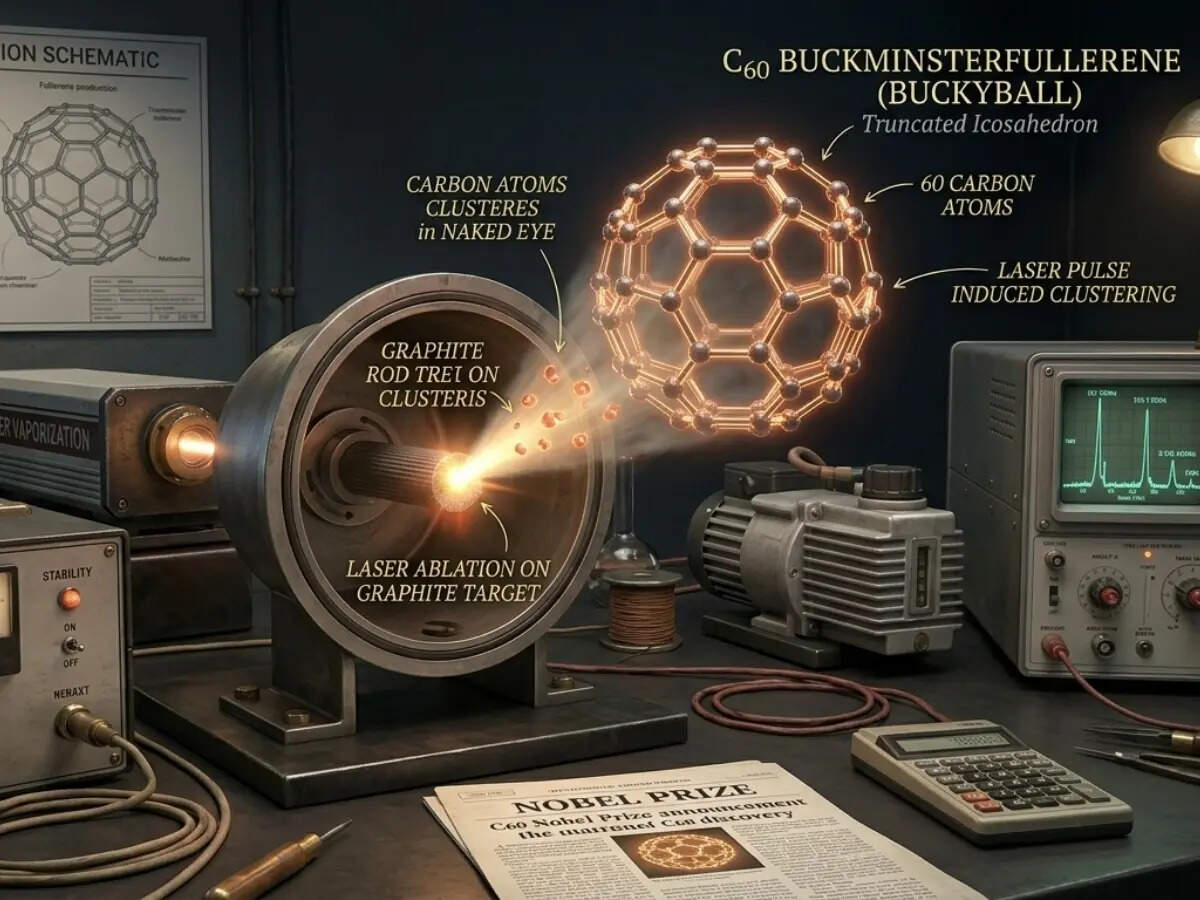
A carbon vapour experiment produced a mysterious 60-atom pattern. Image credit – Gemini
How the molecule got its famous nameThe interesting structural formation reminded scientists of geodesic domes created by an architect named Buckminster Fuller. The molecule earned the name buckminsterfullerene since it was shaped like a dome. The name proved useful to popularize the discovery since it helped to picture what kind of molecule had been discovered. Scientists liked to refer to it as a soccer ball because of the repetitive structure of pentagons and hexagons in the ball. That simple explanation of the complex molecule transformed a scientific discovery into a notion that people from various branches of science could discuss.Significance beyond chemistryThe buckminsterfullerene molecule was vital to science since it brought chemistry into the realm of nanotechnology. People began to study small molecules with special properties. Another review conducted by the Royal Society of Chemistry cited the 1985 fullerene discovery as one of the most important breakthroughs in the modern history of chemistry since it altered scientists’ understanding of the nature of carbon bonds and nanoparticles altogether.As a matter of fact, C60 contributed greatly to further investigations of other nanocarbon structures like carbon nanotubes and graphene, which, today, play important roles in electronics, energy storage, coatings, biosensing applications, and materials design. However, no commercially available products could be derived from the discovery at once, but it still provided a scientific basis for future nanotechnology studies.An almost imperceptible molecular signature with a monumental legacy in scienceThe importance of the discovery can also be seen from the fact that the history of groundbreaking achievements in science starts with unexpected data in many cases. In the particular case under analysis, Kroto, Curl, and Smalley simply observed something unusual which happened to lead them to an incredible breakthrough. In other words, the ability to perceive an unexpected pattern was what made the difference.However, C60 is far more than a mere molecule. It is a symbol of the time when chemistry ventured into the world of the nanoscale. From an odd signal detected during a study of carbon vapour, it emerged as a remarkable discovery that still shapes the course of studies in physics, chemistry, electronics, and nanotechnology.