
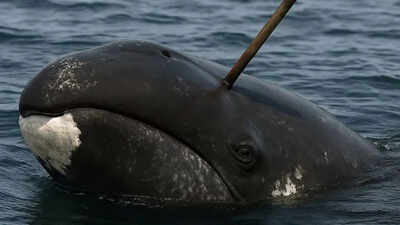
The Arctic does not often give up its secrets quickly. Ice, distance, and long stretches of darkness have a way of preserving stories that would disappear elsewhere. As reported by The New York Times, in 2007, one such story surfaced from the body of a bowhead whale harvested during a subsistence hunt in Alaska. Hidden beneath layers of skin and blubber was a fragment of a weapon that had not belonged to the modern era at all. It came from a time when industrial whaling fleets crossed northern seas in pursuit of whale oil and baleen. What began as an unusual discovery inside a whale soon became one of the strongest reminders that some of Earth’s largest animals can outlive entire human generations.
An old whaling weapon offered an unexpected clue that stunned researchers
The whale had been taken during a legally permitted Indigenous subsistence hunt, a tradition that has sustained Arctic communities for thousands of years. While the animal was being processed, fragments of metal were noticed deep within its tissues.The object was not immediately recognisable. Once examined by specialists, it turned out to be part of an old-style exploding harpoon. These devices were widely used by commercial whalers during the late nineteenth century, particularly by fleets operating out of New Bedford, Massachusetts, which was then one of the world’s leading whaling centres.The design itself provided an important clue. Historians familiar with whaling technology were able to identify the weapon as a patented lance type that was commonly used between the 1880s and 1890s. The implication was difficult to ignore. If the whale had survived being struck by the harpoon when it was first fired, then the animal had likely been swimming through Arctic waters for well over a century.
A century-old clue pointed to one of the oldest mammals on Earth
The embedded weapon suggested that the whale had encountered commercial hunters sometime between 1885 and 1895. Since the animal was still alive when harvested in 2007, scientists estimated its age at roughly 115 years.That figure alone would place the whale among the oldest mammals ever recorded. Yet even that estimate may not have represented its full lifespan. The harpoon could only establish a minimum age. The whale might already have been several years old when it was struck.Bowhead whales have become famous among biologists for precisely this reason. They appear to age extraordinarily slowly compared with most mammals, showing a lifespan that stretches far beyond what would normally be expected for an animal of their size.
The mystery of how bowhead whales survive for so long
Long before the discovery of the harpoon, there had been hints that bowheads were unusual. Indigenous knowledge had long suggested these whales lived exceptionally long lives, but confirming such claims scientifically was far from straightforward.Unlike trees, whales do not grow rings that can be counted. There are no convenient records of their birth dates. Determining the age of an animal that may have been alive before the invention of the motor car presents obvious challenges.As evidence accumulated, however, researchers began to realise that bowheads were not merely long-lived. They occupied an entirely different category of longevity. Some estimates indicate that certain individuals may survive beyond 200 years, placing them ahead of every other known mammal.
How scientists use eye lenses to estimate a whale’s age
One of the most reliable ways of estimating a bowhead whale’s age comes from an unlikely place: its eye lens. Within the lens is a substance called aspartate, an amino acid that exists in two mirror-image forms. At birth, the balance is heavily skewed towards one form. As decades pass, the molecules slowly shift towards equilibrium.By measuring the ratio between the two versions of aspartate, scientists can estimate how much time has passed since the tissue formed. The process has been compared to a biological clock, allowing researchers to approximate ages even when no historical records exist.
From near collapse to recovery
The fact that bowhead whales are still around to surprise scientists is something of a conservation success story.Commercial whaling pushed their numbers to dangerous lows. Decades of intensive hunting dramatically reduced populations across the Arctic, leaving only a small fraction of the original numbers by the early twentieth century.Large-scale commercial harvesting eventually came to an end, and protection measures followed. Since then, bowhead populations have shown signs of recovery. Estimates vary between regions, but the species has rebounded substantially from its historical low point.Subsistence hunting by Indigenous communities continues under regulated agreements, reflecting a practice that predates industrial whaling by thousands of years and remains culturally significant across parts of Alaska and the Arctic.
The biology behind a long life
Scientists remain fascinated by how bowhead whales manage such extraordinary longevity. Their bodies appear to possess mechanisms that help reduce cellular damage and maintain genetic stability over long periods.Part of this may involve a slower approach to cell division. Cells are given more time to repair mistakes before reproducing, reducing the accumulation of damage that typically accompanies ageing.The bowhead discovered in 2007 carried physical proof of that history within its body. The rusted remains of a harpoon served as a reminder that while human lives are measured in decades, some creatures quietly move through centuries.