
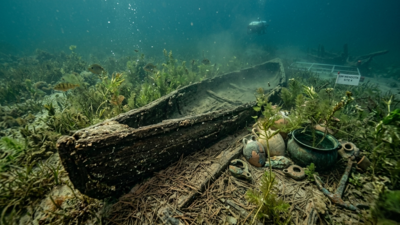
On occasions, the oldest stories on earth lie buried not too deep within our ordinary existence, lurking under just a few feet below the coasts and beaches where we spend our weekends. For a scuba diver exploring the icy waters of Lake Mendota in Wisconsin, what seemed initially like a piece of driftwood partially buried in sediment proved itself to be much more intentional in origin – the distinctly cut lines of an ancient boat crafted by the hands of man several millennia ago.Such a discovery spurred tremendous efforts to salvage and protect one of the most invaluable historical treasures, referred to as a cultural time capsule. For the Ho-Chunk Nation, the canoe symbolises a connection to their ancestors, whose rich culture prospered in these parts of America throughout many centuries. Inorganic objects rarely decay due to contact with nature, which makes the finding of such a well-preserved vessel a genuine scientific sensation. It proves without a doubt that the current quiet waters of Wisconsin were full of life, hosting the bustling activities of ancient people.Preservation science behind Wisconsin canoe discoveryDespite the numerous similar objects made of wood in Wisconsin dating back to the pre-colonial period that have long since disintegrated into thin air, this one survived because of special conditions created at the bottom of Lake Mendota. Organic materials such as wood cannot withstand being exposed to oxygen and certain microorganisms, so burying them in deep water creates favourable conditions for preservation. According to the Wisconsin Dugout Canoe Survey Project, Lake Mendota has unique bed chemistry, resulting in the creation of a “dead zone” that halted the process of decomposition for 1,200 years.

Laser scanning technology is being used to digitally preserve the vessel, revealing its intricate craftsmanship and historical significance. Image Credit: Google Gemini
The recovery process should strike a delicate balance between what happened in the past and what happens now. The moment an old wooden object comes out of water, it becomes extremely sensitive to the atmosphere; there is always a likelihood that it will twist or even break. In order to avoid such an eventuality, scientists came up with a technique called laser scanning. As stated in the report, a 3D scan will reveal the stories hidden within a 1,200-year-old Wisconsin canoe; this technology allowed researchers to create a perfect digital twin of the vessel. It creates a digital copy of the canoe with all the information regarding the story behind it, including the markings done by stones when creating it.A spiritual connection to Ho-Chunk cultureNot only is the discovery a groundbreaking achievement in underwater archaeology, but it is also extremely symbolic for the Ho-Chunk. As stated on the UW–Madison Lakeshore Nature Preserve website, people lived on and around the shores of Lake Mendota over 12,000 years ago. The canoe becomes tangible proof of the lake’s importance throughout the years as a means of transportation, allowing the indigenous people to fish in the waters and move from one effigy mound to another. Thus, the lake becomes something similar to a “sacred book” that has only started telling its story.The significance of the canoe returning to its home goes beyond just restoring what has been lost; it is more about a homecoming. This canoe is directly connected to the art of boat-building that was practised by the Ho-Chunk people’s forefathers, who were able to mould a big piece of wood into a boat. Since this particular canoe was built before colonisation, this artefact provides a glimpse into the past, a history not found in typical school textbooks. The fact that this boat stayed intact for a thousand years shows the legacy of the Ho-Chunk people’s forefathers in terms of water.Right now, the canoe is being preserved through an extremely cautious process, which involves immersing the artefact in a chemical solution. The idea is to replace the water trapped inside its fibres with synthetic wax so that the material does not contract when it dries. Since the finding last year, scientists have been investigating the bottom of Lake Mendota more closely and speculating about whether this boat was actually just one member of a hidden fleet. It is a simple reminder that history never really disappears; it only goes underground for a little while.