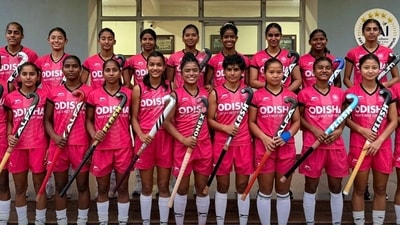
India completed a historic hat-trick of Women’s Junior Asia Cup titles on Sunday, beating hosts China 1-0 in a tense final at the Moqi Training Base in Hulunbuir, with Sanika Chandrakant Mane scoring the goal that separated the two sides. Mane struck in the 17th minute to give India the advantage, and the defending champions made it count, protecting the slender lead through the remainder of the contest to finish their campaign unbeaten and retain their continental crown. The victory gave India a third successive Junior Asia Cup title after their triumphs in 2023 and 2024.
The title also secured India a place at the FIH Junior World Cup, adding another significant reward to a campaign in which the junior women underlined their growing dominance at the continental level. It was also a fitting way for India to complete a tournament in which they had shown two very different sides of their game. They had overwhelmed opponents with their attacking firepower through most of the competition, but when the final demanded patience and defensive discipline against the hosts, India found a way to win with just one goal.
China had already shown earlier in the tournament that they could contain India’s attack. The two teams had played out a goalless draw in their Elite Pool meeting, the only match in the competition in which India failed to score. That result still allowed India to finish on top of the pool with 10 points from three victories and a draw. The rematch carried considerably greater stakes, with the title on the line and China playing on home turf. Mane, however, ensured that the deadlock did not last nearly as long this time. Her 17th-minute strike put India in front early in the second quarter, and the one-goal cushion ultimately proved enough.
India cap dominant campaign with title
India had arrived at the final after putting together one of the most dominant campaigns of the tournament. Their title defence began with a 4-1 victory over South Korea before an 11-1 demolition of Malaysia. India then swept Japan aside 7-0 and followed it with the 0-0 draw against China to finish unbeaten at the top of the Elite Pool.
The gap between India and their quarter-final opponents was even more pronounced. Facing Pakistan, India produced a staggering 19-0 victory, scoring across all four quarters in a completely one-sided contest. Mane was among the scorers on that occasion as well, finding the net twice as India booked their place in the last four.
The semi-final brought another meeting with South Korea, but India were even more convincing than they had been in their opening match. Drag-flick specialist Supriya scored a hat-trick, converting three penalty corners, while Madhu Sidar and Sukhveer Kaur also found the net in a 5-1 victory that sent the defending champions into another final.
China reached the title clash after thrashing Japan 6-0 in the other semi-final, setting up a repeat of the pool-stage encounter between the two unbeaten sides. This time, there would be no stalemate.
Mane, who had already contributed goals during India’s run through the tournament, provided the decisive moment. Once India had their lead, the final became a test very different from their high-scoring victories over Malaysia, Japan and Pakistan. They passed that examination too.
The 1-0 victory meant India ended the tournament without a defeat while completing an extraordinary run of three consecutive continental titles. From scoring 19 goals in a single knockout match to grinding out a one-goal win over the hosts in the final, India found almost every possible route to victory over the course of the competition.
Hockey India subsequently announced a cash reward for the title-winning squad, with each player set to receive ₹3 lakh while every member of the support staff will be awarded ₹1.5 lakh. The federation also highlighted India’s qualification for the FIH Junior World Cup, ensuring the continental triumph will lead directly into another opportunity for this group to test itself on the global stage. For now, however, the Junior Asia Cup remains in Indian hands. And when their most important match was decided by the finest of margins, Mane’s 17th-minute goal was enough to secure another title, another World Cup berth and a remarkable continental three-peat.