
There was a time when hitting a six was considered a risk, an audacious shot reserved for situations that demanded something extraordinary. When Shai Hope and Sherfane Rutherford unleashed a six-hitting spree in Hyderabad, they offered a reminder of how much T20 cricket has changed. As the format continues to push the boundaries of the possible, what was once extraordinary has now become routine.
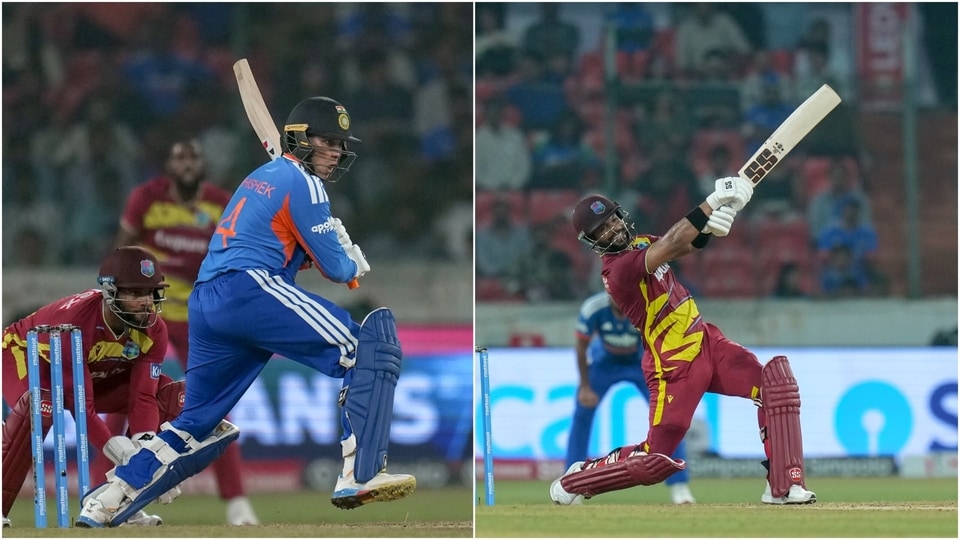
In the ongoing five-match T20I series between India and West Indies, the four matches have produced a staggering 98 sixes. According to CricViz, of the 1,661 runs scored between the two sides, 1,196 runs have come off boundaries and 588 have come from sixes alone. Essentially, 35.40% of runs have come from sixes.
And there is still one match to go.
The series is already among the most prolific six-hitting bilateral contests involving ICC full members. In the final T20I at Bengaluru, the record of most sixes scored in a bilateral T20I series could be broken. Another 23 sixes in the final game would take the tally past the 120 recorded during England’s five-match tour of West Indies in 2023, which remains the ceiling at the moment.
Concentration of sixes across phases
The evolution of T20 batting also suggests that batters are not necessarily waiting for the final overs or just a loose delivery to clear the ropes. Instead, the ability to hit sixes has become a skill to be deployed throughout an innings.
In this series, India concentrated their six-hitting during the Powerplay, scoring 14 sixes compared to West Indies’ 10. Interestingly, West Indies have hit 27 sixes in the middle overs, compared with India’s 16. They hit another 20 at the death against India’s 11. In all, more than 82% of West Indies’ sixes have come after the Powerplay.
While India with its explosive top-order comprising the likes of Abhishek Sharma, Sanju Samson or Vaibhav Sooryavanshi and Ishan Kishan continue to go gung-ho in the powerplays, for West Indies’ the middle overs seem to have become another opportunity to attack. It is one of the most obvious departures from the traditional understanding of the middle overs as a period of consolidation, when batters would rotate the strike, preserve wickets and build towards a final assault.
Preferred mode: fours or sixes?
There also emerged a distinct approach even in this collective appetite for power-hitting. There is no doubt that both sides relied heavily on boundaries. India scored 124 runs in boundaries compared to West Indies’ 126.
India, however, prefer to hit more fours – 83 compared with 69 while West Indies have struck 57 sixes to India’s 41. West Indies sixes have accounted for a remarkable 40.81% of their runs, while India’s figures stand at 29.89%.
West Indies, in this series, have preferred to clear the field altogether. India have found a more even balance between finding the gaps and clearing the ropes.
Hope’s approach
Shai Hope’s batting in this series has been special. He has piled up five 50+ scores across ODIs and T20Is, of which four were centuries. His case is particularly intriguing. Long associated with a more measured style of batting, his six-hitting numbers offer a glimpse into how batters traditionally known for constructing innings are also adapting to the increasingly aggressive demands of T20 cricket.
Hope has struck 20 sixes in the series, while Sherfane Rutherford has contributed another 15. Between them, they have cleared the ropes 35 times — just six fewer than the entire Indian batting line-up.
India, meanwhile, are more spread out as there is no single dominant six-hitter in India’s line-up comparable to Hope. Instead, several batters have contributed to the team’s boundary-scoring output.
Interestingly, in a line-up with Samson and Abhishek who have hit eight sixes, it is actually Shreyas Iyer who has led India’s six-hitting charts with nine sixes.
Consequences for bowlers
Since six-hitting is no longer seen as audacious but routine, many batters are using sixes as a repeatable scoring option even when the required run rate does not demand immediate aggression. For instance, West Indies’ batting approach in the fourth T20I in Hyderabad where they scored 247/3 came while batting first, not in a condition necessarily with pressure.
That evolution has consequences for bowlers, too. If batters are prepared to attack throughout an innings, even reasonably good deliveries can disappear into the stands. In this series, Axar Patel (14) and Naman Dhir (12) have conceded the most sixes even though they have managed to pick up wickets.
With the series headed towards a possible record, the numbers alone cannot establish that one approach is superior to the other as shaped by personnel, venues and match situations.