
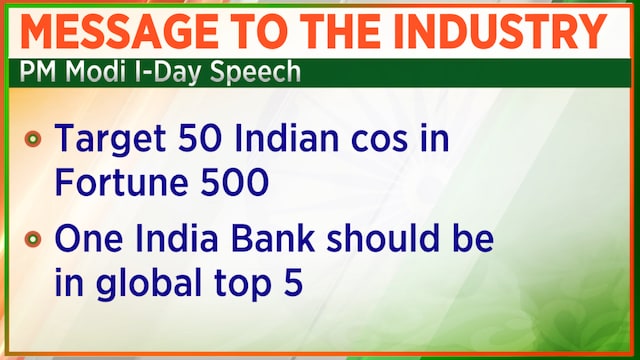
Prashant Khemka, Founder of WhiteOak Capital Group, said the biggest takeaway was the Prime Minister’s renewed focus on the speed of reforms. He expects this push to translate into policy measures in the months ahead, including in Budget 2027. Faster reforms, he said, will be critical for economic growth, job creation and strengthening corporate India.
Khemka also highlighted the significance of the Prime Minister setting specific targets for Indian companies, including having 50 Indian companies in the Fortune 500. “The speed of reforms” will be critical, he said, because growth is essential to achieving the aspiration of a developed India by 2047.
Manufacturing needs quality, scale
AK Bhattacharya, Editorial Director at Business Standard, said the speech carried a clear message that manufacturing, trade and micro, small, and medium enterprises (MSMEs) will be central to the next phase of India’s growth.
India has signed free trade agreements (FTAs) with nearly 40 countries since 2014, but the next step is to use these agreements to build globally competitive businesses. Bhattacharya said manufacturing and trade are closely linked, with India needing to focus not just on costs but also on quality and scale.
The message from the Prime Minister was clear: “Quality, quality, quality.”
Anant Swarup, Secretary General of Federation of Indian Chambers of Commerce and Industry (FICCI), said government incentives will remain important for manufacturing, but they cannot be the only answer. Companies still face challenges around land, approvals, licences and ease of doing business, particularly at the state level.
He said the government, industry and academia also need to work together on innovation, new technology and scaling up manufacturing.
AI skills key to India’s demographic advantage
Varun Modgil, MD of Cognavi India, said India’s large young population can become a major economic advantage only if the workforce is trained for the jobs of the future.
With AI and robotics increasingly entering different industries, artificial intelligence (AI) literacy is becoming a requirement rather than an option. Modgil said the education system needs to be better connected with industry requirements so that graduates are more employable.
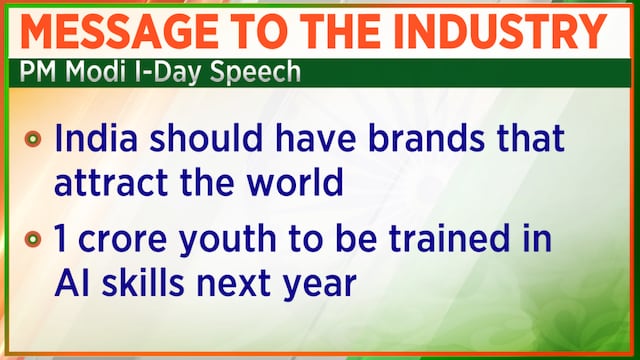
The Prime Minister’s plan to train one crore young people in AI over the next year could therefore become an important part of converting India’s demographic advantage into productive employment.
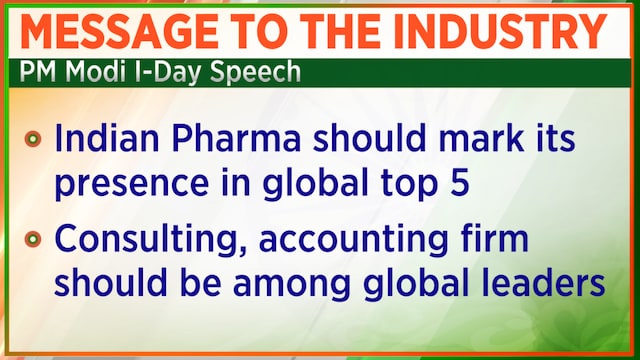
India needs more export markets
On trade, Bhattacharya said the India-US trade agreement remains important but should not become India’s only focus. Geopolitical tensions and possible tariff risks make it important for India to develop alternative markets and trade relationships.
He pointed to ongoing efforts with the European Union (EU), United Kingdom (UK) and Association of Southeast Asian Nations (ASEAN) as important parts of a broader strategy. For India’s export ambitions to succeed, both government and industry will need to contribute through better policies, competitive pricing and improved quality.
Energy security remains a priority
Dhiraj Agarwal, Managing Director of Ambit Investment Managers, said India has already made significant progress in renewable energy over the past 10-15 years.
This progress has helped reduce the impact of higher crude prices on the economy compared with previous periods. Agarwal believes India can achieve its renewable and alternative-energy targets for 2047, while also reducing its dependence on imported crude.
He said India’s crude import dependence still represents a significant economic burden and needs to come down further.
EV growth needs stronger R&D
Nirmal Kumar Minda, President of Associated Chambers of Commerce and Industry of India (ASSOCHAM) and Chairman of Uno Minda Group, said electric mobility will require stronger research and development as well as greater localisation.
While India has made considerable progress in localising components for two-wheelers, four-wheelers still have a gap because newer technologies are emerging rapidly. Minda said automakers and suppliers need to work together on research and development (R&D) and proof-of-concept projects to build a more self-reliant electric vehicle (EV) ecosystem.
Quality standards and skilled workers
HC Mario Schmidt, Managing Director of Lingel Group, said Indian manufacturers already have stronger quality standards in some sectors, but awareness about quality products needs to improve.
Watch the full conversation here

He also highlighted the shortage of industry-ready workers. Training and skilling programmes, he said, need to be strengthened so that workers can enter factories with the skills required by manufacturers.
Taken together, the panel’s message was that the 2047 target will require more than government announcements. Faster reforms, competitive manufacturing, skilled workers, technology, stronger exports and private-sector investment will all need to move together for India to achieve its ambition of becoming a developed economy.
For more details, follow our 80th Independence Day 2026 Live Updates here.