
The pipeline includes around 130 companies that have already received SEBI approval, with another 75-odd issuers at the Draft Red Herring Prospectus (DRHP) stage. The numbers point to a sustained supply of potential listings even as the market moves beyond the episodic IPO cycles of the past.
IPO pipeline builds well beyond current fundraising
The scale-up is visible across the broader primary market. AIBI data shows mainboard IPOs have raised ₹8.36 lakh crore cumulatively between 2016 and 2026 YTD, with annual fundraising rising from ₹26,494 crore in 2016 to ₹1.76 lakh crore in 2025. The 84 issues in 2026 YTD have already raised ₹1.10 lakh crore, putting this year’s fundraising on a sizeable base even before the pipeline is tapped.
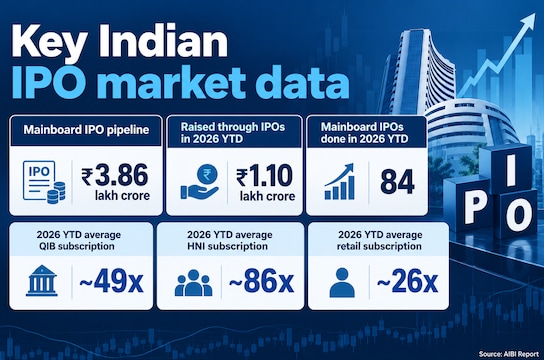
AIBI Chairman Mahavir Lunawat said the ₹3.86 lakh crore pipeline comprises around ₹2.43 lakh crore from companies with SEBI approval and another ₹1.44 lakh crore from issuers awaiting approval. He said the depth of supply, alongside participation from QIB, HNI and retail investors, shows the primary market is becoming a broader channel for capital formation.
SME market adds another layer
The expansion is not confined to large companies. India’s SME IPO market recorded 267 issues in 2025 — the highest annual number in the period covered by AIBI — followed by 156 issues in 2026 YTD.
Cumulative SME fundraising has reached ₹39,849 crore since 2016, while the average issue size has risen from ₹8 crore in 2016 to ₹45 crore in 2026 YTD.
The intermediary ecosystem has expanded alongside this activity, with registered merchant bankers rising 33% to 250 in September 2026 from 188 in September 2016. Investor participation has also remained strong, with average subscription levels of around 49 times for QIBs, 86 times for HNIs and 26 times for retail investors in 2026 YTD, although individual issue outcomes have varied materially.Lunawat said the next phase of the primary market will depend less on the number of listings and more on issuer quality, institutional participation, disclosure standards and how effectively public and private capital is channelled into business expansion and productive investment.