82% of that sum, or ₹32,142 crore, has been raised in just the last five years, showcasing the recency of the SME IPO market boom.
| Year | No. Of Issues | Funds Raised (₹ Cr) |
| 2021 | 59 | 746 |
| 2022 | 109 | 1,875 |
| 2023 | 182 | 4,686 |
| 2024 | 240 | 8,761 |
| 2025 | 267 | 11,455 |
| 2026 (YTD) | 103 | 4,619 |
Bigger Deals, Maturing Market
The amount raised through SME IPOs has seen a 15x jump from 2021 levels by the end of 2025. A total of 59 companies had raised ₹746 crore through the SME IPO route in 2021, which increased to 267 companies in 2025, who raised a total of ₹11,455 crore.
Over this four year period, the amount raised has seen a Compound Annual Growth Rate (CAGR) of 98%, while the deal count has grown at a 46% CAGR.
Average issue size, from ₹12.6 crore in 2021, has also nearly quadrupled to ₹44 crore so far this year, meaning more established companies are also beginning to chose this route rather than just the smaller names.
| Metric | 2021 | 2,025 |
| No. Of IPOs | 59 | 267 |
| Amount Raised (₹ Cr) | 746 | 11,455 |
| Issue Size (Avg., ₹ Cr)) | 12.6 | 44 |
A Subdued Year So Far
The number of issuances so far this year are half of what they were in 2025 at the same time. A large part of this is also due to last year’s revised ICDR norms implemented by market regulator Securities & Exchange Board of India (SEBI). The revised norms raised the bar for entry, requiring minimum profitability on the Earnings Before Interest, Tax, Depreciation and Amortisation (EBITDA) front, and doubling the minimum application size from 1 lakh to 2 lakh.
Sector-wise, manufacturing and engineering, particularly EPC, precision components, and industrial equipment, have been the most consistent draw, with capital goods and IT together accounting for nearly 45% of the index market cap. While healthcare, construction and services command a much smaller portion, renewable energy and regional consumer brands have emerged as newer themes this year.
The Other Side Of The SME Coin
While the SME IPO boom has projected the increasing penetration of India’s capital markets story, it also comes with its own set of red flags. Accounting mismatches, troubled investments and corporate governance issues have ensured that the trust deficit with regards to this space has grown at an equal clip as the space in itself has.
Here’s an example:
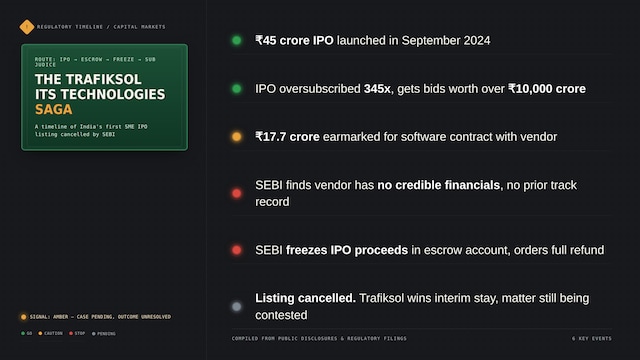
Trafiksol ITS Technologies is a Noida-based traffic and toll-management software firm. It raised ₹45 crore through its IPO in September 2024, which was oversubscribed 345 times the total shares on offer, raking in bids worth over ₹10,000 crore.
Of the total funds raised, ₹17.7 crore of those were earmarked for a software contract with a vendor. A SEBI investigation discovered that the vendor had no credible financials, no prior track record, and had been included in the prospectus using fabricated profiles and forged statements, effectively making it a shell company.
A former director’s testimony revealed that the vendor in question was once sold for a measly ₹20,000. SEBI froze the IPO proceeds in an escrow account, ordered a full refund to investors with interest, and directed the cancellation of shares that were already credited to the demat accounts of investors. This became a rare case of a fraud being discovered even before trading began on the bourses.
Since then, Trafiksol has won an interim stay on the appeal, and the matter remains contested.
Auditor resignations, a sudden pre-IPO bonus share surge, an unexplained spike in profitability right before the filing of the IPO, have now become a textbook warning list for these IPOs.
Trafiksol isn’t the only red flag.
Add-Shop-E-Retail followed a similar pre-listing logic, but in reverse. Instead of diverting funds to a fake vendor, it inflated its own revenue.
SEBI found that over 46% of its reported sales across three years were fictitious, routed through related-party transactions without proper approval. The company and its promoters were barred from the markets.
Here are some more:
DU Digital Global saw its shares surge by 1,392% from its listing in August 2021 till March 2023. This was done by synchronized, circular, and reversal trades among a group of entities designed to artificially distort price and volume.
SEBI eventually penalized 26 entities 1.85 crore and barred them from the securities market for varying periods.
A SEBI order on Synoptics Technologies showed diversion of IPO proceeds and artificial inflation of the share price. Not just that, SEBI also barred the merchant banker involved in the IPO.
Mismatch In Pre and Post-IPO Numbers
Studio LSD is a case in point in this instance. As per its prospectus, the company’s net profit in financial year 2024 stood at ₹10.9 crore, while for financial year 2025, it stood at ₹11.77 crore.
Investors were presented with two straight years of double-digit profitability. The IPO was priced at nearly 19x trailing earnings. Reality strikes soon after listing.
For the first six months of financial year 2026, the company reported a net loss of ₹3.49 crore. For the full year, the company reported a loss of ₹1 crore on revenue of ₹72 crore, which was also down 31% from last year.
Operating cash flow at the end of financial year 2026 stood at a negative ₹22.25 crore, a reversal from a positive ₹5.71 crore last year. This raised questions about what was promised to the investors before the IPO and the post-listing scenario.
The examples mentioned above are not isolated cases. They are an evidence of a structural pattern of weak pre-listing scrutiny, promoter-driven hype cycles after listing, and thin regulatory bandwidth to catch it all in real time.
How Can One Keep Checks & Balances In SME IPOs?
Start with the DRHP’s use-of-proceeds section, if a large share of the raise is earmarked for an unnamed or newly-incorporated vendor, that’s your first red flag, as was the case with Trafiksol.
Related party transactions are also worth a close look. SEBI’s own review has found that half of the SME-listed companies have related-party transactions in excess of ₹10 crore, while one in five exceed ₹50 crore. This then becomes a common channel for inflated revenue, as was seen in the Add-Shop case.
Comparing the last three years of financials line by line can also surface a sudden pre-IPO spike in profit or share capital, or a bonus issue timed just before filing , both flagged by investors in Trafiksol ahead of its listing being halted.
Beyond the numbers, a few structural signals help too: frequent or unexplained auditor resignations, concentrated promoter shareholding with a large Offer-for-Sale component that lets promoters cash out immediately, and the merchant banker’s own track record.
It’s also worth checking profit against operating cash flow directly, strong reported profit with weak or negative cash flow is a classic marker of the fictitious-sales pattern One thing to actively discount: extreme oversubscription or grey market premium (GMP) buzz.
The BSE SME IPO index is up 39% from the lows it saw on March 30, 2026. This rebound came after a sharp 30% fall in the index levels from the highs of August 2025.