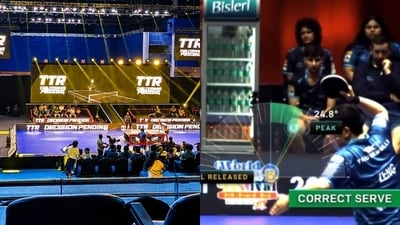
There is the heartbeat sound, just like in cricket. There is the anxious wait, just like in cricket and tennis. And then comes the replay on the giant screen, followed by the verdict that draws either a roar of celebration or a collective gasp.
Cricket has DRS. Tennis has Hawk-Eye. And now table tennis, the fastest racket sport in the world, where rallies unfold in the blink of an eye, has its own review system.
At Ultimate Table Tennis (UTT) Season 7 in Goa, the Table Tennis Review (TTR) is being used for the first time in India. Ask anyone involved, players, coaches, commentators or the umpire adjudicating the challenges, and the verdict is almost unanimous: it is a long-overdue innovation for a sport where decisive moments are often determined in fractions of a second.
Yet, unlike DRS or Hawk-Eye, TTR isn’t primarily about line calls. Its biggest challenge lies in adjudicating the most intricate part of table tennis: the serve.
What TTR actually reviews, and how
At UTT, the TTR is being used to adjudicate six scenarios — serve toss height (must be at least 16 cm), serve toss angle (can’t go over 30 degrees), whether the toss starts below the playing surface, whether it starts inside the table’s end-line, whether the ball is hidden from the receiver during the toss, and edge or net-ball calls. Internationally, the system is built to review up to 10 types of decisions; UTT, using the version developed by Stupa Sports, the world’s leading AI-powered sports technology and analytics firm from India, has rolled out 6 for this season.
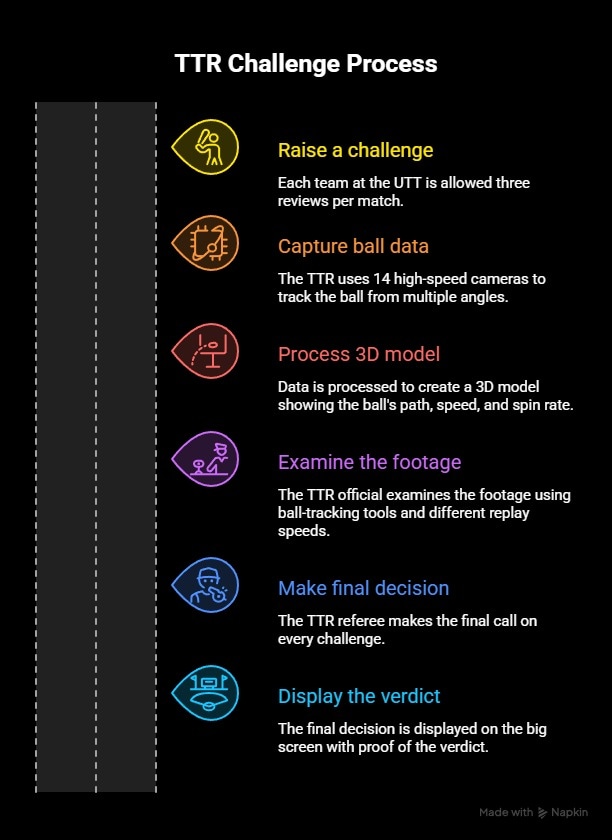
Each team at the UTT is allowed three reviews per match. If the challenge is successful or the result is inconclusive, the review is retained. If the call is confirmed and the challenge fails, the team loses the review.
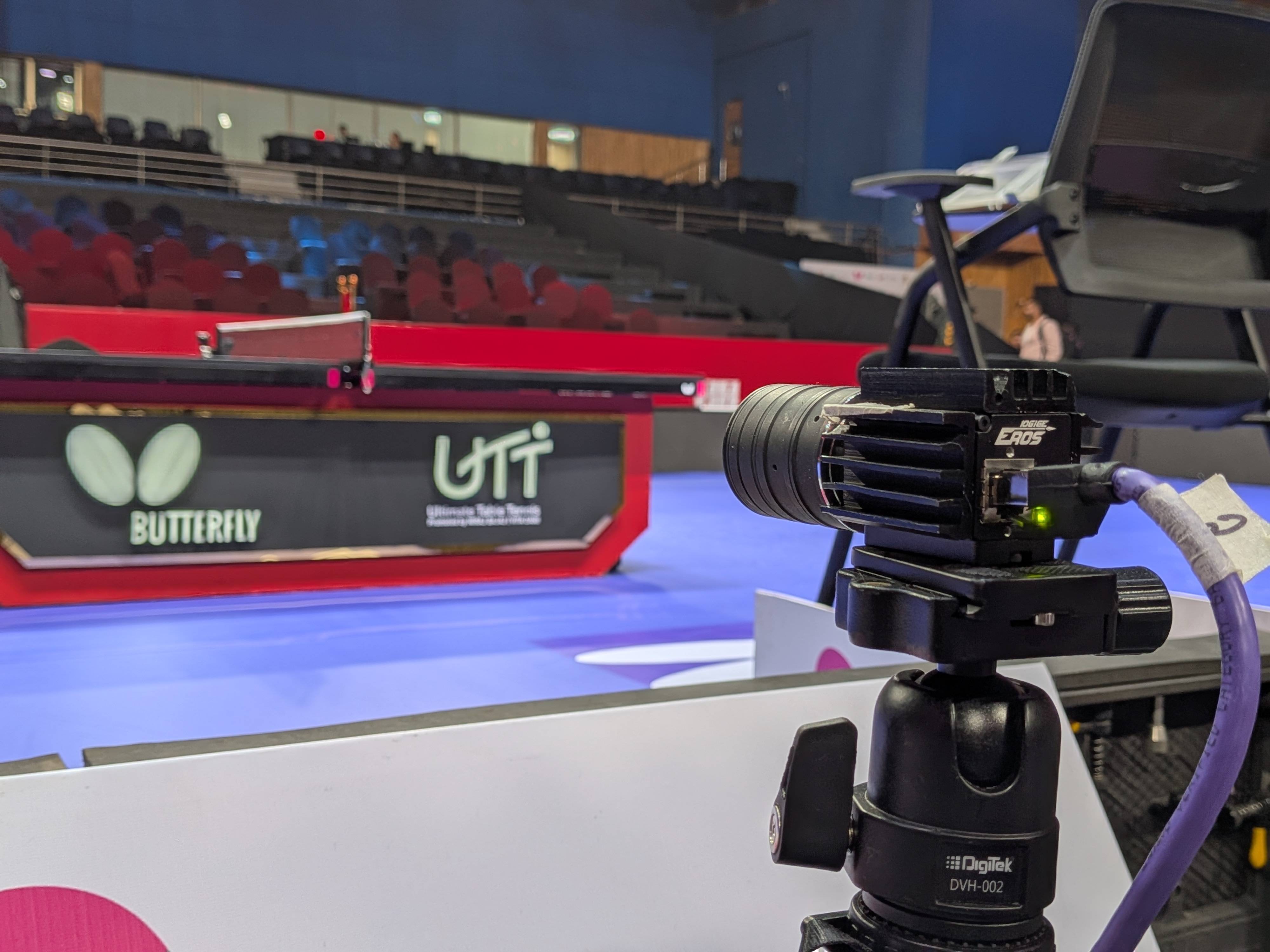
The TTR at the UTT uses 14 high-speed cameras, placed around the court at varying heights, to track from multiple angles. The data is then processed to create a 3D model that shows the ball’s path, speed, spin rate and more. Hence, when a challenge is raised, the TTR official examines the footage using the ball-tracking tools and different replay speeds, before making the final decision, which is eventually displayed on the big screen, with the proof of how the verdict was reached.
International Blue Badge umpire Vipin Kumar is the tournament’s dedicated TTR referee this season at the UTT, and is only the second Gold Badge umpire in the world. He’s the one making the final call on every challenge, and he explains exactly what the system is hunting for in each review.
“We use 14 cameras positioned around the table,” Kumar, who was part of the TTR initiative, and during the 2025 China Smash in Beijing, officiated matches where TTR was used on court, told Hindustan Times on the sidelines of the UTT tournament. “The most critical part is identifying the exact frame where the ball leaves the player’s palm. That initial release point, along with the ball’s peak trajectory, is essential for accurately judging service height and angle. If that frame isn’t identified correctly, the decision itself can be incorrect.”
The turnaround isn’t uniform across scenarios. “For service height and service angle, reviews usually take between 18 and 24 seconds,” Kumar, who has been associated with the UTT since its inception added. “Hidden service reviews take longer — typically 40 to 49 seconds — because we need to assess not only the server’s position but also whether the receiver’s view of the ball was obstructed.” Stupa Sports’ own pre-season pitch promised verdicts in under 20 seconds — the more complex hidden-serve calls suggest that figure is closer to an average across scenarios than a hard ceiling.
And for all the technology involved, it still comes down to one person’s judgment at the point of decision. “Just one official is involved,” the veteran umpire, with over two decades of experience in international officiating, said. “That’s the practice across international table tennis as well, because TTR is still relatively new. Even at major tournaments with seven or eight tables, TTR is usually available only on the centre court.”
Where did TTR come from?
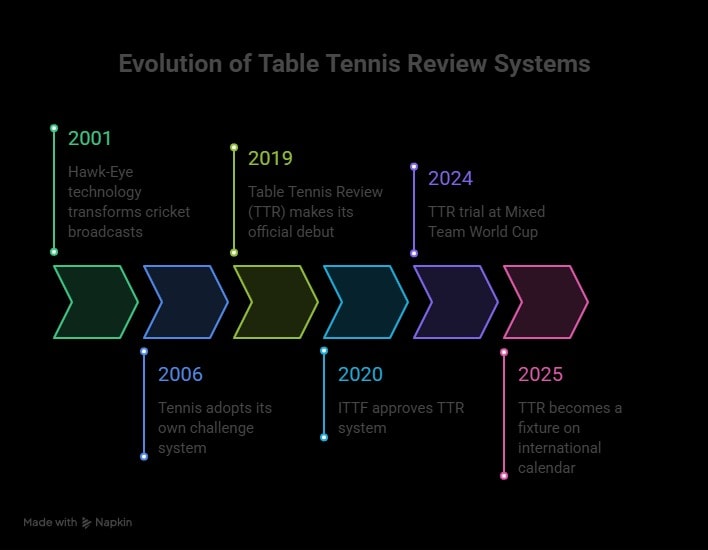
The Table Tennis Review system is not a UTT invention, and neither is it a table-tennis-first idea. The entire system was built on the concept used in Hawk-Eye, the ball-tracking technology that transformed cricket broadcasts from 2001 and later enabled tennis to adopt its own challenge system by 2006.
Table tennis saw its version developed by the Chinese company Rigour Technology, which had already built performance-tracking systems for China’s national team before adapting the concept for live officiating in partnership with the Chinese Table Tennis Association and the ITTF.
However, it was not until 2019 that TTR made its official debut, and the ITTF later approved the system in early 2020. It was slated to be used at the Tokyo Olympics as well, but was delayed due to the Covid pandemic. TTR returned for a trial at the 2024 Mixed Team World Cup and became a fixture on the international calendar through 2025 — the World Cup in April, the World Championships in May, and China’s domestic Super League by June. Stupa Sports then created its own version for UTT, which made its debut in the ongoing seventh edition of the league.
What makes the TTR special is that table tennis is the first Olympic sport to use tech specifically to monitor serves, not just line calls or goals. Serving has been the hardest thing to judge in real-time.
Why table tennis needed its own version
Table tennis demanded a review system tailored to its unique challenges. Unlike tennis or cricket, rallies unfold in split seconds, where a single wrong call, especially on the serve, can change the course of a match. Moreover, the main reason TTR could not simply be a copy of the Hawk Eye is that the ball moves in a three-dimensional space above, around, and even along the sides of the table, making tracking far more complex than on a flat court.
“The overall concept is actually quite similar. Tennis and badminton have an additional feature in the form of ball or shuttle tracking, and we’re also working towards that. The experience for players and spectators is very similar—that sense of anticipation while waiting for a decision, much like an LBW review in cricket. Sometimes I need to examine three or four different camera angles before arriving at a conclusion. Basketball also follows a similar review process. So while the sport is different, the philosophy and decision-making process remain largely the same,” Kumar explained when asked about the difference in the technologies used.
He added that high-speed cameras and adjustable playback ensure officials can make accurate calls despite the sport’s blistering pace.
The early numbers at UTT
Kumar says the tournament has logged 33 TTR challenges midway through the second week in the season, a figure he’s still finalising into a fuller breakdown of correct and incorrect original calls against justified and unjustified appeals — numbers he expects to firm up only once the tournament concludes. One pattern is already clear, though: “Around 70 per cent of all challenges have been related to service angle,” he says, “and I expect that trend to continue until the end of the tournament.”
That lines up with what similar systems have shown at the international level. At the 2025 ITTF World Cup and World Championships, umpire accuracy on serve calls rose from 76 per cent at the World Cup to 82 per cent by the Worlds, while players’ own success rate in challenging their opponents’ serves jumped from 45 per cent to 75 per cent over the same stretch, suggesting players got sharper and more selective about when to call for a review rather than just reflexively contesting close calls.
What players, coaches and commentators are actually saying
The overwhelming sentiment from inside the tournament is positive, a feedback that even Kumar received, but a genuinely interesting tactical layer has emerged underneath the surface-level praise.
Egypt’s Omar Assar, playing for Pune Jaguars, said the value of the system is straightforward: it protects the correctness of the call, not the umpire’s authority. “TTR simply gives everyone the opportunity to double-check a decision,” he told HT. “It isn’t about questioning the umpire, it’s about ensuring the correct decision is made.”
And Assar has lived both sides of it. At the LA Grand Smash two weeks before UTT, an umpire called a fault on his serve that he was certain was legal; the review proved him right, and the umpire apologised afterwards. “That’s exactly why I think TTR is good for the sport,” he added. “It encourages players to develop technically correct serves and rewards those who do.”
But Assar is also candid that reviews have become a genuine tactical layer of the game, not just a fairness mechanism. “We study our opponents before matches,” he said. “There are certain players whose serves we feel deserve closer attention, so we discuss situations where it might be worth using a challenge. Sometimes those players adjust because they know they’re being watched, while others continue with the same serves. So there is definitely a tactical element involved.”
Asked whether reviews could be used to slow a match down at a crucial moment, he doesn’t dodge the question: “I hope players don’t use it that way, because it wouldn’t be in the spirit of the game. That said, it’s possible some players may use a review to catch their breath or disrupt the rhythm of a match. That’s always a possibility.”
Indian national coach Sourav Chakraborty, in his debut UTT season with Ahmedabad APL Pipers, is more measured on the tactics question. “We don’t specifically discuss TTR before matches because it comes with both advantages and risks,” he told the publication. “If you ask for a review and it’s unsuccessful, you lose the point.” But he’s unreserved about its value in genuinely borderline calls — “doubtful serves, the height or angle of the ball, edge balls or net touches. In those situations, TTR really helps.” He’s also notably enjoying the theatre of it: “Especially when the opposition asks for a TTR review, the music creates so much suspense that you start wondering what’s going to happen next. It’s actually quite exciting.”
Commentator Adam Bobrow, UTT’s long-time “Voice of Table Tennis,” is unequivocal. “I genuinely think it’s one of the best additions the league has made,” he said. “UTT keeps pushing boundaries, and that’s one of the reasons I enjoy being part of it.”
But praise isn’t where he stops. Asked whether the system could go further, he doesn’t rule himself out of the conversation: “That’s probably above my pay grade. Having said that, if someone invited me into a room to brainstorm ideas, I’d happily contribute. I think there’s still plenty of scope to develop TTR further — making it faster, expanding the types of decisions it can review and continuing to improve the experience.”
That instinct, that TTR is a foundation rather than a finished product, echoes what’s happened at the very top of the sport internationally, where even strong advocates for the system have flagged real friction. Longer hidden-serve reviews have, at times, run past a minute at major tournaments, disrupting match rhythm enough that some coaches have publicly worried about the toll on players’ focus. UTT’s numbers so far suggest a tighter, more controlled version of the same technology, but the underlying tension the system has to manage is the same everywhere it’s used: speed versus certainty, in a sport where both matter more than almost anywhere else.