
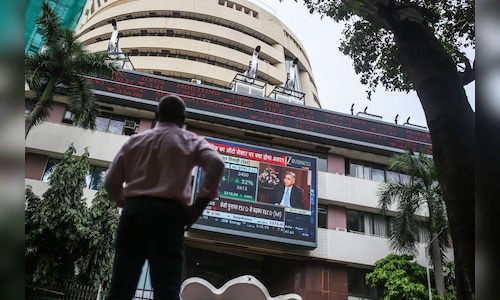
Speaking to CNBC-TV18, Dharamshi said markets tend to stabilise once investors are able to assess and quantify risks, even during periods of geopolitical tension.
“Once the market gets a sense that it can quantify the risk, things settle down,” he said. “What markets tend to react to is what is unknown and unknowable.”
His comments come as investors continue to track developments in the ongoing Middle East conflict and its impact on crude oil prices and global risk sentiment. Friday’s market weakness reflected lingering uncertainty, although broader markets showed greater resilience. Mid-cap stocks outperformed the benchmark indices, while the Nifty Bank also managed to end with gains.
Dharamshi said investors now appear to believe that the most intense phase of hostilities may be over, reducing fears of a prolonged disruption.
“I do believe that unless we see a fresh spike in crude beyond $120–130, we are, for the moment, done with this whole episode,” he said.
Despite geopolitical concerns weighing on headline indices, Dharamshi said underlying economic conditions in India remain supportive. He pointed to steady credit growth, healthy monthly sales data and corporate earnings as signs that the domestic economy is moving towards a cyclical recovery.
“It is a very bipolar market,” he said. “Economically, we are on the cusp of a cyclical recovery, but because of global uncertainty, we are capped.”
According to Dharamshi, the disconnect between weak benchmark performance and strength in select sectors has created what he described as a stealth bull market.
“So headline indices are not headed anywhere, but there is clearly a segment of the market where a bull market is underway,” he said. “It is a stealth bull market because it is not fully on the radar.”
He said the strongest momentum is visible within industrial and manufacturing-linked companies rather than across the broader market.
Dharamshi linked this trend to what he sees as a wider global industrial capital expenditure supercycle. He argued that the world is moving away from a decades-old model built purely around low-cost global supply chains and is instead prioritising resilience, energy security and technological independence.
According to him, disruptions ranging from the pandemic and semiconductor shortages to the Russia-Ukraine conflict and trade disputes have reshaped investment priorities globally.
“We are no longer focused only on cost and efficiency; we are focused on resilience, redundancy, safety and security,” Dharamshi said.
He believes this shift is driving large-scale investment in industrial infrastructure, manufacturing, electrification and technology supply chains across countries, including India.
While acknowledging that valuations in industrial names have become expensive after a sharp rally, Dharamshi said investors may still be underestimating the duration and scale of the opportunity.
Also Read | India can still deliver positive returns without the AI trade, say UBS strategists
“There is no doubt valuations have become expensive,” he said, but added that “the cycle is not ending”.
He cited sectors such as transformers and power infrastructure, where a small number of manufacturers serve rapidly expanding demand linked to electrification and data centre development.
Dharamshi maintained that investors should focus more on the broader cycle than on valuations alone.
“If valuation alone becomes your decision point for entry or exit, you may miss out,” he said.
He added that India’s large domestic capex cycle and growing data centre investments remain ahead, suggesting that the industrial investment story still has room to play out despite near-term volatility in markets.