
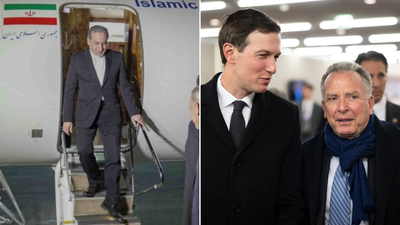
US President Donald Trump is sending his envoys Steve Witkoff and Jared Kushner to Pakistan, the White House said Friday, just hours after Iran’s top diplomat headed to the South Asian nation where officials have been trying to get US and Iran to convene for a second round of ceasefire negotiations. The trip comes as much of the world is on edge over a war that has snarled crucial energy exports through the Strait of Hormuz, clouded the global economic picture and left thousands dead across West Asia. White House press secretary Karoline Leavitt said in an interview on Fox News Channel that the two will have talks with Iranian foreign minister Abbas Araghchi on Saturday. “We’re hopeful that it will be a productive conversation and hopefully move the ball forward to a deal,” Leavitt said. She said vice-president J D Vance would not be traveling but that he remains “deeply involved”. She said he will be in the US, along with secretary of state Marco Rubio and the president’s national security team, on “standby” to fly to Pakistan “if necessary”. Earlier Friday, Araghchi wrote on X that he was on his way to Pakistan, Oman and Russia on a trip focused on “bilateral matters and regional developments”. AP
‘Nukes must never be allowed’: Trump rules out N-strike on Iran
President Donald Trump on Thursday ruled out striking Iran with a nuclear weapon, after his previous threats to completely destroy Iranian civilisation. “No, I wouldn’t use it,” he told reporters at the White House. “Why would I use a nuclear weapon when we’ve, in a very conventional way, decimated them without it?” He added, “A nuclear weapon should never be allowed to be used by anybody.”On April 7, the US president had issued a genocidal threat to Iran that a “whole civilisation will die tonight, never to be brought back”, but, within hours, agreed to a ceasefire.On Friday, the White House said Trump issued a 90-day extension to the Jones Act waiver, making it easier for non-American vessels to transport oil and natural gas.Trump first announced a 60-day waiver in March in a move intended to stabilise energy prices and ease oil and gas shipments to US following effective closure of Strait of Hormuz. “New data compiled since the initial waiver was issued revealed that significantly more supply was able to reach US ports faster,” the White House said on social media.The price of Brent crude oil retreated on the news, vacillating between $103 a barrel and more than $107 – still 50% higher than where it was on Feb 28, when the war began.The squeeze on shipments through the strait has rippled through global maritime trade flows, including through the Panama Canal nearly halfway around the world.Pakistan has been trying to get US and Iranian officials back to the table after Trump this week announced an indefinite extension of the ceasefire with Iran, honouring Islamabad’s request for more time for diplomatic outreach.That hasn’t lowered tensions in the strait, a strategic waterway through which a fifth of the world’s oil and natural gas is shipped during peacetime. Iran has kept its stranglehold on traffic, attacking three ships this week, while US is maintaining a blockade on Iranian ports and Trump has ordered the military to “shoot and kill” small boats that could be placing mines.“Iran has an important choice, a chance to make a deal, a good deal, a wise deal,” US defence secretary Pete Hegseth told reporters on Friday. He said a second US aircraft carrier would join the blockade in a few days.Washington already has three aircraft carriers in the region: USS George HW Bush in the Indian Ocean; USS Abraham Lincoln in the Arabian Sea; and USS Gerald R Ford in the Red Sea. This is the first time since 2003 that three US carriers have been operating there simultaneously. The force includes 200 aircraft and 15,000 sailors and Marines, US Central Command said.Since the war began, at least 3,375 people have been killed in Iran, and more than 2,490 people in Lebanon, where new fighting between Israel and the Iran-backed militant group Hezbollah broke out two days after the war started, according to authorities. Additionally, 23 people have died in Israel and more than a dozen in Gulf Arab states. Fifteen Israeli soldiers in Lebanon and 13 US service members throughout the region have been killed.The UN peacekeeping force in southern Lebanon has also sustained casualties. UNIFIL said on Friday an Indonesian peacekeeper died of wounds sustained in an attack on his base on March 29, raising to six – four Indonesians and two French – the number of force members killed since the war erupted.