
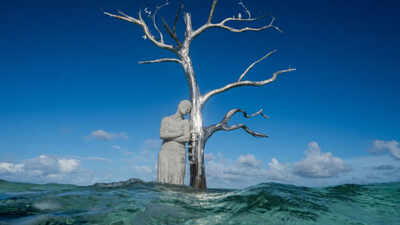
The ocean has always been a symbol of life but now in many parts of the world it is also becoming a force for irreversible loss. Wondering how? Well, the sea has quietly erased an entire island from the map, in the remote Solomon Islands in the Pacific. Lush forests and white sandy beaches that once welcomed visitors are now replaced by waves only. But beneath those waters, a new landmark has risen, not to reclaim the lost land but to preserve memory and inspire action.Now there is a life-size sculpture called The Solomon Siren in the intertidal waters where Kale Island used to be. But the installation is more than a memorial. It’s designed to become a living ecosystem for marine life, a thriving artificial reef, to transform a symbol of climate loss.
The disappearing island
Kale, an island of 50,000 square metres in the Solomon Islands archipelago, officially disappeared under rising sea levels in 2016 after years of relentless coastal erosion. It was a small community at one time, but it was one of the first documented islands in the world that was lost completely to climate change-driven sea-level rise. Kale’s disappearance was not an isolated incident. Throughout the Solomon Islands, sea level rise and more severe weather have changed coastlines and forced communities to relocate. Since 2008, more than 26,000 people have been forced to flee as rising waters engulfed homes, farmland and cultural landscapes.To the residents, Kale was far more than a geographical feature. It was renowned for its outstanding natural beauty, with unspoiled beaches, crystal-clear waters and dense tropical forests. The island was also of deep cultural significance for communities in Isabel Province, meaning its disappearance was both an environmental and emotional loss.
A memorial driven by climate resilience
To celebrate 10 years since Kale disappeared under the sea, renowned British marine artist Jason deCaires Taylor created The Solomon Siren. The sculpture, placed in the shallow waters where the island once stood, commemorates the vanished landscape and the resilience of the people who continue to confront the realities of climate change. The sculpture is based on Solomon Islands climate activist Gladys Habu Bartlett who has campaigned to raise awareness of environmental issues and gender equality around the Pacific. Taylor’s work is a tribute to Bartlett’s advocacy, and to the communities that are already on the frontlines of climate change.The life-size figure is leaning against a sculpted tree, which stands for the lush vegetation and natural resources that once flourished on Kale Island. The figure and the tree together signify memory, resilience, and the ongoing relationship between people and place.
A sculpture meant to live
The Solomon Siren was designed with the future in mind, not like the monuments of the past. The sculpture is created from pH neutral cement mixed with biochar and features a porous surface to encourage algae, corals, sponges and other marine life to attach and grow on it over time. The branching structure also provides resting places for seabirds, enabling the installation to develop as a functioning marine habitat rather than being a static work of art. As nature slowly takes over the sculpture, it will be embedded in the ecosystem that it is trying to draw attention to. In so doing, the artwork reflects loss and renewal, suggesting that opportunities for ecological restoration can arise even in places altered by climate change.
A timeline penned by the sea
One of the most striking features of the sculpture is a series of engraved sea level markers. These record water levels are from 2006, 2016 and 2026 and projected water levels for 2036 and 2046 based on climate models. According to reports, the marks are a visual history of rising oceans, a reminder of how fast coastlines can change. This message could not be more timely, coming on the heels of new findings by the United Nations that the world’s sea levels are now rising at approximately double the rate they were a decade ago. The sculpture for Bartlett encapsulates years of watching her homeland slowly disappear. Having witnessed the sea mercilessly claiming Kale Island, she chose to tell the story of her community so that it would not only be a record of local loss but a warning to the rest of the world of the mounting effects of climate change.
Art that speaks for the sea
The Solomon Siren is the newest addition to Jason deCaires Taylor’s internationally acclaimed “Siren” series, which fuses environmental activism with public art. It is reported that the past installations have addressed urgent marine problems in other parts of the world. His sculpture, Sirens of Sewage, in Whitstable, England, drew attention to the problem of untreated sewage being discharged into coastal waters and Ocean Siren, off the coast of Australia, changes colour in real time showing rising sea temperatures and the threat of coral bleaching on the Great Barrier Reef.Images Courtesy: Jason deCaires Taylor