
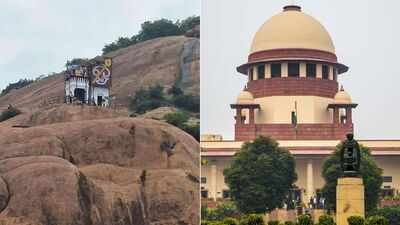
NEW DELHI: The Supreme Court has permitted the lighting of the traditional Karthigai Deepam lamp at the Deepathoon, a stone pillar on Thiruparankundram Hill in Madurai, Tamil Nadu, on November 24, 2026, as an interim arrangement.A bench of Justices Aravind Kumar and Vipul M Pancholi, however, stayed portions of the Madras high court judgment that had upheld the direction to restore the practice of lighting the lamp at the Deepathoon. The interim permission comes amid a dispute between Hindu worshippers and the Hazrat Sultan Sikandar Badusha Auliya Dargah over ownership of the hilltop and the location of the ritual.The development follows arguments by the dargah before the top court on Thursday, when it claimed ownership of the entire hilltop and opposed the demand to light the lamp at the stone pillar. The hearing on the matter had remained inconclusive, with the court scheduled to continue proceedings on Friday.Senior advocate Amit Anand Tiwari, appearing for the dargah, referred to a 1920 judicial order passed in a civil suit and said there were findings establishing that the flight of stairs from Nellithope to the hill belonged to the shrine.“The entire top of the hill belongs to the dargah. There is no question of lighting the deepam at the top of the hill, where the stone pillar is situated, irrespective of what the distance between the dargah and the stone pillar is,” Tiwari said.He also submitted that the “whole of the top of the hillock on which the mosque and the flagstaff stand” as well as the stone pillar are located is the property of the dargah.
What is the Karthigai Deepam dispute
The controversy centres on the location of the traditional Karthigai Deepam lighting ceremony at the Arulmigu Subramaniaswamy temple in Thiruparankundram. For decades, the festival lamp has been lit at the Deepa Mandapam near the Uchipillaiyar temple on the lower slopes of the hill.Hindu groups have sought permission to light the lamp at the Deepathoon, an ancient stone pillar higher up the hill and around 50 metres from the dargah. The dispute has led to legal proceedings over the location of the ritual and ownership of the hill.The Tamil Nadu government had opposed the demand, arguing that permitting the lighting of the lamp near the dargah could create wider legal and administrative complications. On Wednesday, it told the Supreme Court that allowing the practice could lead to thousands of survey pillars across the country acquiring a religious character.The dargah committee had also challenged the procedure followed by the Madras High Court. Senior advocate Huzefa Ahmadi, appearing for the committee, argued that a single-judge bench had passed its order without giving the dargah adequate time to file a reply under the high court rules. He also submitted that the judge had conducted a site visit without notifying the dargah before passing the order.
Tamil Nadu government opposes ASI takeover
The Tamil Nadu Hindu Religious and Charitable Endowments (HR&CE) department has opposed a petition seeking to bring the temple and the entire Thiruparankundram hill under the control of the Archaeological Survey of India (ASI).In an affidavit before the Supreme Court, HR&CE Commissioner T G Vinay said the temple’s ownership and existing religious practices had been settled through decades of judicial proceedings. He maintained that the hill was owned by the Arulmigu Subramaniaswamy temple to the extent recognised by a civil court decree of 1923, which was subsequently restored by the Privy Council in 1931.The affidavit opposed three reliefs sought by petitioner Hindu Dharma Parishad: handing over the entire temple and hill to the ASI, keeping a lamp burning round the clock at the stone pillar described as the Deepathoon, and illuminating the entire hill with lamps during Karthigai Deepam.“A title so settled cannot be disturbed and the administration of a religious endowment entrusted by statute to the HR&CE cannot be wrested away and handed over to the ASI upon a petition that pleads no ground in law and seeks the relief in the teeth of a concluded civil adjudication of title,” the affidavit had said.
Share your thoughts in the comments
Be respectful · TOI community guidelines
On the lighting ceremony, the HR&CE commissioner maintained that the festival lamp had traditionally been lit at the Deepa Mandapam near the Uchipillaiyar temple, and not at the hilltop or the stone pillar.The department also referred to historical records of attempts made in 1862 and 1912 to light lamps near the hill’s summit, where the dargah is situated. It argued that archaeological protection at Thiruparankundram covered specified features, including the rock-cut cave and inscriptions, and did not extend to the entire hill or the functioning temple.The department cautioned that allowing lamps to be lit at multiple locations, particularly near the dargah, could disrupt existing arrangements and create law-and-order challenges at a site with a history of communal tension.