
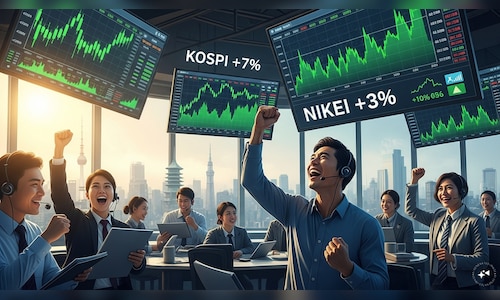
The broader MSCI Asia Pacific Index rose 2%, led by a 7% jump in South Korea’s Kospi, while Japanese and Australian equities also gained. Japan’s Nikkei 225 climbed 3.1%, while the broader Topix rose 1.8%, ending a three-session losing streak. Australia’s S&P/ASX 200 advanced 1.5%.
South Korean technology stocks led the rally, with shares of Samsung Electronics and SK Hynix rising more than 9% each as investors returned to AI-linked names following the sharp rebound in US semiconductor stocks.
The rally was so strong that the Korea Exchange briefly halted program buying after futures surged sharply in early trade.
The gains followed a strong session on Wall Street, where the S&P 500 rose 1.8%, and the Nasdaq 100 surged 3.3%. The Philadelphia Semiconductor Index jumped nearly 8%, helping drive a broad rally in technology and AI-linked stocks.
Investor sentiment improved after Trump signalled that a peace agreement with Iran could be signed as early as this weekend. At a virtual campaign rally, he said in a comment that the US had “ended the war with Iran”.
This came as he backed away from earlier threats of further military action against Tehran and said discussions had reached the highest levels of Iran’s leadership.
The prospect of a deal also weighed on oil prices. Brent crude fell about 1.5% to around $89 a barrel after Trump said the proposed agreement would include reopening the Strait of Hormuz, a key route for global oil shipments.
The easing in oil prices helped support risk assets as investors assessed the possibility of reduced supply disruptions and lower inflationary pressures. Markets have been closely monitoring developments in the Strait of Hormuz, which has faced severe disruptions during the conflict and is critical for energy-importing economies across Asia.
Japanese stocks were among the beneficiaries of the improved outlook. Concerns over energy supply disruptions have weighed on Japanese manufacturers in recent months, with the country relying on the Middle East for more than 90% of its crude oil imports.
US equity futures also edged higher in Asian trading, with S&P 500 futures rising 0.2%, while Hang Seng futures gained 0.9%.
Despite the improved market mood, uncertainty remains over the timing of any agreement. Iranian media reported that Tehran had not yet approved the text of a proposed deal with the United States.
Meanwhile, investors continued to monitor central bank expectations after oil prices fell and US Treasury yields declined. Traders have pushed back expectations for any further US interest-rate increase, while the European Central Bank raised rates on Thursday.
With inputs from Bloomberg