
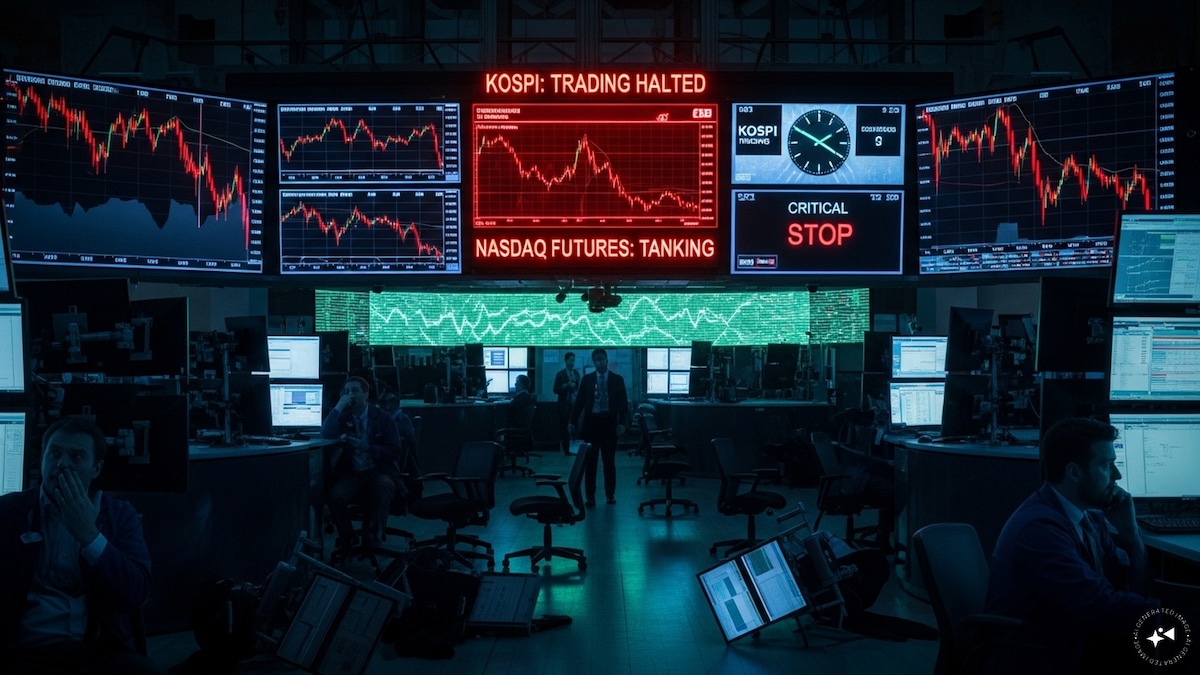
The benchmark KOSPI plunged as much as 9% after trading resumed following a 20-minute circuit breaker.
Chip giants Samsung Electronics and SK Hynix each lost over 10% during the session, while overseas investors offloaded nearly 3 trillion won ($1.9 billion) worth of KOSPI shares in morning trade.
The cautious mood was also reflected in the US derivatives market. Futures tracking the Nasdaq 100 and the S&P 500 traded lower on Friday.
The latest bout of selling shows a dramatic shift in sentiment just a day after optimism surrounding AI-related stocks had lifted markets. On Thursday, upbeat guidance from Micron Technology and reports of SK Hynix exploring a US listing had fuelled hopes that the semiconductor rally still had room to run.
However, investors quickly turned cautious as multiple concerns emerged simultaneously. Reports suggesting OpenAI could delay its IPO, Apple’s decision to raise product prices amid memory chip shortages, and expectations of massive capital expenditure announcements from South Korean chipmakers all prompted traders to reassess the outlook for the sector.
Analysts believe these developments have intensified concerns that the current AI-driven memory boom may be approaching a turning point.
“The memory trade still has legs, but the tailwind is becoming increasingly selective while the headwind is much broader,” Charu Chanana, Chief Investment Strategist at Saxo Markets was quoted as saying by Bloomberg.
She added that investors are beginning to price in the risk that a stronger memory cycle may eventually weigh on the broader AI trade.
Homin Lee, strategist at Lombard Odier, said speculation around a potential delay in OpenAI’s IPO, coupled with Apple’s price hikes, has reignited debate over whether the industry’s memory-chip driven growth cycle can be sustained. He expects market volatility to remain elevated as leveraged positions continue to amplify price swings.
South Korea’s equity market has witnessed exceptional volatility this year, driven by heavy retail participation, widespread use of margin financing and growing popularity of leveraged exchange-traded funds linked to semiconductor stocks. Since 2000, the KOSPI has triggered circuit breakers 11 times, with nearly half of those instances occurring this year alone.
The index has become increasingly dependent on Samsung Electronics and SK Hynix, which together account for nearly 60% of its weighting. Their sharp price swings have prompted some market observers to compare recent trading activity with the meme-stock frenzy seen in previous years.
Adding another layer of uncertainty, local media reports indicate Samsung and SK Hynix are expected to unveil fresh investment plans worth hundreds of billions of dollars next week. Maeil Business Newspaper reported that Samsung Group alone could announce a 1,000 trillion won investment programme over the coming decade, potentially the largest corporate investment commitment in the country’s history.
With agency inputs