

MUMBAI: Discussions across medical forums in recent weeks have centred around “problems” with the Medical Termination of Pregnancy (MTP) Act after two court interventions put gynaecologists under scrutiny.“Why are doctors being made scapegoats?” asked senior Mumbai gynaecologist Dr Sudhir Naik, reflecting the anger in medical circles.In one case, an FIR was filed against a gynaecologist at Satara Civil Hospital after a “failed” MTP involving a 16-year-old rape survivor ended in the birth of a live baby who later died without medical attention. In another, the Supreme Court warned AIIMS doctors of contempt proceedings if they did not terminate a 30-week pregnancy of a 15-year-old rape survivor.Though India extended the upper limit for termination from 20 to 24 weeks in 2021, doctors and legal experts say the law still rests on a flawed structure that prioritises medical approval over women’s autonomy. Supreme Court in the AIIMS matter, incidentally, flagged the need for amendments.
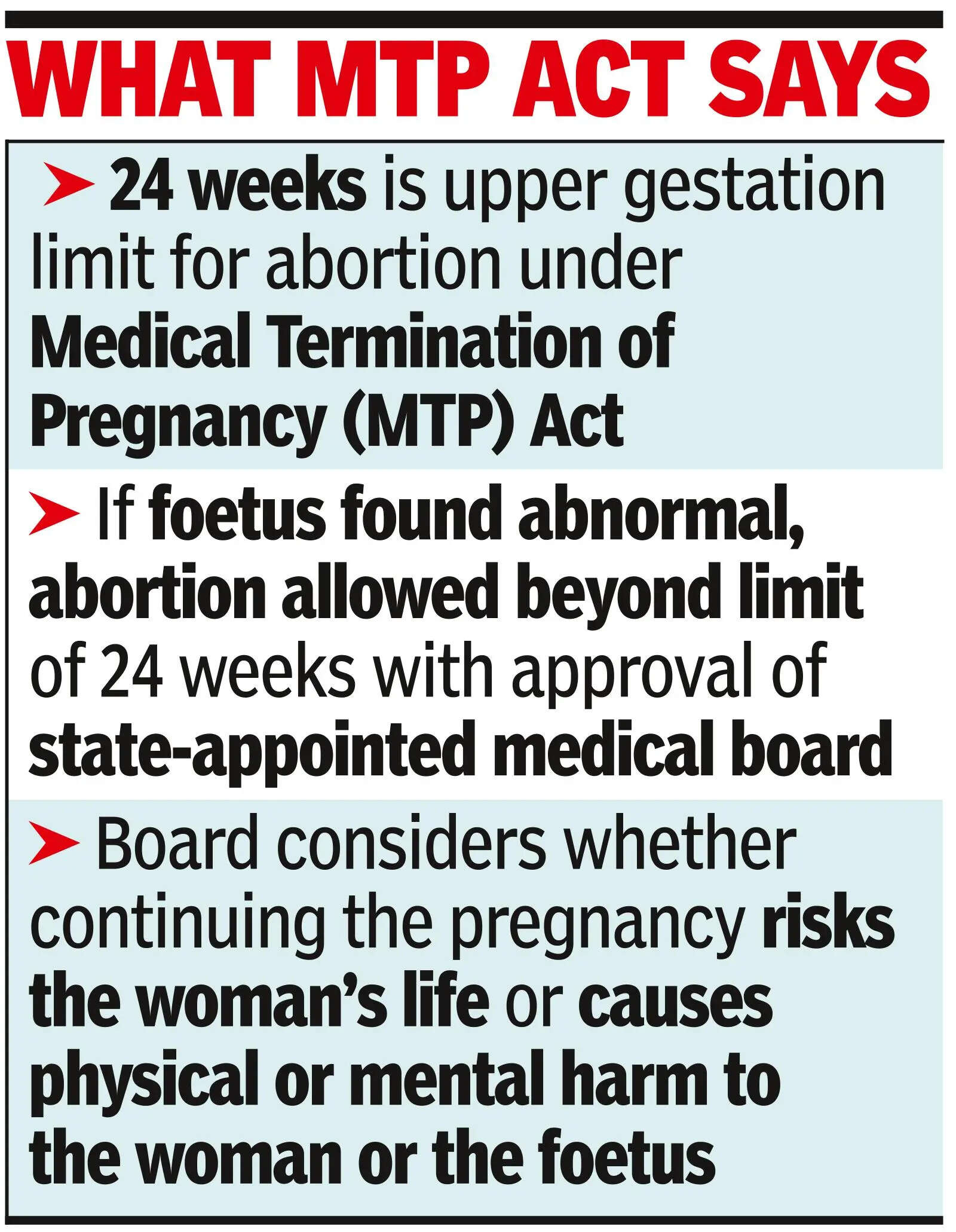
“There are two things to be done. Decriminalise abortion and allow complete autonomy to women and not their doctors in this matter,” said Dipika Jain, professor at Jindal Global Law School, Delhi.Despite the extension of the upper limit for MTP to 24 weeks in 2021, doctors and legal experts say the law still prioritises medical approval over women’s autonomy.Not Women-Centric To understand this, a historical perspective on abortions in India is needed: miscarriages or abortion were criminalised under the Indian Penal Code, with both the woman and her doctor liable for it. “MTP is criminalised even under the Bharatiya Nyaya Sanhita, unless it falls within the narrow exception created by the MTP Act,” said gynaecologist Dr Nikhil Datar, who has long campaigned for extending the legal time limit. Then in 1971, the MTP Act came up mainly as an exception to protect doctors. “It was decided that the doctor’s discretion would help decide on MTP, thereby making MTP a medical model not an autonomy model for the woman,” said Jain.Mumbai lawyer Anubha Rastogi agreed, calling the law “service provider-centric”. Under the Act, termination is allowed only for legally recognised reasons and only when doctors form the required opinion. “This effectively turns doctors into gatekeepers,” said Rastogi.
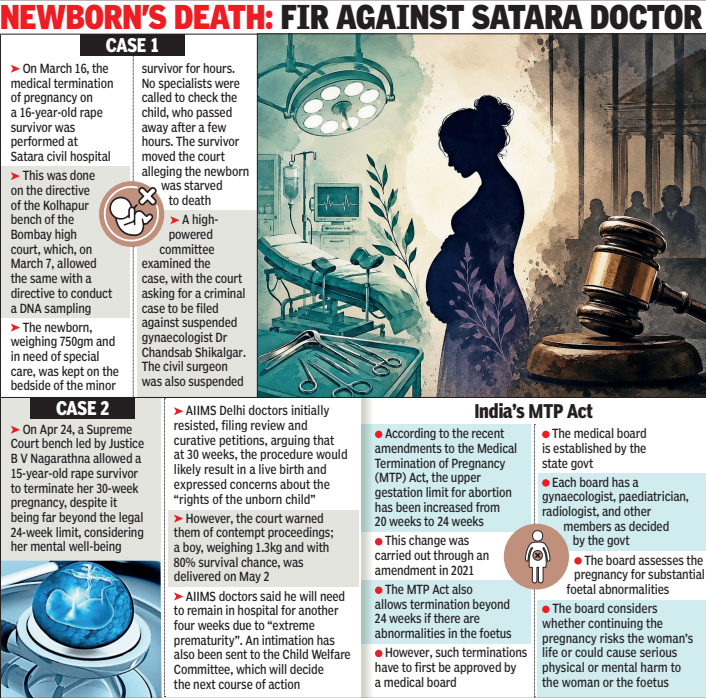
She, however, said “the law is, thankfully, not getting into how you terminate the pregnancy. There is a process where you are allowed to do a certain set of things, you should be doing them without any court having to tell you yes or not”. The law allows for foeticide (a process in which an ultrasound-guided potassium chloride injection is given to the foetus when still in the uterus to end life). “It is in the written guidelines but it’s not very clear to me why doctors are asking for the court to permit the process,” she added.Worse for MinorsThat gatekeeping becomes most visible in cases involving minor rape survivors. Under current law, termination beyond 24 weeks is restricted to situations involving immediate danger to a woman’s life or severe foetal abnormalities. For many minors who discover pregnancies late, the only practical route is to move court.“A young rape survivor may not be dying physically, but continuing the pregnancy can destroy her life mentally and emotionally,” Dr Datar said. He said courts, including the Supreme Court, have permitted late-term abortions in exceptional cases even when the statute itself does not clearly allow them. “Those repeated judicial interventions expose the gap between legal text and reality,” he said.Jain questioned what she described as “disability exceptionalism.” Courts have allowed terminations even at 33 weeks in cases of foetal anomaly, showing late-term procedures are medically possible. “Why,” she asked, “should similar access be denied to rape survivors, minors or women facing changed circumstances?”Treat abortion as healthcare governed by the pregnant woman’s informed choice, she said, pointing to Nepal’s law that allows abortion up to 20 weeks without requiring women to justify their reasons. “In India, women are still expected to explain and defend why they do not want to continue a pregnancy.”Why Medical BoardsWhile the 2021 amendment expanded gestational limits, some experts say it deepened bureaucracy. “Abortions up to 20 weeks require one doctor’s opinion; 20 to 24 weeks require two doctors for specified categories; beyond 24 weeks, cases often depend on foetal anomaly or risk to the woman’s life, with medical boards playing a decisive role,” said Jain.Dr Datar said medical boards typically include a gynaecologist along with specialists from other disciplines. Dr Datar said, “…specialists who may never have performed even one termination can collectively outvote a gynaecologist.”Confusing Name TooDr Datar also said the law remains confusing in its very language. “India borrowed ideas from Britain’s Abortion Act of 1967 but avoided using the word ‘abortion’ in its own law. Instead, the law uses the term MTP without clearly explaining its purpose,” he said. He argued the definition is so incoherent it can technically cover removal of a dead embryo, surgery for ectopic pregnancy or even an emergency Caesarean section, while leaving deliberate foetal reduction in multifoetal pregnancies in an ambiguous zone.