
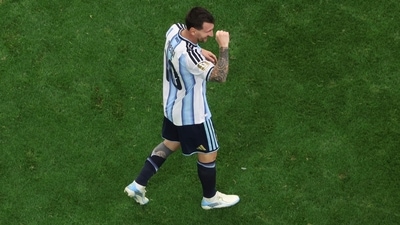
Argentina are through, Lionel Messi has made history again, and the defending champions have done almost everything expected of them in the opening stretch of the World Cup. Two matches, two wins, five goals scored, none conceded, and a place in the Round of 32 sealed before their final group game – on paper, it is close to perfect.
But Argentina’s 2-0 win over Austria also left behind a question Lionel Scaloni cannot completely ignore: beyond Messi, where is the attacking responsibility coming from?
The night in Dallas belonged to Messi for obvious reasons. He missed an early penalty after Lautaro Martinez was brought down in the box, but responded in the way he has done for most of his career. In the 38th minute, Thiago Almada drove the move forward, Facundo Medina supplied the cut-back, Almada cleverly let the ball run, and Messi swept Argentina ahead with his left foot. Deep into stoppage time, after Julian Alvarez’s initial effort was saved and Messi’s first follow-up was blocked, the Argentina captain finished again from close range.
With that brace, Messi moved to 18 World Cup goals, going past Miroslav Klose’s men’s record and also moving beyond Marta’s overall tournament mark. He has five goals in two matches at this World Cup. He has scored all five of Argentina’s goals so far.
That is both extraordinary and slightly uncomfortable.
Messi is not just finishing Argentina’s attacks, he is dominating them
The biggest concern for Argentina is not that the team is dysfunctional. It clearly is not. Their defensive base looks strong, Emiliano Martinez has two clean sheets, Cristian Romero and Lisandro Martinez have largely protected the centre, and the midfield still has the structure and competitive bite that made them champions in Qatar.
The problem is further forward. Argentina are winning, but their final-third output is becoming heavily, almost dangerously, concentrated around Messi.
Against Austria, Messi did not merely score twice. He also had the most shots in the match with seven, and the most touches in the opposition box with eight. That is the number that should worry Scaloni. In a side that started with Lautaro Martinez as the central striker and had Thiago Almada, Alexis Mac Allister, Enzo Fernandez and Rodrigo De Paul around Messi, the 38-year-old was still Argentina’s leading box presence.
That tells a story beyond romance. It says Argentina’s most dangerous receiver, shooter and finisher in the box is still Messi. Not Lautaro. Not Alvarez. Not Almada. Messi.
The same pattern was visible in the first match against Algeria. Messi scored all three goals in Argentina’s 3-0 win, had a team-leading six shots and also created two chances, more than any other player on the pitch. That means he was not simply standing at the end of moves. He was also helping generate them.
So the equation is not just “Messi is scoring.” It is more layered than that. Messi is receiving in dangerous zones, taking the shots, creating chances, carrying the emotional weight, and converting the moments that decide the game.
For Argentina, that is a gift. For Argentina, that is also the risk.
The supporting cast has not been absent. De Paul assisted Messi’s opener against Algeria. Mac Allister’s shot created the rebound for Messi’s second in that match. Nico Gonzalez combined with him for the third. Against Austria, Medina supplied the assist, Almada’s dummy was crucial, and Lautaro won the penalty. There is contribution, there is structure, there is movement.
But there is still no shared scoring burden.
That is the issue.
Lautaro Martinez has won a penalty and worked hard, but he has not scored. Julian Alvarez came on against Austria and was involved in the late sequence before Messi finished, but he has not scored either. Almada has influenced patterns of play, Mac Allister and Enzo have controlled phases, and De Paul remains the connector around Messi. Yet none of them has put their name on the scoresheet.
Argentina have five goals. Messi has five goals. The rest of Argentina have zero.
For a group-stage story, that looks magical. For a knockout campaign, it can become dangerous.
Better opponents will study this. They will know Argentina can control midfield and protect their own box, but they will also know where the killing touch is coming from. If Messi is Argentina’s only consistent final-third answer, elite knockout teams will build their defensive plan around delaying his touches, crowding the zone around his left foot, and daring others to finish.
That is where Scaloni needs more from Lautaro and Alvarez in particular. Argentina do not need Messi to do less. That would be foolish. They need others to do more around him.
There is a difference between being Messi-led and Messi-dependent. A Messi-led Argentina can win the World Cup. A Messi-dependent Argentina can be trapped by one bad night, one tight defence, one missed chance, one physical game where space disappears.
Austria gave Argentina a warning despite the 2-0 scoreline. Ralf Rangnick’s side were brave, pressed with energy, and had spells where Argentina were not entirely comfortable. They did not have enough quality in the final third to punish the champions, but knockout-level opponents might. On another night, if Messi does not rescue the rhythm, Argentina may need someone else to decide the game.
Also Read: Lionel Messi breaks six World Cup records in one night as Argentina beat Austria to reach knockouts
That someone has not appeared yet.
The good news for Argentina is that this concern is coming from a position of strength. They are already through. They have not conceded. Messi looks sharp, decisive and historically motivated. The team still has its competitive identity. But the final group game against Jordan now becomes useful for another reason: it is a chance for Scaloni to widen the attacking load.
Lautaro needs a goal. Alvarez needs rhythm. Almada needs to become more than a facilitator. Mac Allister and Enzo need to keep arriving around the box. Argentina cannot reach the knockouts with the attack still reading like a one-man scoreboard.
Messi is still the headline, still the history-maker, still the player who bends World Cup nights around him. But Argentina’s title defence cannot be only Lionel Messi and a question mark.
Sooner or later, someone else has to answer.