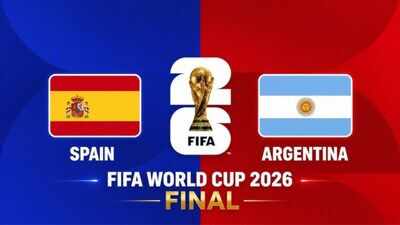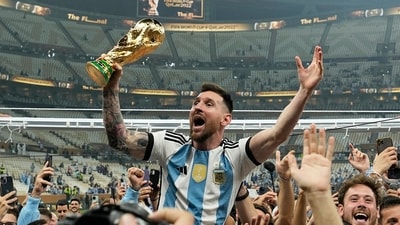
Lionel Messi is set to play in his third FIFA World Cup final, as defending champions Argentina take on Spain. The 39-year-old has been his side’s main man in this campaign, once again proving that age is just a number.
He is currently second in the Golden Boot race and the all-time World Cup goalscorers list. Kylian Mbappe occupies the top spot after his brace in the third-place playoff vs England, taking his campaign tally to 10 (22 overall). Messi has eight goals and 21 goals overall.
Also Read: Lionel Messi sends one last message before World Cup final and it’s impossible to ignore
At the 2022 final against Mbappe’s France, Messi was pivotal, scoring twice as the match ended 3-3 in extra-time and Argentina won on penalties (4-2). Messi converted his penalty and also scored twice during the match.
He opened the scoring with a penalty and also netted a dramatic extra-time goal, which put Argentina 3-2 up. But then Mbappe equalised to make it 3-3, forcing extra-time.
Messi attempted five shots, out of which three were on target. He also made two key passes. He was adjudged as Man of the Match and also had a passing accuracy of 90 per cent (35 accurate passes).
His 2022 performance was more clinical than Argentina’s 2014 World Cup final defeat to Germany. In 2014, Messi was named Player of the Tournament. In the final, he created many chances for his teammates, but they failed to convert, and he was a huge threat on the counterattack.
He registered four shots, none of which were on target. He also made three key passes and had a total passing accuracy of 80 per cent (32 accurate passes), and played the full 120 minutes.
Overall influence in decisive moments
The main difference between Messi’s displays in the two finals was his overall influence in decisive moments. In 2014, he was the sole creative outlet and had to often drop deep to collect possession before taking his team forward. Argentina could also have beaten Germany, or at least taken the game to penalties. Gonzalo Higuain and Rodrigo Palacios missed sitters.
In Qatar, Messi had a more complete performance. Lionel Scaloni has built the team so that Messi doesn’t need to just orchestrate attacks. He needs to mix playmaking with ruthless finishing. His teammates can also turn up with assists, something that wasn’t present during the Sergio Aguero and Higuain era.
In Brazil, he was reliant on dribbling and bursts of acceleration. By 2022, his game became more measured as he picked his moments carefully, controlling the tempo and also delivering in decisive moments.