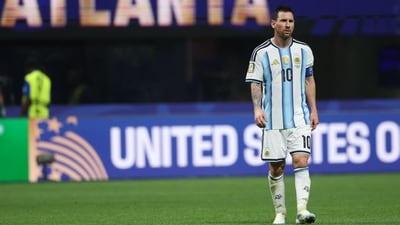
There are World Cups won by great teams, and then there are World Cups seized by one man until the tournament itself begins to look like an extension of his will. Diego Maradona did that in 1986. Lionel Messi, having already won his World Cup in 2022, now appears to be walking towards something even more dangerous: not just repeating El Diego’s miracle, but perhaps bettering it.
The comparison was once unfair to Messi. Qatar 2022 was his crowning achievement, but it was not a solo conquest. Argentina were complete, balanced and emotionally welded together. Julian Alvarez ran himself into history, Angel Di Maria turned up in the final like he always does, Alexis Mac Allister and Enzo Fernandez gave the midfield legs and clarity, Rodrigo De Paul emptied himself for the cause, and Emiliano Martinez gave Argentina the kind of goalkeeper every champion needs.
Messi was the centre of it all, of course. He scored, created, controlled, suffered and finally lifted the trophy that had escaped him for so long. But that Argentina was a team with Messi as its divine conductor.
This 2026 version feels different.
La Pulga Enters El Diego Territory
At 39, Messi is no longer merely decorating Argentina’s title defence. He is holding it together. Through the 2026 World Cup, the defending champions have repeatedly flirted with danger, and repeatedly Messi has dragged them back from the edge. Against Cape Verde, Argentina needed extra time to survive. Against Egypt, they were 2-0 down with just 11 minutes left in the Round of 16. Messi had missed a penalty. The dream was shaking. The last dance was turning into a goodbye.
Then came the old pull of greatness.
Cristian Romero scored from Messi’s delivery. Messi then equalised himself. Enzo Fernandez completed the comeback in stoppage time. Argentina survived 3-2, but the story of the night was unmistakable: the champions had not simply advanced; they had been rescued by the same man who was supposed to be playing under reduced burden after completing football four years earlier.
This is where the Maradona comparison becomes unavoidable.
In 1986, Maradona did not just win a World Cup. He bent it around himself. Five goals, five assists, direct involvement in most of Argentina’s goals, the Hand of God, the Goal of the Century, the pass for Jorge Burruchaga in the final – it remains the purest individual World Cup campaign football has seen. Maradona was not part of the story. He was the story.
Messi’s 2022 was not quite that. His 2026 is beginning to look closer.
The difference is that Messi is not chasing his first immortal moment anymore. He already has it. That makes this campaign stranger, heavier and possibly greater. Maradona in 1986 climbed the mountain for the first time. Messi is trying to climb it again after everyone assumed the summit had already been reached.
Maradona could not defend the crown in 1990. He took Argentina to the final, which itself was heroic, but West Germany stopped the repeat. Since Brazil in 1962, no team has retained the men’s World Cup. That is the ghost Messi is chasing now. Not only Maradona’s 1986, but Maradona’s unfinished 1990.
That is why this run carries such rare electricity. Messi is no longer simply trying to be Argentina’s greatest player. That debate has already become endless, emotional and almost religious. He is trying to do something even El Diego could not: win the World Cup, return as defending champion, and carry Argentina all the way again.
The image is perfect. El Diego was thunder, fury and rebellion. La Pulga was touch, rhythm and inevitability. One conquered the world with chaos. The other may yet conquer it twice with control.
If Argentina go all the way in 2026, Messi will not erase Maradona’s 1986. Nothing can erase that. But he may do something more audacious. He may take the old Maradona script – the No. 10 carrying Argentina through danger – and add the one ending El Diego never could.
A successful title defence. That would not just be Messi repeating Maradona. That would be La Pulga stepping into El Diego’s myth, borrowing its outline, and writing a final chapter even Argentina’s greatest football god left unfinished.