
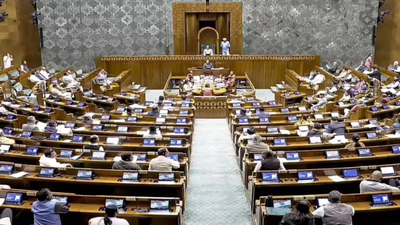
NEW DELHI: The question of how many members should sit in the Lok Sabha was debated in the constituent assembly nearly 77 years ago, when a proposal to remove the 500-seat ceiling was rejected. The debate took place on January 4, 1949, with economist KT Shah arguing that the number of MPs should grow with the population, while Congress member M Ananthasayanam Ayyangar defended the proposed limit, saying a 500-member House was sufficient.Shah moved an amendment seeking to replace the fixed ceiling with a provision for one representative for every 500,000 people across the Union. He argued that the Constitution should not permanently restrict the strength of the country’s popular chamber.“It is, I think, not in accord with the correct principle of popular representation, that it must be the people’s voice which must be the final authority in the governance of a country calling itself a democracy. Under such a principle the Constitution should not fix permanently the maximum number of representatives for the popular chamber,” he said according to a report by news agency PTI.
Why Shah opposed a fixed ceiling
Shah argued that India’s population was steadily increasing and that a fixed number of MPs would eventually mean each representative had to represent a larger number of people. This, he said, could weaken the principle of popular representation.“We have observed the tendency, during the last three or four census, towards a steady increase of the population of our country at every decennium. The last census shows an increase of as much as 15 per cent in ten years. If, now, you fix the absolute maximum number, it would happen that you might change the number of persons represented by each representative in an undesirable direction,” he said.He proposed fixing the representation ratio at one member for every 500,000 people instead of limiting the total number of directly elected representatives to 500.“I would suggest that a limit of 500,000 population be fixed as being entitled to be represented. This would be much more likely to reflect the real opinion of the people, even on a number of issues, than if you fix the total number of representatives at 500 as is contemplated under this clause,” he said.Shah also argued that a House of 600 members would not be too large for a country of India’s size and population.
Why Ayyangar defended the 500-seat limit
Countering Shah’s proposal, Ayyangar argued that a 500-member House would be large enough to ensure representation without making parliamentary proceedings less effective.“My impression is 500 is large enough. Already, in a House which consists of three hundred members, almost every day we have to ring the bell to get a quorum; and so what is the good of multiplying the number? There will not be effective representation,” he said.He maintained that while the House should not be too small, increasing its strength substantially was unnecessary.“Of course it ought not to be too small. Five hundred seems to be quite a good number,” he said.Ayyangar also pointed out that 500 was not necessarily an absolute limit, citing provisions for the nomination of Anglo-Indian members if the community was inadequately represented and for members from territories outside the states.“Under those circumstances five hundred is not a definite number; but it ought not to be increased enormously,” he said.Shah’s amendment was put to vote but was negatived by the Constituent Assembly.
How the Lok Sabha’s strength changed
The Constitution, adopted on November 26, 1949, provided for a maximum of 500 directly elected members from the states under Article 81(1)(a).The provision stated that “the House of the People shall consist of not more than five hundred members directly elected by the voters in the States”.Subsequent constitutional amendments changed the ceiling. The maximum strength now stands at 530 members from states and 20 from Union territories.The question of the Lok Sabha’s strength has returned to the political spotlight, with the Centre set to introduce the Constitution (132nd Amendment) Bill, 2026, during the special Parliament session beginning November 30.
Share your thoughts in the comments
Be respectful · TOI community guidelines
The Bill proposes to raise the Lok Sabha’s maximum strength from the existing 550-seat constitutional ceiling to 850, comprising up to 815 members from states and 35 from Union territories. It also proposes to increase the maximum strength of state legislative assemblies from 500 to 650.The proposed expansion is aimed at facilitating the implementation of the Nari Shakti Vandan Adhiniyam, which provides for 33% reservation for women in the Lok Sabha and state assemblies. The revised seat allocations and constituency boundaries are proposed to remain frozen until 2051.The special sitting of Parliament will begin with the Lok Sabha meeting on November 30, followed by the Rajya Sabha on December 2. The sittings are scheduled to conclude on December 3.