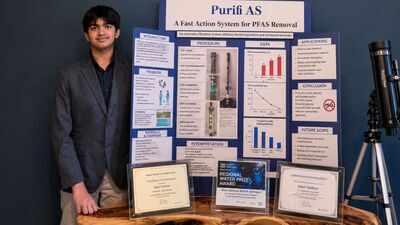
A Union County teenager has developed a floating water-purification system designed to tackle PFAS (Per- and polyfluoroalkyl substances), a class of persistent chemicals called ‘forever chemicals’. Aadit P. Krishna, whose research focuses on decentralised water purification, developed HelioPure as a solar-powered platform that can operate on surface water. The system combines several treatment stages, including titanium dioxide photocatalysis, strong-base anion exchange resin, granular activated carbon, and fine filtration. According to research published in the journal Zenodo titled ‘HelioPure: A Multi-Stage Photocatalytic-Ion Exchange-Adsorptive System for Decentralized Surface Water Treatment’ examined turbidity and total dissolved solids while aiming to create a system that could work without laboratory facilities or grid infrastructure. Krishna says his interest in the research was partly motivated by water contamination challenges facing his village in Tirunelveli, Tamil Nadu, India.
How does Aadit Krishna ’s floating HelioPure system work
The HelioPure system is designed as a floating platform that treats surface water while using sunlight as its energy source. Krishna describes the system as a decentralised purification approach for places where infrastructure may be limited. Its treatment combines immobilised anatase titanium dioxide photocatalysis with a strong-base anion exchange resin, granular activated carbon and fine filtration. The design brings these stages together so multiple contaminants can be addressed within one treatment system. Krishna says the platform was built from commercially available components without laboratory facilities. The research places particular emphasis on making the system suitable for off-grid use, including settings where access to conventional water-treatment infrastructure is difficult. This design is central to HelioPure’s intended applications in resource-limited settings.
What did the PFAS testing of HelioPure show in North Carolina
The reported results came from three field trials using untreated surface water in Waxhaw, North Carolina, under natural winter sunlight. Krishna’s research found that the HelioPure system produced an average turbidity reduction of 78.4% and a total dissolved solids reduction of 50.1%. Compared with the system’s granular activated carbon and filtration-only control, the full treatment train performed better for both measures. The strongest result involved PFAS. Water entering the system contained an average PFAS concentration of 59.12 parts per trillion, while treated water measured 9.04 parts per trillion. That represented an average removal of 84.8%. The study also reported relatively stable pH within potable limits.
How did Krishna develop a decentralised PFAS water treatment system
The project grew from Krishna’s interest in decentralised water purification. In his LinkedIn profile, he says he began researching at age 11 and now focuses on removing PFAS and other persistent chemical contaminants from surface water in infrastructure-limited environments. He also links the work to water contamination challenges facing his family’s village in Tirunelveli, Tamil Nadu. HelioPure was developed with affordability and accessibility in mind. The research says the prototype was constructed from components at a cost of about $165 without laboratory facilities. Conservative modelling estimated treated-water production at roughly $0.001 to $0.005 per litre under stated operating assumptions. The concept centres on a compact floating treatment platform that can operate independently of existing grid infrastructure while combining established treatment mechanisms.
What makes HelioPure different from earlier PFAS treatment systems
PFAS are persistent synthetic chemicals that can remain in the environment for long periods. HelioPure’s research focuses on removing these compounds from untreated surface water and is not presented as a universal solution. Krishna says the project is in the process of being patented. His profile also notes that an earlier system, PuriFAS, reduced PFAS from 65 to 83 parts per trillion to between 3 and 5 parts per trillion using a multi-stage granular activated carbon, resin, and reverse-osmosis system. HelioPure takes a different approach by adding solar-driven photocatalysis and a floating format. The results are an early demonstration of the concept. Much broader independent testing would be needed across different waters and operating conditions in practice before wider deployment.