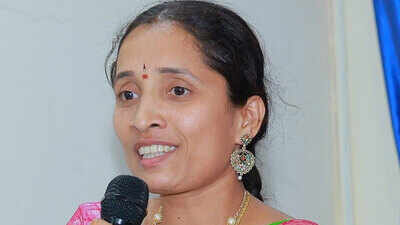
A Telangana government-school teacher has turned an ordinary classroom into a much larger learning platform.Bompelly Bhavani, a teacher at MPPS Girls Gandhari in Kamareddy, Telangana, has been selected among the 48 recipients of the National Teachers’ Awards 2026. Her work stands out for combining classroom innovation, digital education, community outreach and a sustained effort to increase enrolment.Her school, which had around 40 students, grew to approximately 130 students, according to the Ministry of Education profile. Alongside her work in school, Bhavani has created 1,336 teaching videos, which have collectively crossed 57 crore views, extending her teaching far beyond the children physically present in her classroom.Her recognition is part of a larger list of teachers from across India who are being honoured this year for introducing innovative approaches to education, improving access and attendance, supporting disadvantaged children and connecting classroom learning with real-world needs.
Who is Bompelly Bhavani?
Bhavani teaches at MPPS Girls Gandhari in Kamareddy, Telangana.Her work has focused on making learning more accessible and engaging for children, particularly through play-based and digital methods.One of her notable achievements has been helping increase enrolment at her school from 40 students to 130 students.She has also pioneered pre-primary education and developed learning environments that combine play, technology and classroom instruction.Her approach includes the Concrete-Pictorial-Abstract (CPA) method, which can help children understand abstract mathematical concepts by first working with physical objects and visual representations before moving to symbols and formulas.She has also used low-cost learning aids to help students overcome barriers in mathematics and language.
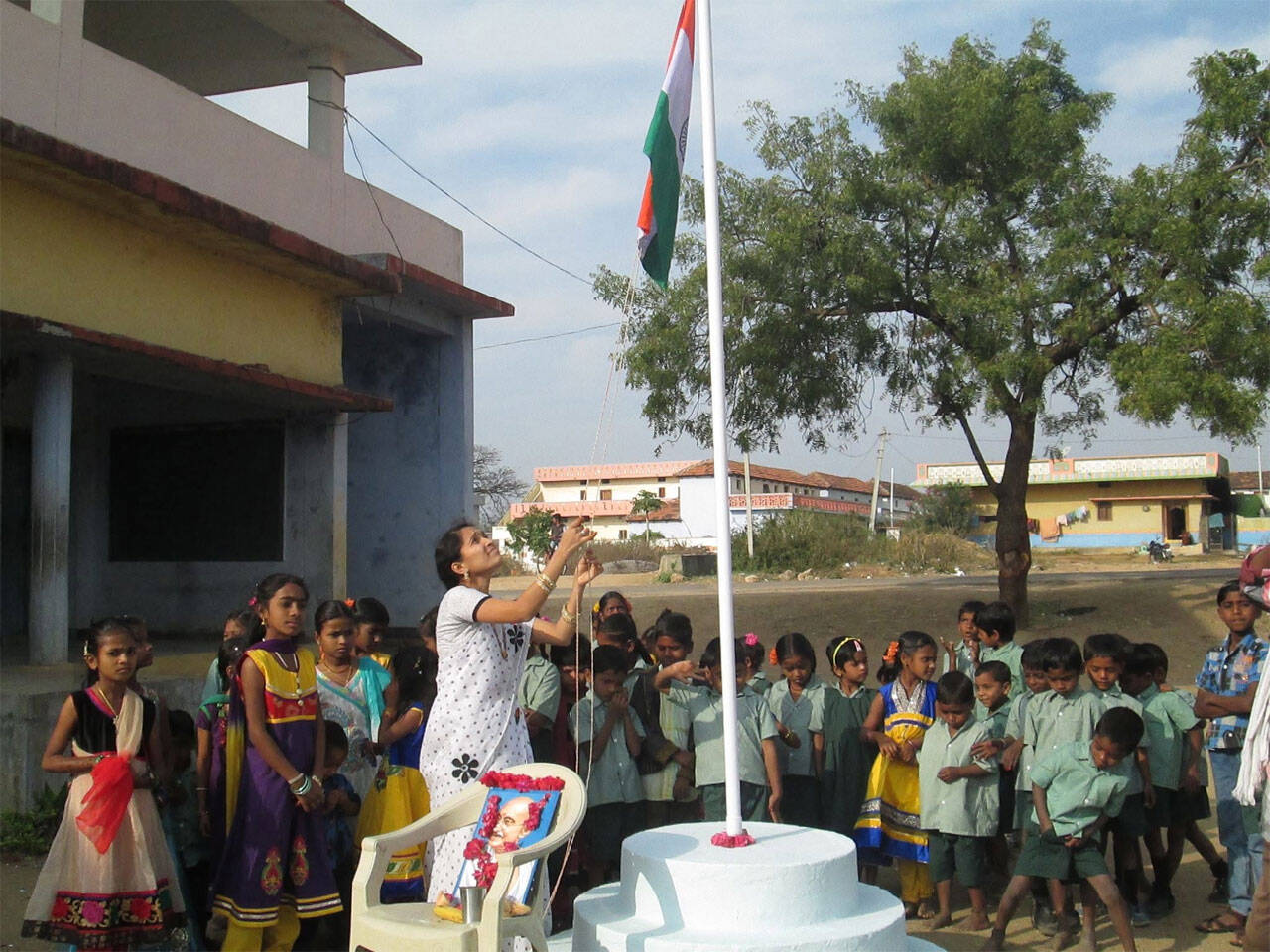
Bompelly Bhavani, a teacher at MPPS Girls Gandhari in Kamareddy, Telangana. (Photo: FB)
1,336 videos and 57 crore views: Her classroom goes beyond school
Perhaps the most striking part of Bhavani’s profile is the scale of her digital teaching work.She has created 1,336 teaching videos, which have crossed 57 crore views.That means her teaching material has potentially reached an audience vastly larger than the number of students in her own school.For a government-school teacher, this represents a significant shift in how educational resources can be created and shared.A teacher no longer has to be limited to the students sitting in front of a blackboard. Digital platforms can allow a lesson prepared for one classroom to reach children, parents and educators far beyond that school.Bhavani’s recognition therefore reflects both sides of contemporary school education: the importance of improving learning inside the classroom and the potential of digital resources to take that learning outside it.
From enrolment to community development
Bhavani’s work has not been restricted to academic teaching.She established the Navajeevan Foundation for orphaned children and has also coached rural students preparing for state residential-school examinations.This combination of classroom teaching and community engagement is an important feature of several teachers recognised in the 2026 awards.The teachers on this year’s list have worked with children from rural communities, disadvantaged families, tribal backgrounds and children with special needs. Many have addressed issues that directly affect whether children can attend school, participate in learning and continue their education.
Why the National Teachers’ Awards matter
The National Teachers’ Awards recognise school teachers whose work has made a notable contribution to education.The 2026 list includes 48 awardees representing different states, Union Territories and central government organisations.Their work demonstrates how the role of a teacher is changing.Some awardees have used technology and digital pedagogy. Others have focused on STEM education, environmental awareness, inclusive classrooms, foundational literacy and numeracy, student health, community participation or vocational skills.Several have also created innovative teaching materials that can be used by other educators.
From asteroid hunts to environmental projects
The 2026 awardees include educators who have taken science learning well beyond conventional classroom lessons.Teachers have encouraged students to participate in scientific projects, develop prototypes and explore environmental issues through hands-on activities.In Madhya Pradesh, Dr Archana Shukla has combined science education with environmental stewardship. Her initiatives include installing more than 1,000 sparrow houses, digitally mapping thousands of campus trees using QR codes and identifying 102 species of trees and plants.In Odisha, Padaraj Umakanta Nayak has guided students in developing 50-plus prototypes, including a low-cost automatic plate-washing machine for which a student received a Government of India patent.In Puducherry, S Ganesan, a physics teacher, developed a Science Theatre Integration Model using drama, storytelling and performances to make complex scientific concepts easier to understand.His students have also participated in projects associated with the National Children’s Science Congress, ISRO Yuvika and other science programmes.
Teachers are tackling attendance, nutrition and inclusion too
For many children, the biggest barriers to learning are not simply academic.Attendance, family circumstances, health, financial constraints and social disadvantage can all affect a child’s ability to stay in school.The awardees include teachers who have responded to these challenges directly.Khushboo Kumari of Bihar has used activity-based learning, low-cost teaching-learning materials and ICT, while also conducting home visits and parent-teacher interactions.Her efforts helped increase attendance at her school from around 50% to more than 90%, while uniform compliance improved from around 30–40% to 100%.Kunda Jayawant Bachhav of Maharashtra has used what she calls an “Educational Parenting” initiative to provide financial and academic support to more than 150 underprivileged girls, helping prevent early marriage and create pathways to higher education.She has also helped mobilise more than Rs 55 lakh in community and CSR support.
Making classrooms more inclusive
Another major theme among this year’s awardees is inclusive education.Mahadev Hanamant Shinde, a special educator in Goa, has nearly three decades of experience working with children with disabilities.His work includes developing activity sourcebooks, teacher handbooks and tablet-based digital learning resources. He has also introduced initiatives such as hydrotherapy, home-based education and vocational-skills programmes.In Uttar Pradesh, Dr Renu Tripathi has worked to bring dropout and out-of-school children from 60 villages back into classrooms.Her work combines STEM, ICT, low-cost teaching materials, project-based learning and science activities to develop students’ scientific temper, creativity, problem-solving and digital skills.
Making mathematics less intimidating
Several teachers on the list have also focused on changing the way students approach mathematics.Vaibhav Vasantrao Kulkarni of Maharashtra has used toy-based pedagogy, art, sports and real-life problem-solving to make mathematics more engaging.He created the open-access platform Maths Made Easy with Vaibhav Kulkarni, which has more than 700 videos, and has contributed to educational initiatives including PM eVIDYA, Swayam Prabha and NCERT.He has also trained around 900 educators through the Navodaya Leadership Institute.Bhavani’s use of the Concrete-Pictorial-Abstract approach reflects the same broader effort: helping students move from memorising formulas to understanding concepts.
A national list with very different stories
The 48 teachers selected for the National Teachers’ Awards 2026 come from different educational backgrounds and parts of the country.Their schools range from primary and middle schools to higher secondary institutions, special schools, residential schools and Kendriya Vidyalayas.Some have focused on technology. Others have concentrated on community mobilisation, girls’ education, environmental conservation, tribal education, science, mathematics, sports or inclusive learning.What connects their stories is that their contribution goes beyond simply completing a syllabus.
Complete list of National Teachers’ Awards 2026 recipients
| No. | Awardee | State / Organisation | School |
| 1 | Shri J Prakash Rao | Andaman and Nicobar Islands | PM SHRI GMSSS Mayabunder, Pokadera |
| 2 | Shri Rajesh Kouluri | Andhra Pradesh | MPPS Chinamallupeta, Chinamallupeta |
| 3 | Ms. Yaku Tame | Arunachal Pradesh | Government Secondary School G-Sector Naharlagun, Papum Pare |
| 4 | Shri Rajesh Bordoloi | Assam | Adarsha Tribal Higher Secondary School, Jorhat, Kalbari |
| 5 | Ms. Khushboo Kumari | Bihar | Urdu Primary School Bidaydih, Bidaydih |
| 6 | Ms. Pushpa Prasad | Bihar | Middle School Kuchaikote Kanya, Kuchaikote |
| 7 | Ms. Radha Rajesh | CISCE | New Horizon Public School, Indiranagar |
| 8 | Ms. Sangeeta Yadav | CBSE | St. Joseph’s Convent Sr Sec School, Ward No. 8, Idgah Hills |
| 9 | Shri Ravi Jaiswal | Chandigarh | Govt. Model High School, Maloya Colony |
| 10 | Ms. Sunita Yadav | Chhattisgarh | Govt. M S Khichari, Khichari |
| 11 | Ms. Patel Purnima Mohanlal | Dadra and Nagar Haveli and Daman and Diu | GHS Dalwada, Dalwada |
| 12 | Ms. Suman Goel | Delhi | GSKV Pooth Kalan, Pooth Kalan |
| 13 | Md. Zafar Alam | Eklavya Model Residential Schools, Ministry of Tribal Affairs | EMRS Karanjia, Binuria (Tato) |
| 14 | Shri Mahadev Hanamant Shinde | Goa | Gujarati Samaj-Special School, Aquem |
| 15 | Shri Nitinkumar Mahendrakumar Pathak | Gujarat | Rangpur Primary School, Rangpur |
| 16 | Shri Anil Kaushik | Haryana | GMSSSS Sanghi Rohtak, Sanghi |
| 17 | Ms. Manjari V Mahajan | Himachal Pradesh | Government Senior Secondary School, Bhaleth |
| 18 | Mohd Ayaz Raina | Jammu and Kashmir | HSS Dalhori, Dalhori |
| 19 | Ms. Munmun Bhattacharjee | Jharkhand | MS Barmasia, Barmasia |
| 20 | Ms. Rathnakumari S | Karnataka | Government Higher Primary School Samatagaru, Honnebailu |
| 21 | Ms. Amutha J | Kendriya Vidyalaya Sangathan | PM SHRI Kendriya Vidyalaya No. 2 Madurai, Madurai |
| 22 | Dr. Manisha Khetrapal | Kendriya Vidyalaya Sangathan | PM SHRI KV NFR Rangiya, Rangia |
| 23 | Shri Sunil Kumar KP | Kerala | GHSS Irikkur, Irikkur |
| 24 | Shri Mohd Mustafa Kumal | Ladakh | Govt. Middle School Zgangjing, Sankoo, Kanoor |
| 25 | Dr. Archana Shukla | Madhya Pradesh | Govt. Mahatma Gandhi Sandipani Hr. Sec School, BHEL Bhopal |
| 26 | Shri Shailendra Pratap Singh | Madhya Pradesh | Government Middle School Kanjwar, Village Kanjwar, Sidhi |
| 27 | Dr. Kavita Narsingrao Gitte | Maharashtra | Sane Guruji Niwasi Vidyalaya, Kaij |
| 28 | Ms. Kunda Jayawant Bachhav | Maharashtra | NMC School No. 18, Anandwali, Nashik |
| 29 | Shri Wanglembam Gobin Singh | Manipur | Laikon Upper Primary School, Kongba Makha Nandeibam Leikai |
| 30 | Ms. Lalnunmawii | Mizoram | Government Electric Veng High School, Electric Veng |
| 31 | Shri R Ronald Meru | Nagaland | GHSS Sechu Zubza, Sechu |
| 32 | Shri Vaibhav Vasantrao Kulkarni | Navodaya Vidyalaya Samiti | PM SHRI School Jawahar Navodaya Vidyalaya Latur |
| 33 | Shri Padaraj Umakanta Nayak | Odisha | Government High School Alipingal, Alipingal |
| 34 | Shri Ganesan S | Puducherry | Viduthalai Veerar R Seenuvasan Government High School, Mettupalayam |
| 35 | Shri Dinesh Kumar | Punjab | Govt. Victoria Girls Senior Secondary School, Patiala |
| 36 | Dr Divyendu Sen | Rajasthan | Mahatma Gandhi Government School Pachpahar, Pachpahar |
| 37 | Dr Vartika Gulat | Rajasthan | GGUPS Tumli Ka Bas Chaksu, Jaipur |
| 38 | Shri Shivprasad Arvind Tingare | Sainik Schools, Ministry of Defence | Sainik School Satara, Satara |
| 39 | Ms. Sushma Tamang | Sikkim | PM SHRI Government Senior Secondary School Dikling, Dikling |
| 40 | Shri Thanga Raj M | Tamil Nadu | Panchayat Union Primary School Puliyampatti, Puliyampatti |
| 41 | Ms. Bhavani Bompelly | Telangana | MPPS Girls Gandhari, Gandhari |
| 42 | Shri Ranjan Debnath | Tripura | PM SHRI Sabroom Girls HS School, Sabroom |
| 43 | Dr. Renu Tripathi | Uttar Pradesh | Govt. Balika Inter College Vijay Nagar, Ghaziabad |
| 44 | Dr. Iftkhar Khan | Uttar Pradesh | Government Inter College Ballia, Jagdishpur, Ballia |
| 45 | Ms. Shalini Kushwaha | Uttar Pradesh | Composite School Rasoolabad, Koilaha |
| 46 | Shri Gabar Singh | Uttarakhand | Govt. UPS Musyakhand, Maira |
| 47 | Shri Palash Chowdhury | West Bengal | Sri Ramkrishna Sarada Vidyapith Primary School, Ward No. 30 |
| 48 | Shri Santanu Patra | West Bengal | Govt. Model School, Nayagram Block, Baranigui |
From one classroom to thousands of learners
Bompelly Bhavani’s story captures one of the most interesting changes taking place in school education.Her work began with the immediate needs of students at a government school in Telangana: improving enrolment, making learning more engaging and helping rural children overcome academic barriers.But her reach eventually moved beyond the school walls.With 1,336 teaching videos crossing 57 crore views, her classroom has effectively become a digital resource for a much larger audience.That is also what makes the National Teachers’ Awards 2026 more than a list of individual honours. The stories of these 48 teachers show how educators are increasingly being called upon not only to teach subjects, but also to solve problems around access, inclusion, health, technology, community participation and student well-being.From rural classrooms and special schools to digital platforms and science laboratories, these teachers are changing what it means to be an educator in India.And for students, the biggest lesson may be that a teacher’s influence is no longer measured only by how many children sit in a classroom — it can also be measured by how far an idea, a lesson or an act of encouragement travels.