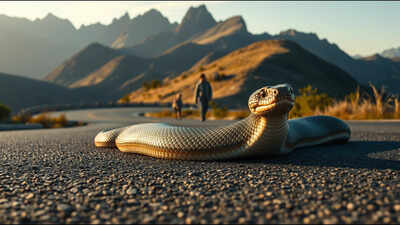
On October 18, 2024, Zhou Jiajun of the Zhejiang Forest Resources Monitoring Centre and local biology enthusiast Chen Haojun found the incomplete remains of an unusual snake while surveying the Kuocang Mountains in Zhejiang Province, China. The snake was slender, brown to dark brown, and unlike the species they were familiar with, but the remains were too incomplete to establish exactly what they had found. A complete specimen was needed for further study. That search eventually involved 17-year-old high school student and wildlife enthusiast Hu Jiahao. After hearing about the discovery, Hu decided to look for the snake himself. During the summer of 2025, he spent more than 40 nights searching the mountains after finishing his daily studies, sometimes travelling nearly 100 kilometres on a round trip. On August 17, 2025, he finally spotted the snake. The adult female he collected became the holotype, the specimen used as the formal reference for describing a new species, which researchers named Achalinus mirabilis.
How Hu Jiahao connected with researchers through an online science community
According to Ecns, Hu had been interested in wildlife since childhood and regularly spent his free time hiking in the mountains to photograph and observe animals. After learning about the incomplete snake specimen, he wanted to see if he could find another one. He contacted Zhou Jiajun online, who uses the username Zhou Yuhei as a science populariser, and the two began working together. Hu spent much of the summer of 2025 travelling to the Kuocang Mountains after school and searching at night, sometimes making a round trip of nearly 100 kilometres. His first searches came up empty, but he kept returning to the same area and changed his approach as he learned more about when and where the snakes might appear.
Why switching from rainy nights to clear ones led to the breakthrough
At first, Hu concentrated his searches on rainy nights because snakes are often more active in wet conditions. It did not work. After repeated unsuccessful trips, he began searching on clear nights instead. On August 17, 2025, while coming down the mountain, he saw a slender snake cross the road. He approached it and realised it appeared to be the animal he had been looking for. The adult female measured 332 millimetres in snout-vent length and shared the distinctive characteristics of the incomplete specimen found in 2024. Researchers later designated it as the holotype for Achalinus mirabilis. Hu continued looking after that discovery and found four more specimens himself over the following two months, including two live snakes and two road-killed specimens.
How five specimens collected by a teenager helped confirm a species new to science
The specimens gave researchers enough material to compare the snake’s physical characteristics and genetics with those of related species. The formal type series consists of the holotype and four paratypes. Among the paratypes is the original road-killed specimen found by Chen Haojun and Zhou Jiajun in October 2024. Researchers also examined a separate fragmented road-killed specimen collected by Hu in August 2025, but the paper lists it separately as an additional specimen rather than as part of the type series. The work eventually established that the snakes represented a species previously unknown to science. Hu’s repeated field searches were particularly important because the original discovery had left researchers with incomplete material, making it difficult to determine exactly what the animal was.
What the Kuocang Mountain odd-scaled snake reveals about citizen science in China
The new species was named Achalinus mirabilis, with the proposed English common name Kuocang Mountain odd-scaled snake. Genetic testing found a 9.5 to 10.9 per cent divergence in the mitochondrial COI gene from its closest known relatives, supporting its classification as a distinct species. The findings were published in Zoosystematics and Evolution in the study Taxonomic reassessment of Achalinus jinggangensis (Zong & Ma, 1983) (Serpentes, Xenodermidae), with description of a new species from Zhejiang Province, China. The discovery adds another species to Achalinus, a genus known for its unusual scales, but the story behind it is just as notable. The first specimen was found by experienced field workers, yet it was a teenager’s persistence that produced the complete material researchers needed. Hu kept returning to the mountains around his school schedule, eventually finding the snake that allowed the team to turn an unidentified set of remains into a formally described species.