
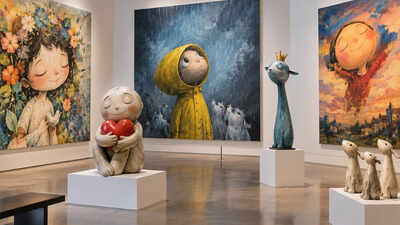
At 9, Joe Whale attracted attention for drawing on the walls of a restaurant in Shrewsbury, England. The young artist, known as the Doodle Boy, went on to work with international brands and create large-scale illustrations. At 16, he returned to Britain from Australia for Ambassadors of Feeling, his first major London solo exhibition, which opened at Truman Brewery on October 23, 2026. The exhibition featured a collection of characters representing different feelings and human experiences through paintings and sculpture. It marked another stage in Whale’s development, moving from the spontaneous doodles that first brought him attention towards a more structured exploration of emotion, technology and growing up.
How Joe Whale went from a restaurant wall to an international art career
Whale first drew widespread attention when his doodles appeared on the walls of Number Four, a restaurant in Shrewsbury. His distinctive illustrations helped establish his public identity as the artist known as the Doodle Boy, and his work subsequently attracted collaborations with brands including Nike, Disney and Marks & Spencer. His projects have extended beyond commercial collaborations. Whale created an eight-foot-by-five-foot canvas doodle of Charles Darwin at Shrewsbury Library for Darwin200, a two-year global voyage aboard the tall ship Oosterschelde retracing the route of Darwin’s HMS Beagle. The voyage, which departed Plymouth in August 2023, also aimed to train 200 young conservation leaders.Whale illustrated Game of Scones (2021), written by Eric Luper and the first book in the five-book Bad Food series. His work has developed alongside changes in his life and surroundings. His family later moved to Adelaide, Australia, where he continued to build his artistic career. His practice has expanded beyond the characters and patterns associated with his early work, incorporating different formats and more deliberate themes. The London exhibition brought together several aspects of that development, presenting a collection built around emotional experiences rather than doodling alone.
Ambassadors of Feeling: 10 characters, paintings and sculptures
Ambassadors of Feeling centred on 10 characters representing different qualities and experiences: Direction, Care, Humanity, Rebellion, Positivity, Peace, Imagination, Unpredictability, Impact and Awareness. According to the exhibition’s press materials, the show featured more than 22 newly created works, including large-scale acrylic paintings and sculpture. The characters gave Whale a framework for exploring feelings through visual forms. Rather than treating emotion only as an abstract concept, the exhibition translated it into a cast of recognisable figures, each associated with a particular theme. The collection invited viewers to consider how these qualities appear in their own lives.Whale has also applied his visual style to objects beyond traditional canvases. As part of outerwear brand Parajumpers’ 20th-anniversary project, he created a hand-illustrated Gobi jacket covered with his colourful characters. The project involved 20 artists reinterpreting the jacket, with their designs debuting at Milan Fashion Week in September 2026. The collaboration connected Whale’s illustration practice with fashion, demonstrating how his imagery could be adapted to a wearable format. It also placed his work within a broader collaboration between artists and a fashion brand. The jacket project was separate from Ambassadors of Feeling and should not be confused with the works exhibited in London. The Truman Brewery exhibition opened on October 23, 2026, and ran through October 25. It gave audiences an opportunity to see the new collection together, with paintings and sculptures forming the core of an exhibition organised around emotion and personal experience.
What research says about drawing and children’s emotions
Research has examined whether drawing can influence children’s moods, although these studies did not investigate Whale or his artwork specifically. In a study by Jennifer E. Drake and Ellen Winner, published in Cognition and Emotion in 2013, researchers examined how children used drawing to regulate their emotions. The researchers found that children’s moods improved more when they drew something unrelated to a negative experience than when they used drawing to express that experience. In the second study, which involved 123 children, researchers also compared drawing as a distraction with copying another person’s drawing. The findings suggested that the benefits depended in part on children actively creating their own drawings. A later study by Jennifer E. Drake, published in Frontiers in Psychology in February 2021, investigated how drawing could improve mood by distracting children from negative feelings. Across three studies involving children aged 6 to 12, the research examined the relationship between drawing, absorption and enjoyment. Drawing as a distraction produced greater absorption and enjoyment than drawing focused on expressing negative feelings.These findings offer one way to understand why drawing can be meaningful for children, but they should not be taken as evidence that every form of art improves emotional wellbeing. The studies examined specific drawing activities and short-term mood changes, rather than the long-term effects of an artistic career or viewing work in a gallery. For Whale, Ambassadors of Feeling brought emotion directly into the subject of his work. The collection’s characters gave individual feelings a visual form, extending the playful, immediate quality of his early doodles into a more structured body of paintings and sculptures. His career has grown from a moment of attention at a restaurant into collaborations across publishing, commercial art and fashion, with the London exhibition placing his exploration of human experience at the centre of his practice.