
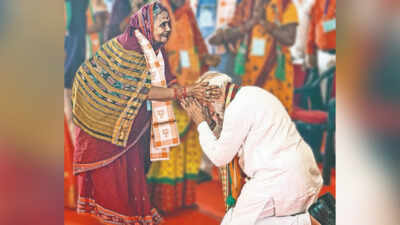
In a democracy, when someone completes 25 consecutive years as the head of a govt, it is indeed special. I heartily congratulate Shri Narendra Modi ji on 25 glorious years of service as head of govt. He is someone I am very fond of and someone I have interacted with closely over the years.Who is Modiji? What makes him successful? What drives him? These are very common questions and are worth pondering over.For me, Prime Minister Modi is a blend of both leadership and spirituality.When I reflect upon the life of Narendrabhai, one quality that draws my attention is this sense of an underlying purpose running through very different phases of his life. I have often spoken of the divided heart – a heart pulled in many directions by competing desires. There is an inherent tension between freedom and desire, between what is pleasant and what is good. Aspirants on the spiritual path encounter this tension and have to work at resolving it before real progress is possible.In Narendrabhai’s life, we can see that this work happened quite early on. I recently learned that at seventeen, he left home, travelled across India and spent time in the Himalayas; influenced by Swami Vivekananda and his encounters with different communities and traditions, his life began to orient itself towards service. Thereafter, the outer form kept changing – from pracharak to organiser, from CM to PM, but the idea of service remained a recurring thread. When the heart becomes united in purpose, positions cease to be destinations in themselves. They become different instruments through which that purpose can find expression.The devastating flood at Morbi in 1979, following failure of the Machchhu dam, gave this commitment a demanding field of action. Narendrabhai worked there as a volunteer in the aftermath of disaster. Years later, while visiting landslide-affected Wayanad in 2024, he recalled that experience as helping him understand suffering of families who’d lost so much. When we serve people in their hour of distress, their difficulties cease to be concerns. They become responsibilities we feel within ourselves.A sense of purpose finds expression in the way we respond to the person before us. When Seva takes root in the heart, even an ordinary encounter becomes an opportunity to care. An incident from Narendrabhai’s earlier life brings this quality to mind.In her account “A train journey and two names to remember,” published in The Hindu in 2014, Leena Sarma recalled her journey from Delhi to Ahmedabad in 1990 with Utpalparna Hazarika. Both women were Railway Traffic Service probationers, travelling for the next phase of training without confirmed berths. The ticket examiner found them space in a first-class compartment occupied by Narendra Modi and Shankersinh Vaghela. That evening, Narendrabhai paid for all four vegetarian meals. Later, when the ticket examiner explained that no berths could be arranged for the women, both men surrendered theirs, spread a cloth on the floor and slept there, leaving the berths to the two probationers.What touches me is the ease with which they gave up their comfort. In Sarma’s recollection, the kindness came without ceremony. This was long before Narendrabhai became chief minister or Prime Minister, and the need before him was simple and immediate. Such moments invite us to reflect on how we behave when no one is watching as an example of leadership. Can we notice another person’s difficulty and respond without seeking recognition? To me, this is generosity of heart. It gives a human warmth to purpose and allows seva to become part of everyday life.Doubt will visit every sincere seeker, just as uncertainty accompanies every person who accepts a great responsibility. If one listens to its whisperings, faith is progressively fractured; the will loses its ability to drive action and real spiritual progress becomes difficult. The question is not whether doubt arises, but whether we allow it to become the driver of our lives. This is where shraddha becomes so important.Shraddha is more than belief; it contains trust, self-confidence, sincerity, determination and inner conviction. I am reminded here of Narendrabhai becoming CM of Gujarat in 2001. At fifty-one, he had never contested an election and had never held an administrative position. He was asked to govern a state still recovering from a devastating earthquake and there were understandable questions about whether an experienced organiser could become an effective administrator. Yet he accepted the responsibility and learnt while carrying it. His early tenure as chief minister was fraught with many challenges that he had to overcome, challenges that could have tested the faith of many.Conviction does not mean that we know beforehand that we will succeed. It means that uncertainty does not prevent us from taking the next step. We may hear the voice of doubt, we may learn from it, but we need not hand over to it the direction of our lives. Narendrabhai’s life is one where doubt has never been allowed into the driver’s seat; in fact, courage and conviction have been given that place.Fear asks, “What if?” while faith responds, “Even if.” Fearlessness does not mean that a human being never experiences fear. What matters is whether fear is permitted to determine our direction. Narendrabhai’s life offers examples of accepting responsibility in very different circumstances of uncertainty. In his mid-sixties, when Narendrabhai accepted the mantle of being Prime Minister of India, the scale of uncertainty was enormous: he moved from leading one state to assuming responsibility for India’s national security, diplomacy and relationships with the world, at a time when questions were being asked about how a state leader would make that transition.Later came a spell of challenges that may constitute one of the most turbulent periods in recent history. The Covid pandemic, trade wars, the geopolitical upheaval following the war in Ukraine and the recent West Asia crisis, along with domestic challenges, feature among circumstances that would have tested the fortitude of any leader, let alone one who holds the hopes of 1.4 billion. To navigate this with poise is exemplary. Perhaps this is one way of understanding courage spiritually. It is not to say, “Nothing can happen to me.” It is to say, “Whatever may happen, I will not allow fear alone to decide what I must do.”And so, for any student of leadership, there is a clear lesson from his life. Cultivating a heart free from division, allowing generosity to guide our actions, anchoring mind in conviction and developing a spirit that does not act from fear are spiritual principles that have helped shape Narendrabhai’s path as a karmayogi. These principles are universal and when we see them manifest in someone’s life, we can use them as inspiration.
Share your thoughts in the comments
Be respectful · TOI community guidelines
I take this occasion to wish Narendrabhai all the very best; may the divine grant him a long life to carry forward this era with leadership and guidance, and may he continue to take India to greater and greater heights.(The writer is the president, Shri Ram Chandra Mission, Global Guide of Heartfulness Meditation)