
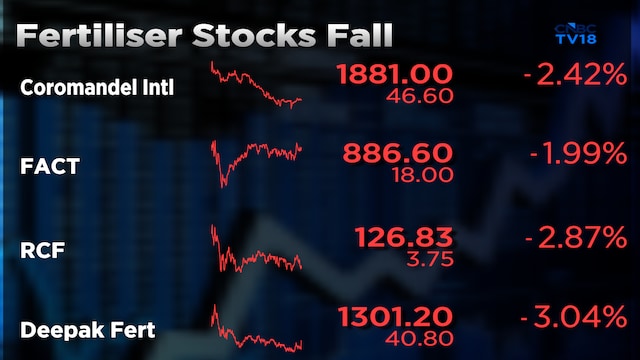
Fertiliser Shares Drop
Fertiliser shares declined across the board, with losses ranging between 0.5% and 2.8%.
Global supply risks and policy shift
India’s fertiliser ecosystem remains structurally dependent on global supply chains and is therefore exposed to geopolitical disruptions in West Asia.
While direct fertiliser trade with Iran is limited, the region plays a critical role in feedstock availability, shipping routes including the Strait of Hormuz, and global pricing dynamics, all of which impacts landed costs, availability and the government’s subsidy burden.
Around 33% of global fertiliser shipments, including urea and sulphur, transit through the Strait of Hormuz.
Modi’s push and sector outlook
Modi’s renewed push for natural farming aligns with India’s ongoing efforts to promote soil health improvement, sustainable agriculture practices and reduced dependence on chemical fertilisers alongside conventional input usage.
Fertiliser consumption remains a key component of India’s agricultural system and is supported by government subsidy mechanisms.
The policy framework has evolved over time, with Paramparagat Krishi Vikas Yojana (2015), Bharatiya Prakritik Krishi Paddhati (2019–20), and the National Mission on Natural Farming (2023) aimed at scaling low-chemical and natural farming practices.
However, chemical fertilisers continue to account for the bulk of agricultural input consumption in India and remain central to productivity and food security requirements.
Stocks In The Spotlight
This puts companies such as Coromandel International, Chambal Fertilisers and Gujarat State Fertilizers and Chemicals in the spotlight. Other names like Deepak Fertilisers will also be in focus.
India’s fertiliser system is also exposed to global energy and feedstock cycles, particularly natural gas.
Government subsidy support has historically cushioned input cost shocks, but sustained supply disruptions would test this framework more on availability than pricing.
Import-substitution themes could see selective tailwinds in case of elevated global prices or supply constraints, with diversified chemical players such as Deepak Fertilisers and Petrochemicals Corporation better placed to benefit from broader chemical demand and margin expansion rather than direct fertiliser substitution.