
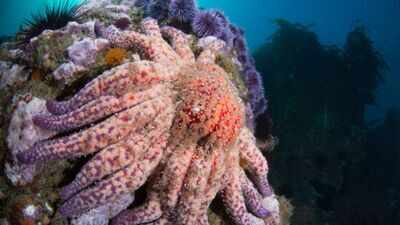
A decade ago, more than 99% of sunflower sea stars vanished from the depths of the ocean. Now, the discovery of a long-lost colony of these organisms is offering new hope for the region’s kelp forests.Sunflower sea stars, known as Pycnopodia helianthoides, may look like an aesthetic and purely decorative feature on the ocean floor, but they are ferocious predators. As adults, they can grow up to 24 arms, span three feet wide, and move three feet per minute. They are superlative, and alien, one of the largest and arguably most ravenous sea stars in the world.They dominated much of the ocean floor until the end of 2013, when a colossal marine heatwave swept over the northeast Pacific just as a mysterious underwater epidemic began causing them to die off en masse. A deadly ailment pocked the starfish bodies with lesions and then dissolved into their flesh. It affected roughly 20 species and killed a whopping 57.5 billion sea stars. Over the past century, these large ribbons of golden-brown seaweed had already dwindled in some stretches of the coast, due to the warming ocean conditions.
A damaged ecosystem
Without the presence of a primary predator, an excess of purple sea urchins insatiably consumed the surrounding kelp forests. By 2017, this sudden explosion of hungry sea urchins and an ongoing marine heat wave, strengthened by an El Niño weather pattern, wiped out more than 90 per cent of kelp forests in some West Coast regions.Kelp forests on the West Coast are critical habitats that support dozens of species including drifting plankton and migrating grey whales. They also form a habitat for lucrative fish species like rockfish, abalone and crabs. More, kelp itself is a sustainable food and helps sequester atmospheric carbon.However, without the presence of sunflower sea stars, kelp forests have been unable to grow back without being devoured by the hungry purple sea urchins. A decade into this devastation, weary coastal communities impacted by the loss of these ecosystems through the state along with the scientists studying this environment wondered whether a population of the sunflower sea stars may have survived somewhere, tucked into a protected coastal inlet or nestled into a forgotten reef.
Sunflower sea stars
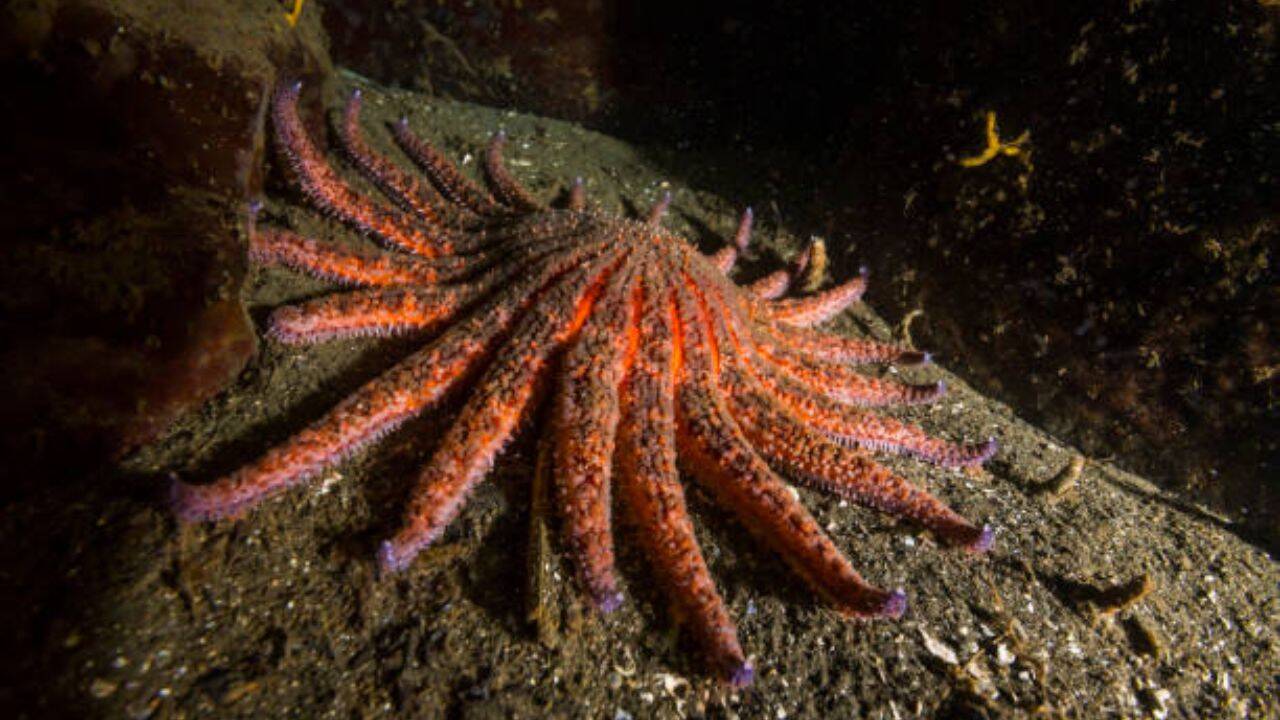
Sea stars are ancient creatures that first appeared on Earth around 480 million years ago, predating the age of the dinosaurs by more than 200 million years.
Sea stars are ancient creatures that first appeared on Earth around 480 million years ago, predating the age of the dinosaurs by more than 200 million years. Over time, they evolved into nearly 2,000 unique species, forming a group called Asteroidea.Sunflower sea stars are among the world’s largest, sometimes growing to the size of a bicycle tyre and sprouting up to 24 arms. Their lifespan in the wild remains unknown, but they’ve survived in aquariums for decades. Most dwell at depths between sea level and 25 meters (82 feet), but they’ve been discovered as deep as 455 m (nearly 500 ft). Historically, they were found trawling for prey from Alaska’s Aleutian Islands down the Pacific coast to Baja California in Mexico. When sea star wasting disease hit in 2013, it essentially eradicated the creature from 2,700 kilometres (about 1,700 miles) of its southern range.Now, more than a decade after the epidemic began, the mysterious killer has finally been unmasked. Researchers at the University of British Columbia and the Hakai Institute in Canada just published their discovery, identifying a strain of the bacterium Vibrio pectenicida as a culprit. Increasing sea surface temperatures in the Pacific Ocean, driven by anthropogenic climate change, are believed to have triggered or exacerbated the disease, according to the IUCN, the global wildlife conservation authority.A coalition of California aquariums, nonprofits, Indigenous groups and government experts had been trying to bring the starfish back and along with them, revive the ecosystem. But even with a groundswell of support from across the state, getting to this point took immense trial and error because little was known about these echinoderms. Over the years, these stars became almost mythological, earning them the affectionate term “seasquatch” among many professional and amateur scientific sleuths. Finally, after years of faithful searching, a hidden “seasquatch” lair was discovered in June 2025.
Reviving the dead
“The moment I saw my first sunflower star underwater, I was so excited that I literally screamed through my regulator,” Rachael Karm, a research technician at Sonoma State University’s Dr. Brent Hughes ecology and conservation lab, noted in an email to National Geographic. “I came up to the surface before remembering to even take a photo.”A subsequent diving expedition revealed a total of 18 sunflower sea stars, the largest and southernmost population of sunflower sea stars documented since sea star wasting disease spread across the coast. Karm and her peers said this discovery offers a major sign of hope for restoring lost sunflower sea stars and potentially even reviving the coast’s lost kelp forests.Kelp began studying kelp forests in northern California in 2020, after most of the sunflower sea stars had already disappeared. Then, her colleagues found a single adult sunflower sea star at an underwater site they regularly monitored for kelp research projects. When Karm returned about a week later to relocate the star and collect genetic samples she was stunned to stumble across four more sunflower sea stars, juveniles this time, including two silver-dollar-sized individuals on the same rock.Just two months later, Karm convened an event dubbed Pycnopalooza. Once Pycnopalooza was announced, it drew a dream team of 25 scientific divers from eight different institutions: The Nature Conservancy; Greater Farallones National Marine Sanctuary; Moss Landing Marine Labs; University of California, Berkeley; Reef Check California; Sonoma State University; Sunflower Star Laboratory; and the Kashia Band of Pomo Indians, whose scientific dive team oversees kelp restoration on their ancestral lands. Over two days, divers systematically surveyed the humble cove off the coast of Sea Ranch, California using an underwater grid system. Teams entered the frigid water with flashlights, measuring reels, and little red floats to be deployed should a wild “Pycno” be found. They also had access to a new technology that allowed them to find bits of sunflower sea star DNA in environmental samples, also known as eDNA.By the end of the two-day effort, 18 adult sunflower sea stars had been found—each individual marked by its own exuberantly bobbing red buoy.
How the sea star colony could help fight disease
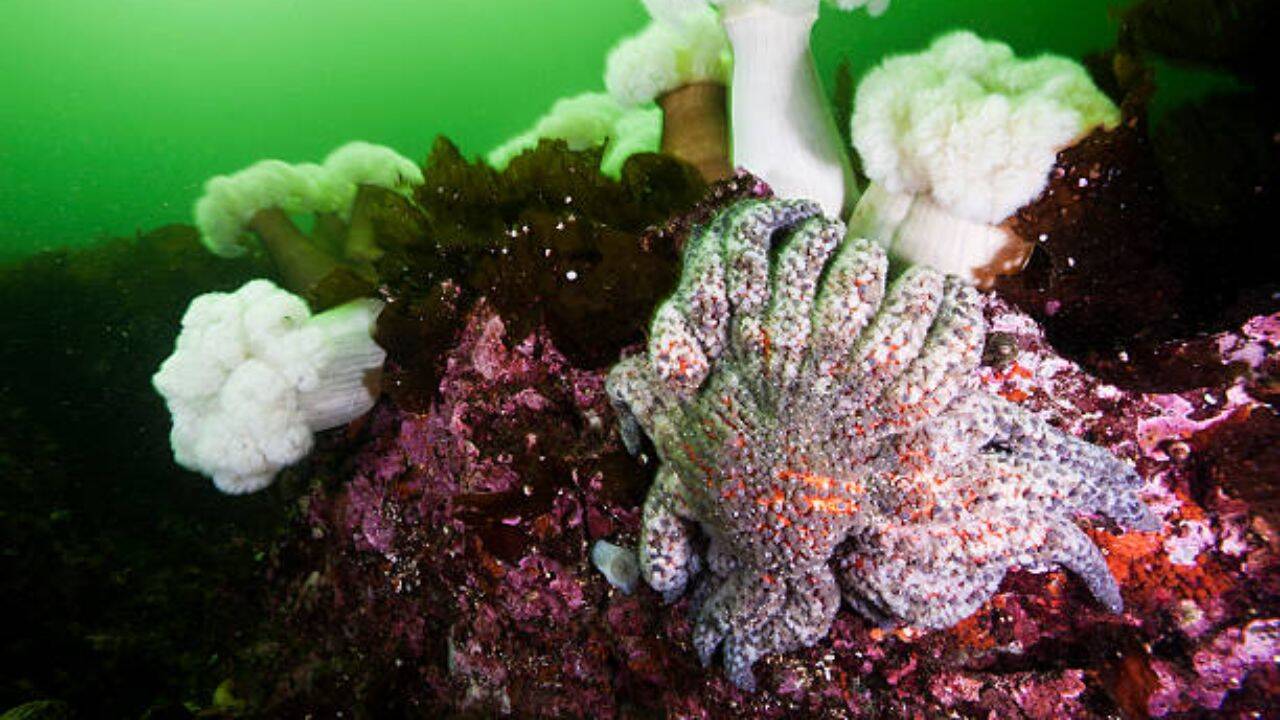
Karm and her peers said this discovery offers a major sign of hope for restoring lost sunflower sea stars and potentially even reviving the coast’s lost kelp forests.
All 18 of the Pycnopalooza stars’ genetic samples are being analysed in a lab at the University of California, Merced where scientists are trying to learn what genetic traits might have helped the stars to survive the wasting disease.Lauren Schiebelhut, an evolutionary ecologist at the University of California, Merced, will be researching the genetic samples collected by pycnopalooza divers to look for clues that might bring the sea stars back.“Discovering a wild population of recovering Pycnos is an amazing opportunity to try and answer questions from the past we missed out on, and to map the next steps of sunflower star recovery,” said Andrew Kim, the lab manager at Sunflower Star Laboratory in Moss Landing, California.Kim’s lab is one of several efforts, from Alaska to California, working to release disease-resistant sunflower sea stars bred in a lab back into the wild. “Understanding what—if anything—is special about the Palooza ‘Pycnos’ is crucial data for reintroduction programs like ours and the greater kelp community,” said Kim.Knowing now that these Pycnos are afoot, Karm and her colleagues will be monitoring the health and movements of these individuals, while searching for more populations along the coast.