
While near-term volatility from global risks like rising crude prices may persist, he remains confident that strong earnings momentum, rising retail participation and India’s structural growth story will support markets over the long term.
Watch the full conversation here or scroll for edited excerpts.
These are edited excerpts from the interview.Q: What are your top goals for FY27?
A: We had a brilliant year in terms of operating performance—up 16% for the full year and 25% for the quarter.
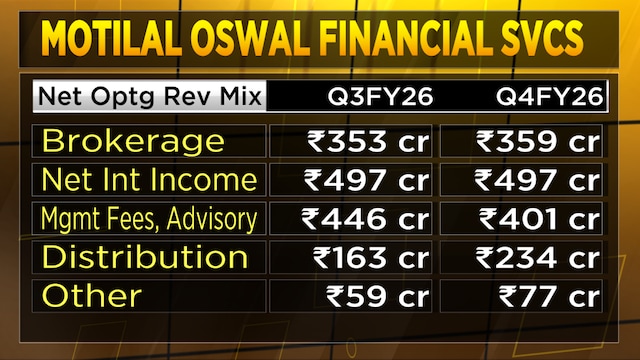
It’s a double-engine model. One is the operating businesses—broking, asset management, private equity, wealth management—all growing at about 20–25% year-on-year. Net revenue is around ₹6,000 crore, and profit is about ₹2,340–2,360 crore.
Retail broking faced regulatory headwinds over the last 12 months, but this quarter has seen a return to natural growth of 35–40%. Going ahead, we expect broking to grow 25–30%, with other businesses also remaining strong.
Overall, we are aiming for about 25% growth in both top line and bottom line.
 Q: What has been the impact of the securities transaction tax (STT) hike?
A: April has been strong. The impact is much lower than feared.
Markets have revived since late March, and in a rising market, higher trading costs have not been noticed much. Some regulatory tightening has also been deferred.
At this point, we don’t see any major disruption from regulatory changes in the next 12 months.
Q: Can you explain the treasury losses and recovery?
A: The losses were mark-to-market and linked to market movement. About 70–80% has already been recovered in April.
With a fully invested equity portfolio, performance moves with the index. A strong rally helped recover ₹400–500 crore in a month.
Also Read | Global markets turn selective as AI, oil and capital flows drive divergence: Manulife Investments
Treasury remains strategic—it provides liquidity and resilience, especially during sharp market moves, ensuring the ability to meet obligations and support clients.
Q: How do you see competitive intensity in your businesses?
A: Capital markets are the most tailwinded segment in India right now. With about 3 million new retail investors entering every month, the market is expanding rapidly.
The challenge is not a lack of opportunity, but how much you can execute. There is competition for large clients and deals, but the overall opportunity is vast.
A key differentiator is talent. We aim to build a strong talent advantage, which will drive growth in the coming years.
 Q: Crude prices have spiked, the rupee is at a fresh low, and global tensions are back. How do you see the Indian market setup? Are we heading into a difficult phase?
A: Despite global uncertainties, India’s resilience stands out. Strong fiscal and monetary management, along with effective forex handling, have helped the economy stay stable even in a challenging environment. Policymakers deserve credit for building this resilience.
One key support is domestic flows. Even as foreign institutional investors (FIIs) pull out significant amounts, domestic investors—especially retail—are stepping in, helping stabilise market sentiment.
That said, there are near-term risks. A weaker rupee combined with rising crude prices could widen the current account deficit and add to inflation if the situation persists.
There is also a broader policy focus on balancing short-term growth with long-term stability, which remains crucial in the current environment.
On the positive side, developments in eastern India could be a structural growth trigger. This region accounts for roughly one-third of India’s population but a much smaller share of GDP due to lower per capita income. If economic and political conditions improve, it could unlock significant growth potential.
Over the next 3–4 years, stronger growth from these states could potentially add around 1 percentage point to India’s overall GDP growth, providing a meaningful long-term boost.
Q: What is your market outlook across timeframes?
A: In the short term—10 hours to 10 months—you have to be cautious due to volatility and macro risks.
But over a 10-year horizon, I remain very positive. Earnings momentum is strong, and ultimately, markets follow earnings.
Corrections of 10–20% can happen, and investors should be mentally prepared, but long-term prospects remain intact.
Catch all the latest updates from the stock market here