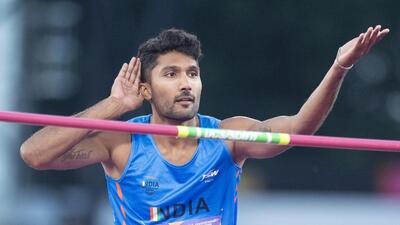
New Delhi: Tejaswin Shankar has earned himself a well-deserved break. Back from the Federation Cup in Ranchi where he became the first Indian decathlete to cross 8000 points and meet the AFI’s entry standards (7787) for this year’s Commonwealth Games, Tejaswin has given himself two weeks to put his feet up and “enjoy the sport as a spectator”. The 27-year-old scored 8057 points in ten disciplines across two gruelling days to become only the 10th Asian to breach the 8k mark.
Tejaswin is characteristically nonchalant in his assessment of his feat. That’s because fairly early in his pivot to combined events, he figured there’s literally no one in the country who could challenge him. So he set bars — and his ambition — so high that on-field competition ceased to matter. The ceiling that began with 7k was raised to 7.5k, 7.7k, and finally, 8k. “There’s no fun in doing it alone, but what has always driven me are medals, even more than my scores,” he said.
It’s not surprising that soon after finishing his 1500m race, the last of his ten events, Tejaswin found himself asking, “All this is fine, but can I do it in major international meets?” It’s an instant, inadvertent throwback to the famous ‘Can he do it on a rainy night in Stokes?’ quip, and quite like Lionel Messi who answered it more than once, Tejaswin aspires to announce himself in tough, international meets.
“There will be people who’ll say, ‘Oh, he did it in India, so what’s the big deal?’ I respect that opinion too. Apne ghar me har koi sher hai (everyone’s a lion at home). If I am able to do it in CWG, Asian Games, Olympics, that’s when I’ll rate myself.”
Therefore, the clock has started ticking for him.
“There are about ten weeks to go for Glasgow CWG. I have taken the first two weeks out for rest, and the last week leading into the Games for tapering off and periodisation. That leaves me with good 6-7 weeks to go hard. I want to go over 8200 for starters, but ultimately, it’s the medal that counts,” he said.
The 2022 edition of CWG had top three finishers crossing 8000 points. In 2018, top two crossed 8k, while in 2014, all three again breached the mark. Safe to say, Tejaswin’s mark is the bare minimum he needs to hit to stay in medal contention in Glasgow. The Asian Games record belongs to Kazakhstan’s Dmitriy Karpov, who scored 8,384 points in the 2006 edition. At 2023 Hangzhou where Tejaswin won a bronze, no athlete crossed 8000 points. Only five decathletes have logged 8k or more at the Asiad.
“At the end of the day, medals matter more than points. And it’s the medals that drive me more than the points. It’s tough to do 8k, to be honest. Doing it once, however, tells me that I can do it again,” he said.
Tejaswin’s key learning, that was instrumental in him scaling the barrier was understanding the need for speed. Since moving back to Kansas State University in the US this January, he has been training to get faster off the blocks. Attaining emotional equilbrium is another tough, albeit underappreciated, ask.
“Speed is the key because the first event (100m) truly sets the tone for the two days. If my 100m doesn’t go well, it just ruins the event, so much so that two days may start feeliing like ten days. Before you realise, you start falling behind. You carry the 100m energy to long jump, where speed once again plays a big role,” he said.
“The 400m race is another important chokepoint. It’s a mix of speed and endurance and if you do well, it gives you the right headstart for Day 2 since it’s the last event of the day.”
The intervening night is almost as important as the two competion days. The body is knackered, the mind is clouded, and the calculations are hectic. “I usually sleep only for 2-3 hours because the recovery protocols take their time and I get up at 4am to reach the stadium early and get a feel of the tracks. I usually have a very good Day 1 because most of my strong suits are on the opening day. If I get 4500 points on Day 1, I can lead myself into believing that I am primed for 9000 pts, but decathlon doesn’t work that way,” he explained.
As it turned out, Tejaswin, after aggregating 4511 on Day 1 had a poor Day 2. After a decent 110m hurdles (14.23s), he had under-par results in discus (37.90m), pole vault (4.20m) and javelin (47.71m), putting a lot of premium on 1500m race, the last of the ten events.
“Hurdling on fresh legs is very different from hurdling on Day 2, but I had a decent outing there, The executionn went awry in throws which made the 1500m critical.”
The first lap of the 1500m is “usually a breeze” but the lactic acid begins to wreak havoc thereafter. “That’s where your mindset kicks in. You just have to keep going even though your legs feel the cumulative fatigue of nine events.” Tejaswin’s wife Siddhi, a former sprinter, was on the sidelines, feverishly calculating the split timings for him to get to 8000 points. Needing 694 points from the final event, Tejaswin accrued 751 with a personal best (4:29.02) to comfortably go over the desired mark.
“The first feeling was that of satisfaction before, you know, I started thinking if I can repeat it in CWG and Asian Games. In the end, it’s the medals that count.” He’ll have his answer soon enough.