
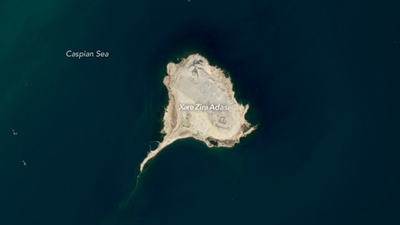
Near the shore of the Caspian Sea is a very unique geological formation called the mud volcano islands. Recently, they have been discussed in the Earth Observatory blog of NASA. They have an unusual formation that seems to be unearthly if seen from space. They are formed through explosive events and ocean waves shaping the volcanic structures. However, the islands provide a lot more interesting information to the geologists because they provide important knowledge on hydrocarbons, plate tectonics, and even environmental processes.
Azerbaijan mud volcano islands: A geological marvel
Often referred to as the “Land of Fire” because of the gas seepages in its territory, Azerbaijan is home to an amazing number of mud volcanoes. It is estimated that the country is home to “at least 220 mud volcanoes,” according to the NASA Earth Observatory, although the numbers can go all the way up to 350.While volcanoes traditionally erupt with lava, mud volcanoes have a different output. They eject mud along with water and methane gas from sedimentary basins where pressure creates hydrocarbon deposits. With time, the accumulated pressure causes the slurry to be emitted from the Earth’s surface via fractures in the crust of the Earth.It is the shape of the islands that makes them unique. As shown by satellite imagery, the islands have elongated shapes with tails that resemble tadpoles. Geologist Mark Tingay said the tail-shaped structures are a result of wave erosion, with mud being deposited at locations where waves have little power to erode.
How mud volcanoes shape the Caspian landscape
Most of these volcanoes are located around the Absheron Peninsula and under the Caspian Sea. It is worth mentioning that there are more than 140 mud volcanoes that emerged under the Caspian Sea and became islands.For example, Xərə Zirə Adası was a volcanic island created due to eruptions, including the large ones that took place in 1961 and 1995. Other islands nearby have had their share of spectacular eruptions as well. For example, the eruptions were so intense that the volcano formed new land in minutes; however, this land was gradually washed out by the sea.Another relevant discovery made by NASA is a ghost island formed after the eruption of a volcano in the Caspian Sea in 2023. However, this ghost island disappeared in 2024.
Scientific importance and environmental insights
The mud volcano islands do not only have scientific importance because of their uniqueness. As these islands are geologically linked to underground oil and gas deposits, they provide scientists with information concerning the genesis and migration of hydrocarbons underground. Nevertheless, there is danger associated with mud volcanoes. According to Tingay, they can generate “short but extremely violent eruptions,” during which huge fireballs can occur because of ignited gases. The volcanic activity makes the objects interesting, but dangerous at the same time.Moreover, the scientific study of mud volcanoes is connected with planetology. These volcanoes may be present on other planets as well; therefore, the Azerbaijanian mud volcanoes may become Earth analogues for extra-terrestrial territories.In summary, the mud volcano islands located on the territory of Azerbaijan are an indicator of the geological activity of the planet. Being shaped by processes occurring deep within the earth, the volcanic islands remain a source of mystery for scientists.