
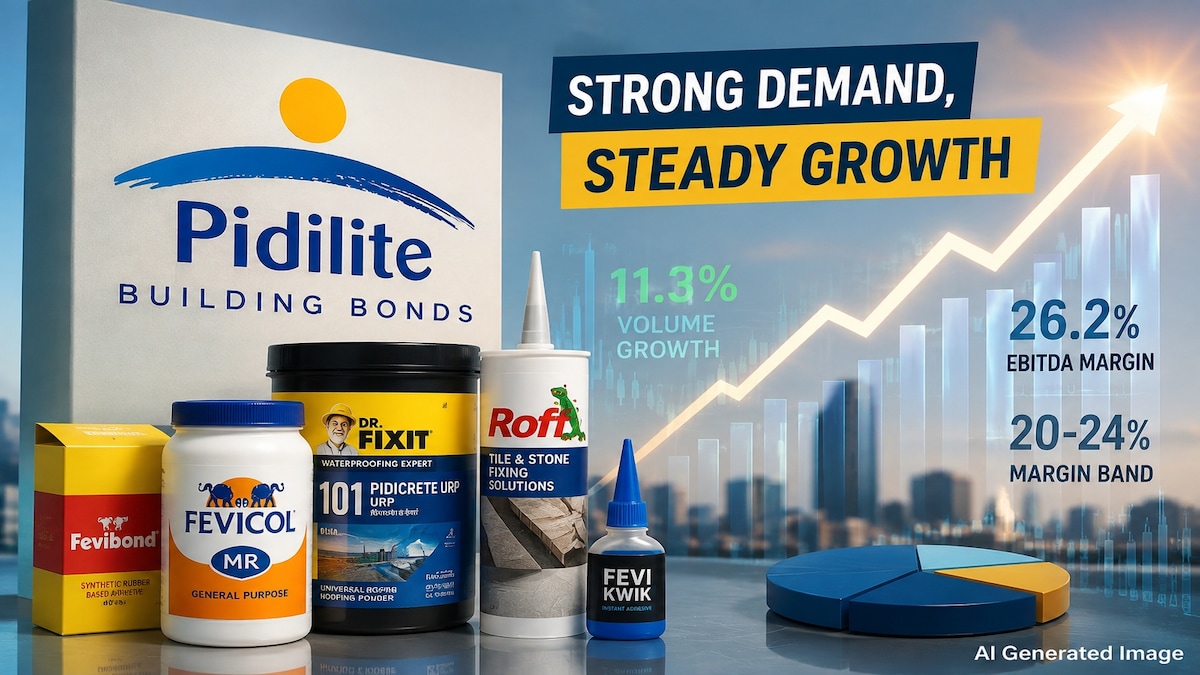
Speaking to CNBC-TV18, Vats said the company was not looking to narrow or change its margin guidance because of continued volatility in raw material prices. He said Pidilite would continue to focus on delivering double-digit underlying volume growth.
“Demand continues to stay strong. At least for us in our categories,” Vats said.
Pidilite reported 11.3% underlying volume growth in the June quarter, slightly higher than the 11.1% average recorded in the previous year. “We’ve always said that we will deliver double-digit underlying volume growth. Our endeavour is to keep inching it up,” he added.
Vats said raw material volatility made it difficult to provide a narrower margin outlook. Vinyl acetate monomer (VAM), one of Pidilite’s key raw materials, had risen from around $800-$900 to nearly $2,000 before falling again, while crude prices have also remained volatile.
“One of our key raw materials, VAM, had shot up from about $800-$900 all the way to almost $2,000. But it’s dropped as well,” Vats said.
Pidilite reported a 21.3% year-on-year increase in consolidated revenue to ₹4,551 crore in the June quarter. EBITDA rose 27% to ₹1,194 crore, while net profit increased 30.3% to ₹884 crore.
The company’s EBITDA margin expanded to 26.2% from 25.1% a year earlier, beating the CNBC-TV18 poll estimate of 24.3%.
Vats attributed the margin expansion to proactive pricing, inventory benefits, cost management and operating leverage. He said Pidilite follows a replacement-margin approach to pricing, while disciplined execution and lower schemes also supported profitability.
The company will continue to adjust prices in response to raw material movements. If costs decline, Pidilite could pass on some of the benefit to customers through rebates, while further price increases could be considered if input costs rise.
VAM backward integration
On VAM, Vats said Pidilite had evaluated backward integration several times, including discussions with partners about setting up a plant in India.
However, he said the company did not see a strong business case because of the scale required and the availability of ethylene.
Paint business remains work in progress
On Pidilite’s paint business, Vats said the rural segment continues to grow but acknowledged that the company needs to improve its urban business.
“Our urban piece, we do need to fix it,” he said.
Vats said Pidilite would expand the paint business only after getting the model right. He asked investors to give the company more time before making a final assessment on whether the company should pursue a broader expansion.
This is the slightly edited transcript of the interview.
Q: Your consolidated growth was 21.3% in the quarter. What were the key drivers of this growth, and how much of it came from the strong performance of your key growth brands such as Roff and Dr Fixit?
Sudhanshu Vats: We delivered, as you know, 21.3% growth at the consolidated level. While it was broad-based growth across the portfolio, including our subsidiaries, international and domestic, I think what clearly stood out is some of our growth brands and the momentum that they are getting. So, brands like Roff and Dr Fixit. The momentum on our growth brands added the additional fillip. It was broad-based growth all across.
Q: And do you believe that is likely to continue? Because you guys were among the first to take a price hike, right? Has that dented demand in any form?
Sudhanshu Vats: Demand continues to stay strong. At least for us in our categories. And we’ve also reported 11.3% underlying volume growth. So, with that price increase, to be able to deliver 11.3% underlying volume growth, which is a third better than our last year’s average of 11.1%, so we are just stepping it up a little bit. So, we see demand as robust as we go forward.
Q: And you continue to maintain this 11% sort of volume growth for the rest of the quarters as well?
Sudhanshu Vats: So, we’ve always said that we will deliver double-digit underlying volume growth. You and I have talked about it many times. Our endeavour is to keep inching it up. We do believe that we should be able to deliver double-digit underlying volume growth.
Q: And the price growth for the year would be what? Because you’ve taken price hikes across the board, and if you look at this quarter, the realisation growth has actually been in high single digits, if not low double digits. So, through the course of this year, do you expect that sort of price strength to continue as well?
Sudhanshu Vats: See, what is happening is that the volatility is extremely high. So, if you look at particularly one of our key raw materials, VAM, it had shot up from about $800-$900 all the way to almost $2,000. But it’s dropped as well. So, the point is, and you can see that even in crude, you know, the volatility is at a very high level. Based on that, it is hard to predict that you will carry forward the pricing because you may have to adjust it, you may have to rebate wherever necessary. And at Pidilite, we always follow a win-win philosophy. So, we should do what is right for our customers and eventually for our consumers. Therefore, if there is a need, if the raw material prices indeed come down, you will see us rebating. If they hold where they are or they go up, then we will take up prices accordingly.
Q: And what I’m very curious about is your margin. For the longest time, you guys have maintained this 20% to 24% sort of band. For the last few years, because of stability and VAM prices and decline as well, you’ve been at the higher end of this range. Now, despite the prices going so much higher because of your pricing action, you’ve done 26%, and you know, it’s not that it’s caused a dent in your volumes or anything of that sort. I just wanted to understand this philosophy. 20% to 24%, yes, but you guys are doing a lot better without losing volumes as well.
Sudhanshu Vats: I think, from our point of view, if you look at the quarter that has gone by, to be fair, there are three things which happened in that quarter. I think we were very proactive in taking up prices, so our pricing was based on replacement margin. So, depending on what the raw material price on the day was, our consumption margins came in a bit higher because we had some inventory which came in. So, I think that’s an advantage which flowed through.
And finally, cost management, disciplined execution, and a little bit of scheme coming down in this period actually made the margins 26.2%, as you rightly said. Quarter one also gets an advantage of leverage because it’s our biggest quarter, and therefore, that leverage comes through on EBITDA.
So, if you look at gross margin, it contracted a little bit, if you saw the number, but we were able to manage the other costs quite well, and the leverage which we got in a bigger quarter gave us that number.
If you were to look at our yearly number, or even in this year, if you were to look at our H1 number, I think we are going to be in our band of that 20% to 24%, perhaps on the higher end, higher side of that band.
Q: So, is it now fair to assume that the margins will be between 22% and 24%, as against this 20% to 24%? Just narrow that range a little bit.
Sudhanshu Vats: No, that’s a question which keeps coming to us. But I think the volatility is so high. Rather than sort of explaining it, I think we would like to continue to have that band for the moment, at least.
Q: Makes sense. And you know, you guys are the largest buyers of vinyl acetate monomer, VAM, as you spoke about it. Have you ever considered backward integration? Because you know the kind of dependence that you have on buying this from a third party. Have you ever thought of that?
Sudhanshu Vats: So, there are two models in these. Some companies believe in backward integration and end-to-end doing that stuff. Others feel that if you are in the branded business and if you sell branded products, then your ability to buy well and ride the crests and troughs of the raw material cycle—if you can buy well, then you manage it very well.
As far as VAM is concerned, this is a question which we’ve looked at many times. We’ve actually also spoken to some of our partners to bring a plant to India, by the way. So, there are some of these large companies. Can you set up a plant in India?
In our understanding, India does not offer a competitive advantage as far as VAM is concerned because you need scale, which has to be at a very high level. Also, the availability of ethylene and all that, some of those things are not there in this country.
So, therefore, to us, the case is not strong enough. We’ve evaluated it. Our partners have evaluated it, but I don’t think there is a case.
Q: Final question, and this is something that I ask you every time towards the end: paint business. What’s the update here? Because every time you’ve been saying it’s work in progress, it’s work in progress. The street’s running a little out of patience now.
Sudhanshu Vats: No, you are absolutely right. I think as far as our rural part is concerned, that continues to grow. But I think our urban piece, we do need to fix it. I think that’s the piece. We will continue to work on getting that model right. So, unfortunately, I don’t have any additional news to give on the paint business. But we will continue to work on the model. When we get the model right is when we will expand it.
Q: At what point do you consider whether we should say it’s a go-ahead or it’s not a go-ahead? Is it a no-go?
Sudhanshu Vats: Give us some more time on this one. That’s what I would say. So, I think we need to continue to work on the model because we at Pidilite, we also play for the long term. We are very persistent. We keep sort of modifying things, so we will keep looking at this as we go forward.