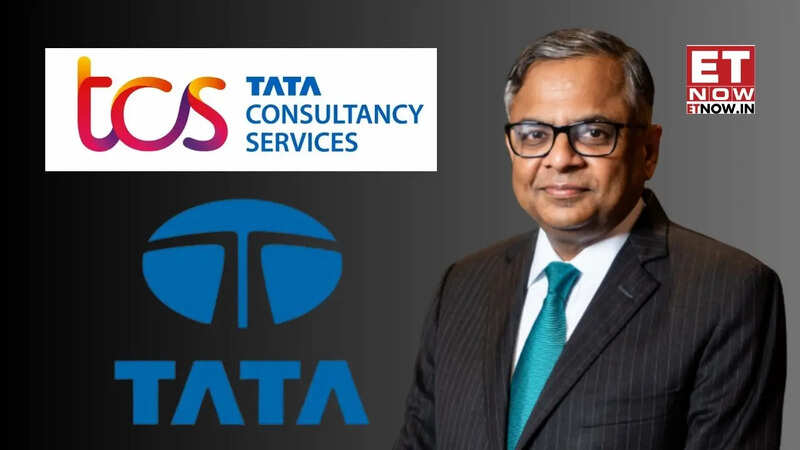
TCS market capitalisation: The stepping down of Natarajan Chandrasekaran as the chairman of Tata Sons has once again put the spotlight on his track record at Tata Consultancy Services, where he served as chief executive officer and managing director from 2009 to 2017.
In the Tata pack, TCS is the most valuable listed company in terms of market capitalisation.
Chandrasekaran’s exit from Tata Sons triggers heavy selling in Tata stocks
After the news of Chandrasekaran’s exit from Tata Sons broke today and the former confirmed that he would not offer himself for reappointment when his current term expires in February 2027, all the Tata Group-back companies’ stocks witnessed heavy selling pressure, plunging up to 5.95 per cent and losing about Rs 46,000 crore in market value.
The shares also witnessed selling pressure as the chairman’s decision raised uncertainty over succession at India’s largest conglomerate.
TCS share price falls by 5.95%
Chandrasekaran took charge of TCS as the Chief Executive Officer (CEO) in October 2009, succeeding S Ramadorai. When he took over, Chandrasekaran (who insisted that everyone call him simply Chandra) was the youngest CEO in the Tata Group’s history, having got the job when he was 45.
Chandra joined TCS at a time when the company had already established itself as a global IT services powerhouse with $6 billion of revenues and margins of 24 per cent.
By the time he moved to Tata Sons in February 2017, the IT giant’s consolidated revenue had grown to $17.6 billion, with a substantially larger global workforce and a market capitalisation that had more than tripled, according to the company’s earnings report for the quarter ended June 30, 2017.
Growth trajectory of Tata Consultancy Services – From $6 billion to $17.6 billion
When Chandrasekaran assumed the role of the top executive in TCS in October 2009, the company reported $6 billion in revenue for the financial year 2028-29 and had more than 140,000 employees. The company had a broad customer base, a global delivery model and operations across 42 countries.
Over the following eight years under the leadership of Chandra, the company’s revenue expanded to $17.58 billion in FY17, implying that the topline nearly tripled during the period. TCS also reported a net profit of $3.92 billion in FY17, while operating profit stood at $4.52 billion.
Apart from the financial figures, its employee base increased from roughly 143,761 at the end of FY2009 to 387,223 across 55 countries by March 2017, representing an increase of nearly 170 per cent in eight years.
TCS market capitalisation crossed Rs 5 trillion in 2017
The transformation in the TCS was not limited to revenues and profits, the company also emerged as one of India’s largest wealth creators during Chandrasekaran’s tenure.
In 2009, TCS’ market capitalisation, with stood Rs 1.468 trillion by the end of the year which rose to Rs 5.153 trillion in 2017, according to a data of Companies Market Cap.
As of August 2026, TCS has a market cap of Rs 8.501 trillion, making it the world’s 282th most valuable company by market valuation, the data revealed.
| End of year market cap | ||
| 2017 | Rs 5.153 trillion | 10.53% |
| 2016 | Rs 4.662 trillion | -2.31% |
| 2015 | Rs 4.773 trillion | -4.75% |
| 2014 | Rs 5.010 trillion | 17.78% |
| 2013 | Rs 4.254 trillion | 73.09% |
| 2012 | Rs 2.457 trillion | 8.41% |
| 2011 | Rs 2.267 trillion | -0.62% |
| 2010 | Rs 2.281 trilion | 55.37% |
| 2009 | Rs 1.468 trillion | 213.98% |
What Chandrasekaran’s TCS legacy means today
Broadly, Chandrasekaran’s legacy at TCS can be characterised by three distinct forces – massive scale, aggressive globalisation and unpresented wealth creation for shareholders.
Taking the helm of a $6-billion global IT services business, Chandra orchestrated a decade-long expansion that transformed the company into a nearly $18-billion technology major.
Besides, its workforce expanded by more than 2.4 lakh people during his tenure, while its market capitalisation increased more than sevenfold during the period.
That era of high-octane growth, however, provided an important contrast to the environment TCS navigates today. It has since grown substantially beyond the scale it has in 2017 but the broader IT services sector is now undergoing a new structural evolution driven by generative AI, automation and changing technology spending patterns.
As the veteran prepares to leave Tata Sons, his track record at TCS stands is one of the strongest triumphs of his executive career.