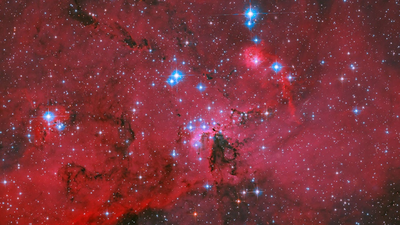
A striking new image released by NASA offers a rare, close up look at one of the busiest star forming regions in a neighbouring galaxy. Captured by the Hubble Space Telescope, the photograph shows brilliant blue and white young stars glowing against a vivid backdrop of crimson hydrogen gas, a scene NASA has compared to fireworks bursting through drifting smoke. The region, known as LH 95, sits inside the Large Magellanic Cloud, a small dwarf galaxy that orbits our own Milky Way at a distance of about 163,000 light years. Within this single stellar nursery, thousands of stars in various stages of formation exist side by side, giving astronomers an unusually clear window into how stars, and eventually planetary systems, come into being.
What makes LH 95 such a rich stellar nursery
LH 95 belongs to a category astronomers call a stellar association, a loosely bound grouping of young stars that formed together from the same collapsing cloud of gas and dust but are not held together tightly enough by gravity to stay clustered forever. According to NASA’s official account of the image, the region hosts low mass infant stars living alongside far more massive blue giant stars, all within the same patch of sky, making it one of many such associations scattered across the Large Magellanic Cloud. What gives the image its distinctive glow is the interaction between these stars and the surrounding hydrogen gas, the most massive stars in the region carry at least three times the mass of the sun and pump out intense ultraviolet radiation along with powerful stellar winds, both of which heat the surrounding gas until it glows a deep crimson red.
Why the colours in the image are not just for show
Every colour visible in the photograph carries real scientific meaning rather than being added purely for visual effect. Hubble’s filters capture light across a range of wavelengths, and in this image blue represents the shorter wavelengths of visible light while red represents longer visible wavelengths along with some near infrared light. Because a star’s colour is closely tied to its surface temperature, this means the brightest blue stars scattered across the frame are also the hottest and most massive objects in the region, while the fainter, redder tones come from cooler gas and dust rather than from the stars themselves. Dark, thread like filaments cutting across the glowing background mark denser lanes of dust that have so far resisted being eroded away by the intense radiation streaming out from the region’s biggest stars.
Thousands of stars still in the process of forming
Beyond its visual impact, the image carries genuine scientific weight because of just how many developing stars it captures in a single frame. According to a detailed report on the discovery, LH 95 contains approximately 2,500 pre-main-sequence stars, meaning stars that have already gathered nearly all of the mass they will ever have but have not yet become hot enough at their core to begin burning hydrogen. By studying these stars individually, astronomers confirmed that the rate at which a young star pulls in surrounding material naturally slows down as the star ages, and they also found that this process of gathering mass can continue for several million years, considerably longer than some earlier scientific models had predicted.
How this helps scientists understand planet formation too
Because young stars gather mass from surrounding discs of gas and dust, and these same discs often go on to form planets once the star itself has finished developing, studying regions like LH 95 offers scientists insight that extends well beyond the stars themselves. Watching how material moves through and eventually depletes from these discs helps researchers build a clearer picture of how planetary systems, potentially including ones similar to our own solar system, gradually take shape around a newly formed star. Every additional observation of a stellar nursery this rich in young, actively forming stars adds another piece to that broader puzzle of how solar systems across the universe eventually come into existence.
A stellar nursery unusually easy to study
Part of what makes LH 95 such a valuable target for astronomers is simply how clearly they can see into it. The region combines an enormous population of young stars with comparatively low levels of obscuring dust when set against similar star forming regions found within our own Milky Way, giving researchers an unusually unobstructed view of stars at many different stages of development all at once. Scientists have also found evidence that star formation within LH 95 did not happen in one single burst, but has instead continued in overlapping waves over an extended period of time, with newer generations of stars likely triggered by the radiation and stellar winds released by older stars that formed earlier in the same region. This layered history makes LH 95 a particularly useful natural laboratory for reconstructing exactly how star formation unfolds and repeats within a single stellar nursery.
Why Hubble is still delivering discoveries after three decades
The new image is also a reminder of just how much scientific value the Hubble Space Telescope continues to deliver more than three decades after its 1990 launch. Hubble’s observations today are increasingly paired with data from newer missions, including the infrared focused James Webb Space Telescope, and its findings will soon be complemented further by NASA’s upcoming Nancy Grace Roman Space Telescope, expected to launch later this year. Together, these overlapping missions are giving astronomers a steadily more complete picture of how stars are born, grow and eventually shape the galaxies around them, with regions like LH 95 continuing to serve as some of the clearest windows available into that entire process.