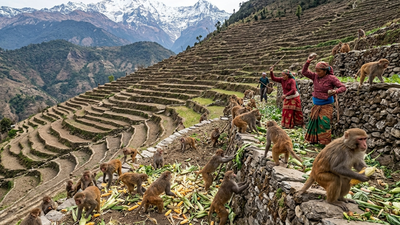
Nepal’s mid-hills are places where farming has long meant working with the landscape rather than against it. Terraces cut into steep slopes turn difficult ground into fields for maize, millet, rice and other crops, with generations of farmers maintaining the walls and soil that make cultivation possible. But the balance between people, farmland and wildlife is becoming harder to manage. Rhesus macaques increasingly venture into cultivated fields, sometimes arriving in large troops and stripping crops that households depend on for food and income. Other animals, including wild boars and Indian crested porcupines, add to the damage.For farmers already dealing with labour shortages and the gradual departure of younger residents, protecting a harvest can demand hours of constant vigilance. Across the hills, wildlife recovery and rural change are colliding in an increasingly difficult question: how can farming communities continue to survive alongside growing animal populations?
Nepal’s hillside farms are caught between wildlife and survival
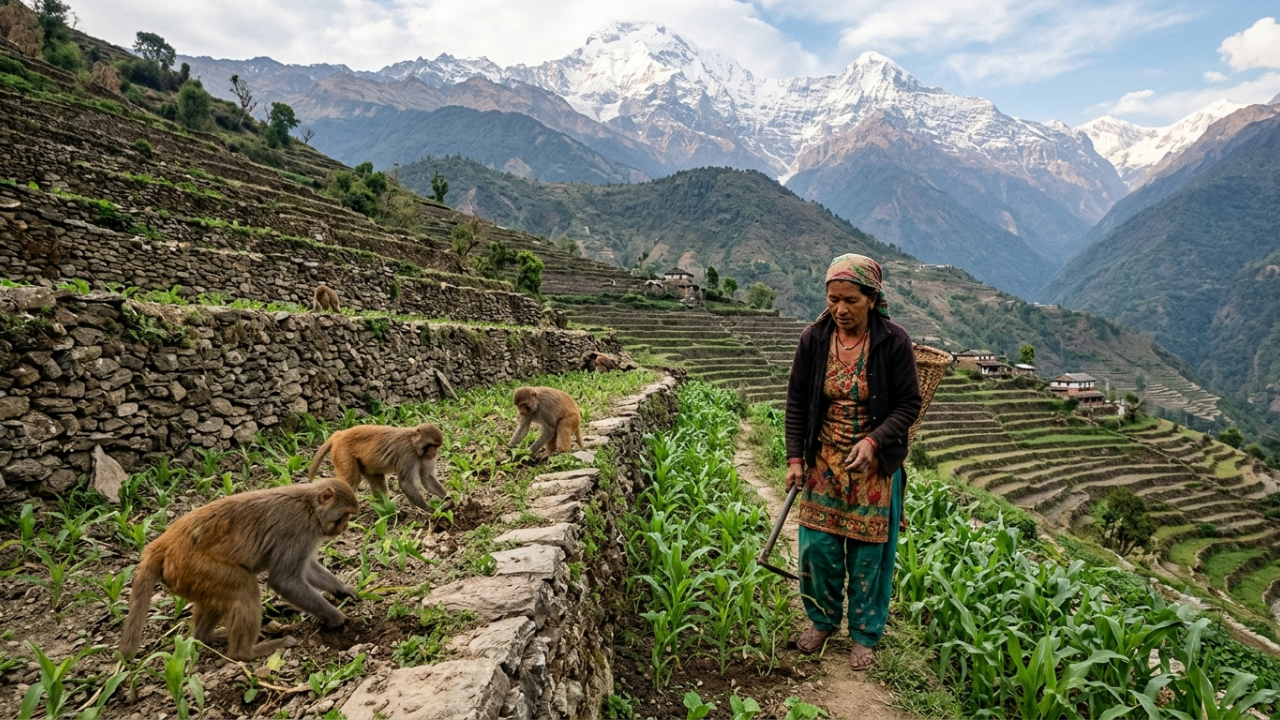
Nepal’s mid-hills are a landscape shaped by farming. Terraces climb slopes where flat ground is scarce, their walls helping retain soil and water during heavy seasonal rains. Maize, millet and rice remain important crops, alongside legumes, potatoes and other food grown according to local conditions.Wild animals have always lived around these settlements. What has changed in some places is how closely their feeding grounds now overlap with cultivated land.Rhesus macaques are among the most persistent visitors. Troops can contain hundreds of animals, and their raids often take place while people are working in the fields. Farmers use slings, sticks and improvised noise-making devices to chase them away. Once darkness arrives, the problem does not necessarily stop. Indian crested porcupines move through fields at night, while wild boars root through crops and disturb the ground.For a household relying on its own harvest, losing a section of maize is not simply a nuisance. It can mean less food stored for the coming months and less produce available to sell.
More than 100,000 macaques are estimated across Nepal’s mid-hills
A count carried out by Nepal’s National Trust for Nature Conservation recorded 20,395 rhesus macaques in 44 areas where conflicts with farmers were considered particularly serious. When the wider mid-hill landscape was considered, the organisation estimated that the population could exceed 104,000 animals.According to the study published in American Journal of Primatology, titled ‘The Crop Feeding Behavior of Rhesus Macaques in a Forest-Farm Mosaic in Central Nepal: Implications for Human–Wildlife Coexistence’ reveals wild macaques in central Nepal estimated that cultivated crops account for about 49% of their annual diet. Farmland is therefore not merely an occasional source of food when forest resources are scarce. For many animals, it has become a regular part of their feeding landscape.The financial figures collected by the NTNC illustrate what that means for farming households. Across 1,846 surveyed households, annual crop losses attributed to wildlife were estimated at around $327,000. The survey also found that households could lose roughly half of their maize harvest to monkey raids.In Palpa district, 85% of 73 randomly selected farmers said wildlife damage had become worse over the preceding five years. The figures vary between communities, but the pattern is difficult to ignore: protecting crops is taking up an increasing share of farmers’ time while the return from cultivation becomes less certain.
Migration is changing who remains to protect the fields
Younger people are leaving rural communities for education, employment and better access to services such as healthcare.That movement has consequences for agriculture. Terraces that once had several people working them may be cultivated less frequently or left unused altogether. A field without someone watching it is easier for animals to enter, particularly where farmland borders woodland or scrub.Research from Mangalsen Municipality in Achham District, titled ‘Community School Education under Threat: The Impact of Monkey and Wild Boar Infestation and Rural Out Migration in Mangalsen Municipality, Nepal’ has linked conflict involving monkeys and wild boars with falling agricultural productivity and increased out-migration. The relationship can work in both directions. Crop losses make farming less attractive, while the departure of working-age residents leaves fewer people available to guard the remaining fields.For older farmers who continue cultivating the land, this can turn wildlife protection into a daily obligation. Someone has to be present when macaques approach. That person cannot be doing another job at the same time.
Farmers are spending hours defending what they grow
In villages affected by macaque raids, crop protection can begin as soon as the animals appear. Farmers watch the edges of their fields and attempt to frighten the troops away before they reach the crop.The effort is repetitive. A group can retreat from one field and appear in another, requiring farmers to move with it. At night, the tactics are of limited use against porcupines, which are active when the people who might chase them away are no longer outside.Some communities have responded in much more harmful ways. The NTNC has documented cases involving mass drownings and high-voltage traps. Such measures reflect the level of frustration surrounding repeated losses, but they also create additional risks for wildlife and people.There is a less visible problem, too. Nepal has a compensation system intended to help farmers affected by wildlife damage, but the NTNC reported that around 80% of affected farmers did not know they were eligible to claim compensation.
An old forestry decision may have added to the pressure
The search for an explanation has also taken researchers beyond the fields themselves.Sabina Koirala, a PhD researcher studying human-monkey conflict, has suggested that Nepal’s reforestation policies from the 1970s may be part of the story. Large areas were planted with fast-growing Australian pine as part of efforts to increase forest cover.Those plantations helped expand tree cover, but pine does not provide macaques with the same range of edible resources as a more diverse native forest. Koirala has proposed that the changing composition of the forest may have left macaques with fewer natural food options, encouraging them to make greater use of nearby farmland.Wildlife movements are shaped by several factors, including food availability, habitat change, human activity and local population dynamics. Still, it points to an important distinction: increasing tree cover does not necessarily mean that every kind of forest provides the same ecological resources.
Native trees could offer an alternative food source
One possible response is to change what is available on the forest side of the boundary.Koirala has suggested enriching habitats with native fruit-bearing trees so that macaques have more natural food available before they reach cultivated fields. The idea is relatively straightforward, although its effectiveness at the scale required remains uncertain.Other measures are also being considered. Government discussions have included crops that are less attractive to wildlife, community patrols and better access to compensation. Each approach addresses a different part of the problem, and none is likely to remove the need for local management.The difficulty is that much of the existing evidence comes from individual communities or relatively small studies. There is still limited large-scale evidence showing which combinations of measures consistently reduce crop losses across Nepal’s diverse mid-hill landscapes.