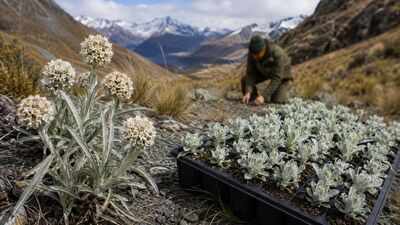
On the dry plains of Central Otago, a small native herb has been given another chance to survive in the wild. Craspedia argentea, a woollyhead found only around the Pisa Flats, had dwindled to just two known plants. By then, even the ordinary business of pollination had become difficult. There were simply too few plants left for the population to function as it once had. Conservationists stepped in, collecting the tiny amount of seed they could find and beginning a careful programme of hand-pollination and propagation. According to Radio New Zealand (RNZ), two years of work at Dunedin Botanic Garden have now produced hundreds of young plants. About 250 seedlings are being returned to Mahaka Katia Scientific Reserve, where their next challenge will be surviving without the protection of a nursery.
New Zealand’s rare dryland plant was running out of chances to survive
Craspedia argentea belongs to the dryland flora of Central Otago, a region known for its sparse vegetation, harsh conditions and wide open landscapes. The plant is endemic to the Pisa Flats, meaning its natural range is confined to this particular part of New Zealand. That makes the loss of a local population especially serious. There is no second wild population elsewhere in the country waiting to replenish it.Botanist Geoffrey Rogers has spent much of his career studying the plants of Otago’s drylands. He had seen Craspedia argentea become increasingly scarce, despite the protection offered by the reserve.The problem was not simply a matter of fewer plants appearing each season. As the population shrank, the pollination system that helped the plants reproduce also began to break down. Then came an alarming indication of just how little remained.As reported by Radio New Zealand (RNZ), in one season, conservationists were able to collect only three seeds. Two germinated. Those two plants became the foundation of the recovery effort.
What began with hopes for 20 plants soon produced hundreds of seedlings
For Richard Ewans, a senior technical adviser in ecology with New Zealand’s Department of Conservation, waiting for the species to recover naturally was no longer a realistic option.Richard said, “We’ve been really concerned about this plant disappearing…. so we knew we had to intervene and start a programme of breeding.”The conservation team began a breeding programme, with the aim of producing enough plants to eventually put back into the reserve. It was delicate work. Flowers had to be pollinated by hand, seeds collected and seedlings raised under controlled conditions. The Dunedin Botanic Garden became an important part of that process, with staff spending about two years working out how to produce healthy plants in useful numbers.At first, the expectations were modest. The team thought it might eventually have 20 or 30 plants ready to move back into the wild. Instead, the propagation effort produced far more. About 800 seeds were obtained in the first season, and those seeds produced roughly 300 seedlings. For a plant whose wild population had once been reduced to two known individuals, the change was substantial.
For conservationists, keeping hundreds of seedlings alive was the next challenge
Getting seeds to germinate was only the beginning. The young woollyheads needed to be kept alive and grown to a size where they had a reasonable chance of coping with life outside cultivation. Staff at Dunedin Botanic Garden spent years caring for the plants, collecting further seed and storing it for future use. Jess Freeman, an apprentice at the garden, was among those involved.There was plenty of routine work behind the scenes: watering the seedlings, monitoring their development, collecting seed and keeping it safely stored. The plants might have looked like ordinary young specimens in a nursery, but each one represented another possible step towards rebuilding a wild population. Botanist Tom Myers also became closely involved with the species.For him, growing Craspedia argentea offered a closer connection with the Central Otago habitat where it naturally belongs. The plant is adapted to that particular dry environment, and getting it from a protected growing space back into that setting presented a different set of problems.The conservationists were beginning to learn how to grow the species reliably. That knowledge could prove as valuable as the seedlings themselves.
About 250 seedlings are now back in the reserve
Around 250 Craspedia argentea seedlings are being planted at Mahaka Katia Scientific Reserve. For the conservation team, this is an important moment, but it is not the end of the rescue programme. The seedlings still have to establish themselves.They will be monitored closely through winter, with conservation staff making monthly visits to check how they are progressing. A trail camera will provide additional information about what happens at the site between visits.The first major hurdle will be getting the young plants through their initial period in the wild. They need to develop strong roots and withstand the conditions of Central Otago before facing their first summer there.
The woollyhead has numbers again, but survival is far from guaranteed
Putting hundreds of seedlings into the reserve gives the species something it has lacked for years: numbers. A larger population means more opportunities for plants to flower at the same time and exchange pollen. If the seedlings mature successfully and begin producing seed, that could provide the raw material for further propagation and future plantings.The process could then become less dependent on those original two wild plants. That is one of the most significant changes brought about by the work. The conservation team has not merely protected a handful of surviving specimens. It has learned how to multiply the species.But there is still a long way to go before Craspedia argentea can be considered secure. The plants must survive in the reserve, reproduce and establish themselves over time. A successful conservation breeding programme ultimately has to lead back to a self-sustaining wild population.
From the brink of extinction, 250 seedlings are getting a chance to survive
The recovery of Craspedia argentea began from an extraordinarily narrow starting point.Three seeds were collected in one season. Two germinated. From those two plants came the next generations, raised through careful propagation and hand-pollination. Now, around 250 seedlings are being returned to the reserve.Their future will depend on what happens once the nursery care stops. They will have to cope with the weather, establish roots, flower and eventually reproduce in the same dryland environment that their species has occupied for generations.