
Ramachandran said the company remains on track to bring its combined ratio below 100% by 2028-29 (FY29), supported largely by operating leverage as the renewal book expands and acquisition costs decline over time. He added that the transition to Ind AS accounting standards will provide a better reflection of the company’s economic value and profitability trajectory.
Watch the full conversation here or scroll for edited excerpts.
For the January-March quarter of 2026 (Q4FY26), Niva Bupa Health Insurance reported a 38.5% year-on-year rise in gross premium written at ₹2,880 crore, while net premium written increased 37.7% to ₹2,302 crore. Net premium earned grew 29.1% to ₹1,972 crore, and total income rose 32.8% to ₹2,078 crore.
The company also saw a sharp improvement in profitability during the quarter. Underwriting profit more than tripled to ₹177 crore from ₹58 crore a year ago, while operating profit jumped nearly 198% to ₹283 crore. Net profit rose 67.5% year-on-year to ₹345 crore.
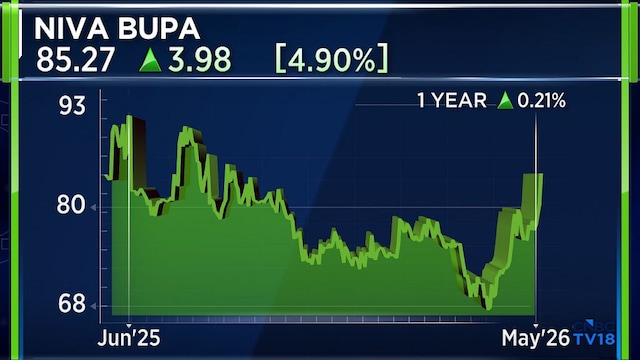
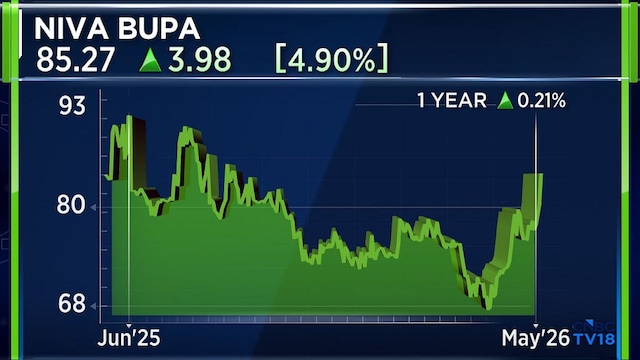
Niva Bupa Health Insurance currently has a market capitalisation of around ₹15,858.57 crore. The stock has gained nearly 2% over the past year.
This is an edited transcript of the interview.Q: What led to the outperformance that we saw in quarter four and for this year? If you could also give us guidance on two to three parameters you are targeting for the coming year.
A: Rather than speaking specifically about quarter four, I would say any business is a continuity, and we look at our business not in quarters but over longer periods of time. Quarter four is really the outcome of strategies that we have been consistently executing.
That includes our focus on product innovation, being a partner in healthcare journeys, emphasis on multi-channel distribution, technology and analytics, talent and so on. So, it is really the steady focus on these inputs that drives our ongoing performance.
Also Read | Bernstein prefers Axis and HDFC Bank, says SBI margin dip temporary but PSU banks story is fading
Quarter four also saw some tailwinds from GST; in fact, both Q3 and Q4 did. But there is nothing specific about Q4 in isolation — it is the outcome of the consistent execution of our long-term strategy.
Q: Let’s focus on a couple of numbers. What are the initial trends on gross written premium as well as net earned premium at the start of the fiscal year, and what guidance would you give for FY27?
A: In terms of guidance, I prefer to talk in slightly longer-term terms rather than annually. Consistent with what we have said earlier, we believe we will continue to grow 5–8 percentage points faster than the market.
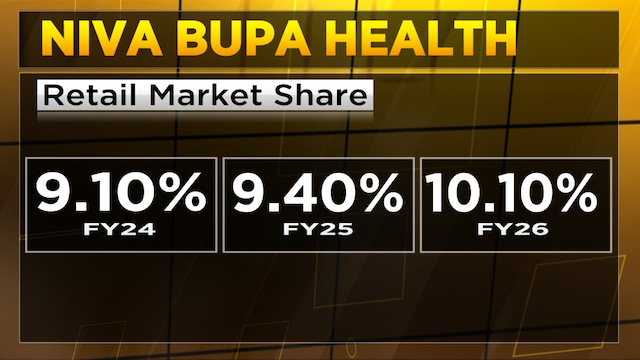
We expect that retail health insurance, which is a major focus area for the company, will continue to grow at around 17–18%. In that context, our own growth trajectory over five years would broadly be between 23% and 25%.
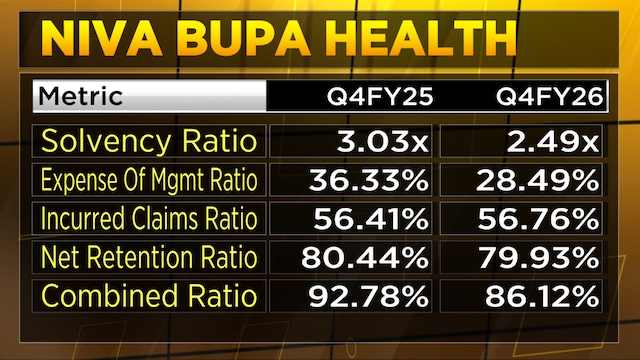 Q: You are also looking to bring down your combined ratio, which currently stands at 101.4%, to below 100% by 2028-29 (FY29). How will that happen?
A: That’s absolutely right. The numbers you are quoting are on an International Financial Reporting Standards (IFRS) or Indian Accounting Standards (Ind AS) basis.
The good news is that Ind AS has now been notified by Insurance Regulatory and Development Authority of India (IRDAI), and we, along with several other companies, will move to the Indian equivalent of IFRS 17. Our guidance of a 98–99% combined ratio by FY29 remains intact. That translates into a mid-teen to high-teen return on equity.
We are very much on course to get there. The biggest lever will clearly be operating leverage. As we get larger as a company, renewal-related costs fall significantly. That, along with operational expense management through technology and AI, will help improve profitability. But operating leverage will be the key driver.
Q: A quick word on the proposed distribution regulations. We understand a comprehensive discussion paper may come out by the end of the month. What are the one or two most consequential things from the industry’s perspective?
A: I would make two comments. One, I believe, the single limit on the expenses of management has been a transformational reform. From our perspective as a company, there should be continuity on that front, and reforms should build further on it.
Also Read | Fed cuts may come only by year-end; markets pricing in a US-Iran deal: Ned Davis strategist
Second, whatever the regulator does, I am confident it will keep the interests of all stakeholders in mind. As the IRDAI chairman has repeatedly said publicly, the process will be gradual and not disruptive, while keeping policyholders’ interests at the centre.
 Q: Could the new framework become effort-based?
A: To be honest, I am not aware of the internal discussions within the authority, so I would not be qualified to comment on that.
Catch all the latest updates from the stock market here