
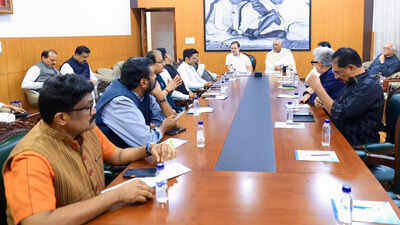
NEW DELHI: The INDIA bloc on Saturday put forward three key demands on the proposed delimitation exercise, calling for the existing strength of the Lok Sabha to be maintained, women’s reservation to be implemented within the current House strength and the allocation of seats among states to remain unchanged for the next 25 years.The demands were outlined by the Congress after a meeting of INDIA bloc floor leaders at the residence of party president and Leader of Opposition in the Rajya Sabha, Mallikarjun Kharge, in New Delhi. Leader of Opposition in the Lok Sabha Rahul Gandhi and several other Opposition leaders attended the meeting to discuss the proposed legislation and formulate a joint strategy ahead of the special session of Parliament beginning November 30.In a post on X, the Congress said the proposed delimitation Bill was discussed at the meeting and reiterated the Opposition’s position on the exercise.“Our clear demands are: The current strength of the Lok Sabha should be maintained; Women’s reservation should be provided based on the current strength of the Lok Sabha; The current allocation of seats among states in the Lok Sabha should be maintained for the next 25 years,” the party said.\Addressing a press conference after the meeting, Kharge said the government was now aiming for “800 paar” by proposing to increase the Lok Sabha’s strength to 850, after its earlier electoral slogan of “400 paar” had fallen by the wayside. He alleged that the move was intended to help the ruling party seize and retain power indefinitely.Kharge also accused the government of disregarding the interests of Scheduled Castes (SCs) and Scheduled Tribes (STs) in the proposed amendment. He said the number of seats reserved for these communities in each state should be proportionate to their population and argued that the proposed legislation made no provision for increasing the number of SC-reserved seats.“Furthermore, the interests of the Scheduled Castes (SC) and Scheduled Tribes (ST) have been completely disregarded; this is an act of injustice… The number of seats reserved for SCs and STs in any given state must be proportional to their respective populations within that state. Consequently, the number of seats reserved for the Scheduled Castes should increase; however, there is no provision for this in the proposed amendment,” he said.Pointing to the upcoming 2026 Census, Kharge questioned why the government had remained silent on using the latest population data for the exercise. He alleged that relying on the latest Census figures would increase the number of seats reserved for SCs and STs in line with their population, but the proposed amendment appeared aimed at denying these communities their “rightful share”.Among those who attended the meeting were Congress leaders Priyanka Gandhi Vadra, Pawan Khera, KC Venugopal, Syed Nasir Hussain, Pramod Tiwari and Gaurav Gogoi, besides Trinamool Congress MPs Abhishek Banerjee and Derek O’Brien.CPI(M) leader A. Rahim, Rashtriya Samaj Party MP N K Premachandran, National Conference leader Chowdry Mohammad Ramzan, Rashtriya Janata Dal leaders Abhay Kushwaha and Manoj Jha, Samajwadi Party MP Ramji Lal Suman and Indian Union Muslim League leader E T Mohammed Basheer were also present.Shiv Sena (UBT) leader Arvind Sawant, Jharkhand Mukti Morcha leader Baidyanath Ram, who joined online, CPI leader P. Santosh and Independent MP Kapil Sibal attended the meeting. A VCK leader could not participate due to a wedding at his residence.The Nationalist Congress Party-Sharadchandra Pawar (NCP-SP), which has indicated support for the revised delimitation proposals, was absent. The DMK, which has also backed the revised proposals subject to safeguards for Tamil Nadu’s representation, did not attend either.The meeting comes amid differences within the Opposition over the proposed legislation. While some regional parties have indicated support for the revised proposals, others have raised concerns about their impact on the representation of states.The ruling National Democratic Alliance (NDA), meanwhile, has received a boost after the DMK and NCP-SP indicated support for the revised proposals. The two parties together have 30 Lok Sabha MPs, potentially taking the alliance’s estimated strength from around 320 to 350.The DMK, which has 22 Lok Sabha MPs, has backed the proposed 50 per cent increase in parliamentary seats across states but has insisted that Tamil Nadu’s existing 7.18 per cent share should not be reduced. DMK MP A Raja has said the party would seek amendments to other provisions if necessary.The NCP-SP, which has eight Lok Sabha MPs, has also indicated support for the revised proposals. Party leader Jitendra Awhad said on Friday that the party had decided to back the delimitation process, describing it as a constitutional requirement. The party had opposed the earlier Bill introduced in April but said it would support the fresh proposal if it provided for a uniform 50 per cent increase in seats.The BJP is confident of securing the required two-thirds majority, banking on support from some parties that opposed the earlier Bill and possible backing from Trinamool Congress MPs who may break ranks.The government would need 360 votes if all 540 sitting members participated in the voting. However, the actual two-thirds threshold would depend on the number of members present and voting. A separate requirement of a majority of the House’s total membership would also apply.The Lok Sabha currently has 540 sitting members and three vacancies. If Trinamool Congress MP Kalyan Banerjee’s suspension remains in force, 539 members, including the Speaker, could attend the proceedings. The Bill would require 359 votes if all 538 members other than the Speaker voted. The threshold would fall if some members were absent.The Union Cabinet has cleared three revised draft legislations: the Constitution (132nd Amendment) Bill, 2026, the Delimitation (Second) Bill, 2026, and a proposed amendment to laws governing Union Territories. The Bills are scheduled to be taken up during the special session of Parliament beginning November 30.
Share your thoughts in the comments
Be respectful · TOI community guidelines
The proposed legislative package provides for a 50 per cent increase in the number of Lok Sabha seats allocated to every state and Union Territory, along with a corresponding increase in the strength of state legislative assemblies. It is also intended to facilitate the implementation of the Nari Shakti Vandan Adhiniyam, which provides for 33 per cent reservation for women in the Lok Sabha and state assemblies.The Opposition has backed women’s reservation but objected to linking its implementation with delimitation. It has also called for the exercise to be based on the latest Census data.Under the Centre’s proposal, the 2011 Census would be used for redrawing constituencies and determining seats reserved for Scheduled Castes and Scheduled Tribes, while the 1971 population basis for allocating Lok Sabha seats among states would be retained until 2051.