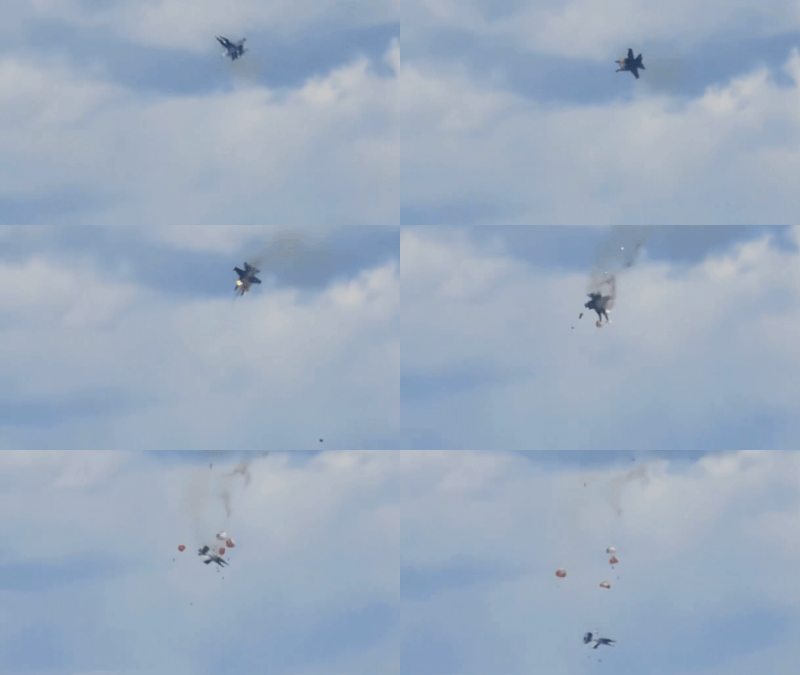
The mid-air collision of two US Navy E/A-18 Growlers of the Electronic Attack Squadron 129 present us with the dangers of low level display flying. One of the most important dictums of aviation is ‘fly high, fly safe’. A low level flying display such as the one in which the two Growlers collided, while performing at the during the Gunfighter Skies Air Show in Mountain Home Air Force Base in the United States, is the exact opposite of a safe flying environment.Air displays are performed at extremely low levels, this reduces the reaction time for the pilots. Air Marshal Diptendu Choudhury (retired), a former fighter pilot who has commanded the (Indian Air Force‘s equivalent of the famed Top Gun School) Tactics and Air Combat Development Establishment (TACDE) and has also ejected from a MiG-21, says “A fighter aircraft performing at low level could be flying a 100 feet off the ground and at speeds of 250 meters per second, the reaction time in such situations is minimal, sometimes less than a second”.With very high performance fighters performing dazzling aerial displays means that there is no margin for errors. Although over the years, especially after the Ramstein Air Show disaster in 1988, many restrictions have been imposed with relations to spectators and aircraft ensuring safety for those on the ground, pilots, as seen in this most recent incident still risk it all in these jaw-dropping displays.Low-level displays are normally a show of the capabilities of the aircraft and the skills of the pilot, but this particular airshow was an advertisement for the ejection seat. It took 8 seconds, from collision to the deployment of the parachutes and more impressively these seats were able to deliver with the last of the four parachutes deploying within four seconds of the initiation of the first ejection from the two planes.Air Marshal Anil Chopra (retired), who commanded India’s test pilot school the prestigious Aircraft & Systems Testing Establishment (ASTE) and ejected from a Mirage-2000 at the age of 59, just shy of his retirement says “The most important thing in a critical situation is to act quickly, there is no time for indecision”.
Working of an ejection seat
Once the ‘handle is pulled’ an explosive cartridge is fired that propels the seat upward along guide rails. As the seat starts ascending, leg restraints automatically secure the pilot’s legs to prevent injury from debris or entanglement. An underseat rocket motor then provides additional thrust, lifting the pilot to a safe altitude within human physiological limits. Before this sequence, the canopy or hatch must be cleared using explosive bolts, detonating cords, or hatches, ensuring an unobstructed escape path.Once clear of the cockpit, many seats, such as the ACES II, employ a secondary rocket motor to boost the pilot another 100–200 feet, allowing clearance of the aircraft’s tail. Outside the aircraft, a drogue gun deploys a small stabilizing parachute to slow and steady the descent. After a timed delay, an altitude sensor triggers deployment of the main parachute from the chute pack. At this stage, a separation motor detaches the seat, leaving the pilot to descend under the main canopy. The entire sequence is designed to maximise survival chances while minimising risk of injury.Air Marshal Chopra states, “Although the entire process takes less than three seconds, it feels like it has taken much longer, all I could see was stars. Once the chute deploys, there is a feeling of joy. As you descend, the world looks beautiful. There is a feeling of being alive.”
The risks of ejecting
The ejection from an aircraft is a traumatic experience. A pilot who has just ‘pulled the handle’ experiences 20-30 Gs, this means experiencing the force of 20-30 the body weight. The risk of spinal injury that can end flying careers is significant. Air Marshall Chaudhry suffered three compression fractures and lost a centimeter in height. “The air force owes me a centimeter” he said jokingly. Air Marshal Chopra suffered a shoulder injury as he had not secured an arm. An unsecure arm or leg can flail around as the pilot leaves the aircraft and encounters wind speeds of hundreds of kilometers per hour.Both Air Marshals described the ejection of the four pilots a miracle. As the E/A-18s collided and became entwined, the ejection seats had unobstructed exit paths. Post collision both airframes were in a state and altitude, so that the pilots could eject and had time for their canopies to open. Had the aircraft had a different orientation, the results could have been different. “Training and survival instinct” is what saved the day said Air Marshal Chaudhry.