
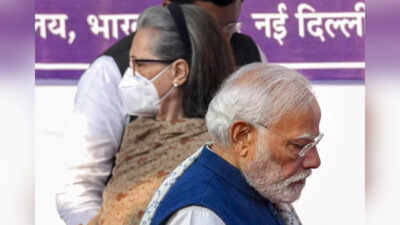
NEW DELHI: Former Congress president Sonia Gandhi, in her memoir, has said that she has had “practically no real contact” with Prime Minister Narendra Modi, despite his more than 12 years in office. She writes that PM Modi tends to look away and avoid eye contact when they come face-to-face.In her memoir, Belonging: A Journey of Love, Sonia Gandhi said their interactions were largely limited to formal greetings at official gatherings and brief exchanges about her health.Describing their occasional encounters, Sonia said they usually meet at semi-official gatherings, such as the meetings of major political party leaders in the Speaker’s chamber at the end of Parliament sessions.“It’s a very small room, and usually many people are present, but when he comes face-to-face with me, we greet each other with a formal namaste. This is different from the past, when leaders across party divides would treat one another with cordiality. He tends to look away, avoiding eye contact,” she wrote.Sonia Gandhi recalled that PM Modi had occasionally enquired about her health after she returned from a hospital stay.He asked, “Theek hain aap?” to which she would reply, “Jee, ab main theek hoon, shukriya.”“Apart from such brief exchanges, we have never really conversed, though we’ve exchanged formal birthday and New Year greetings over the years,” she added.‘We come from different ideological worlds’Sonia Gandhi said her limited interaction with PM Modi was also set against a wider ideological divide between the two leaders. She described their political rivalry as a contest between contrasting visions of India, rather than a personal feud.“We come from different ideological worlds; his idea of this country is vastly different from mine,” she wrote.Explaining the difference, Sonia said, “All I learnt about India was assimilated from the members of my family, their lives of service, and their faith in a nation that encompassed a host of races and cultures, languages and faiths, based on principles of liberty and equality for all.”On the contrary, she said PM Modi’s vision of India was shaped by the RSS and his upbringing.“Narendra Modi’s idea of India was constructed by the ideologues of the RSS and the experience of his own growing up. It affirmed a fundamentalism in which his faith and culture superseded all others. In that India, hierarchy, order, and control are central.”Sonia said she stood for an India based on inclusiveness, secularism and social justice.“He was fighting for his vision of India, and I for mine: an India against hegemony, an India that stands for inclusiveness, secularism, and social justice. It wasn’t personal,” she wrote.Sonia Gandhi on PM Modi’s rise within the RSSSonia acknowledged that PM Modi had worked his way up within the RSS from an underprivileged background. However, she questioned the way his humble origins had been portrayed by his public relations team.“Modi’s origins may not have been as humble as his PR team has made out in marketing his image, but he had certainly worked his way to power within the RSS from an underprivileged world,” she wrote.She also said PM Modi’s political journey had been very different from hers. However, she found herself able to understand some of his discomfort with the ruling elite.Recalling her own experiences in Delhi’s political circles, Sonia Gandhi said she often felt out of place during discussions in privileged drawing rooms. The views expressed there, she said, were far removed from the realities of ordinary Indians.She added that the suffering and struggle for survival she had witnessed in her constituency and during her travels across the country were unimaginable to this privileged group.‘Coarse language’ and attacks on opposition in ParliamentSonia Gandhi also criticised PM Modi’s language in Parliament, alleging that he sometimes uses the same coarse language he employs at public rallies.“When speaking in Parliament, he at times uses the same coarse language he employs in addressing a public rally. Much of the time he derides the opposition in what can only be termed a tirade,” she wrote.She also accused the BJP of repeatedly targeting India’s first prime minister, Jawaharlal Nehru, for establishing the country’s democratic and secular foundations.“Jawaharlal Nehru, our first prime minister, is a particular target of his party’s hostility, for having set our country on a democratic and secular course,” Sonia wrote.She further alleged that Sangh Parivar websites were filled with malicious abuse and falsehoods against Nehru.‘Congress-free India’: Sonia on BJP’s opposition to CongressSonia Gandhi described the BJP’s stated goal of a “Congress-free India” as an attempt to eliminate not just the party but also its policies and ideology.She said she believed the hostility towards Congress stemmed from the prime minister’s conditioning by the RSS.“I tend to believe that this antipathy stems from the conditioning of the prime minister by the RSS. It has inculcated in its cadre a commitment to an exclusionary, hardened version of Hinduism that has been crafted into a political agenda,” she wrote.Sonia Gandhi recalls 2002 Gujarat riotsSonia Gandhi also revisited the 2002 Gujarat riots, which took place when PM Modi was the state’s chief minister.Recalling the violence that followed the Godhra train tragedy, she said the Sabarmati Express was returning to Ahmedabad from Ayodhya with Hindu kar sevaks when four coaches caught fire. Fifty-nine pilgrims were killed. She noted that the cause of the fire remained disputed, while the communal violence that followed spread to several parts of Gujarat and claimed predominantly Muslim victims.“When I was leader of the opposition in Parliament, I met the victims of many tragedies, and each time I was haunted by the misery I had witnessed,” she wrote.She recalled watching television reports of the violence and trying to reach Congress colleagues in Gujarat who were seeking help.“We watched the live reports in horror, and tried to get help to our colleagues in Gujarat who were calling us in desperation, but the administration failed to respond,” she wrote.Sonia Gandhi said the riots were reported to have been fuelled by a fanatical fringe of the BJP and RSS, including the Bajrang Dal. PM Modi was the chief minister of Gujarat at the time.Sonia Gandhi on her understanding of Hinduism and faithSonia also contrasted the RSS’s political interpretation of Hinduism with the inclusive understanding of faith she said she had learnt from her mother-in-law.She described this understanding as one that embraced different beliefs and paths, without being tied to a single deity, dogma, prophet or scripture.“What I learnt from my mother-in-law is the faith that’s been practised for centuries in India by vast numbers of our people — from stalwarts of the freedom struggle to the poorest in our villages. It embraces diverse beliefs and different paths, adheres to no single deity, dogma, prophet, or scripture, and has included traditions of dissent,” she wrote.
Share your thoughts in the comments
Be respectful · TOI community guidelines
She added that she had been educated in the principles of ahimsa and dharma as interpreted by Mahatma Gandhi. She also acknowledged the oppression and inequality associated with India’s caste system, while pointing out that reformers had used ideas within Hinduism to challenge caste discrimination.