
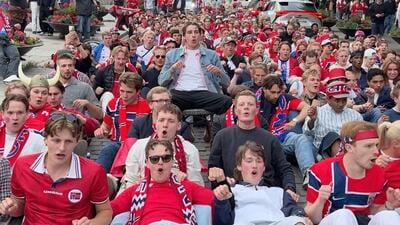
Kolkata: Seated in a Viking longboat formation in front of the goal post with the Metlife Stadium grandstand teeming with red-adorned supporters rising above their eyeline, Norway’s footballers and staff patiently waited for the first beat of the drum.
Then came the motion – arms thrust forward, bodies moving in rhythm, as if they were pulling invisible oars through icy northern waters. With each synchronised row, the crowd roared louder, making it one of the most spontaneous and organic displays of solidarity, celebration and strength in recent World Cup history.
Before this, Norway’s supporters had taken over Times Square, and an escalator at Boston. But this felt different. “I saw it online; it’s gone completely viral,” Erling Haaland, who scored twice in the 3-2 win over Senegal, told Fox Sports. “(Skipper) Martin (Odegaard) asked me before the game: ‘Do you think we should join in?’ I said, ‘If we win, let’s do it, why not?’”
It’s easy to label the Viking Row as yet another social media fuelled spectacle, a “gimmick” even, as Norway manager Stale Solbakken was later quoted as saying. Yet the image of thousands moving in unison, as if powering a Viking longship through rough seas, reveals something deeper about the psychology of the modern sports fan. Like Iceland’s iconic Thunderclap – remember Euro 2016? – or New Zealand’s haka, the Viking Row is not merely a celebration of identity, but a ritual of belonging.
The Norway squad after all had left home after a photo shoot in full Viking gear by renowned British photographer David Yarrow named “The Vikings are Coming” that went viral.
The appeal of the Viking Row lies in its symbolism as well. Fans and players rowing in unison makes this a ritual that transforms spectators into participants and players into representatives of a larger collective identity. Recreating the act in the stands and on the pitch, Norway’s supporters and players announce a shared story: we advance together, we lose together.
Pretty much the same sentiment that makes English football clubs adopt different songs for supportive chanting. Once nothing more than terrace tunes, these chants needed a makeover after travelling to other cities to support their teams became easier post World War 2. Consequently, songs like “You’ll Never Walk Alone” or “Glory, Glory”, which are now synonymous with some of the biggest English clubs, emerged.
A synchronised act like the Viking Row however tends to blur the line between the footballer and the spectator – a welcome break in a world where athletes are separated from fans by wealth and security barriers. It was reminiscent of the hair-raising “Thunderclap” by Iceland at the 2016 European Championship where players and thousands of supporters raise their arms before bringing them together in a synchronised clap, punctuated by a guttural cry. It inspired many spinoffs, most notably in Indian football where Bengaluru FC supporters make it a point to welcome their team with a similar ritual.
The Thunderclap and the Viking Row are fairly recent supporter traditions drawing inspiration from their respective cultures. But nowhere is the connection between history and sport deeper than the New Zealand rugby team’s haka. A pre-match ritual that predates modern sport by centuries, the haka commands silence as the All Blacks stomp, chant and glare into their opponents’ eyes, every movement carrying the weight of history and the generations of rugby they represent. To really understand how the haka transcends sports and culture, watch the “Ka Mate” version, or better, the “Kapa O Pango” haka performed at the 2011 Rugby World Cup final when the entire stadium fell silent before cheering every line as the French team marched in an arrowhead formation to lock themselves in a dramatic standoff with New Zealand.
Of course, who can forget the “Mexican Wave” created by fans at venues of the 1986 World Cup, which captivated global audience and spawned its eddies around major sports events.
Spectacles like these explain why sporting rituals continue to flourish. They offer a shared emotional experience between players and fans that many mediums no longer can ensure, a moment of oneness that will forever remain.
The expression might vary – a rowing motion in Norway, a clap in Iceland, or a haka in New Zealand. But the underlying message remains remarkably consistent: they are always to foster togetherness.