
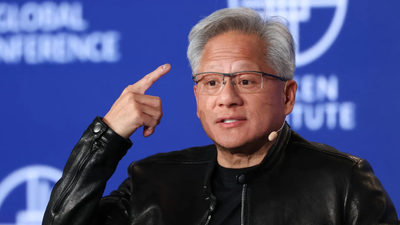
Jensen Huang has spent 33 years telling himself that Nvidia is about a month away from collapse. The phrase has outlasted the botched Sega contract that nearly finished the company in 1996, the layoffs that followed it, and the AI boom that has since pushed Nvidia’s market value to roughly $4.7 trillion. None of that paranoia, it turns out, extends to other people.Speaking at Y Combinator’s Startup School 2026 this week, in conversation with YC chief executive Garry Tan, the 63-year-old Nvidia CEO told the room that this is the single greatest time in history to start a company. Then he went a step further and said he was jealous of the founders sitting in front of him. His argument was not really about model capabilities or funding markets. It was about the distance between how hard a thing looks from the outside and how hard it actually turns out to be.
Jensen Huang ‘s advice to young founders is to stop rehearsing the failure in advance
Huang’s framing is almost aggressively simple. Instead of mapping every obstacle before starting, he suggested founders ask themselves one question: “How hard can it be?” Imagining the full weight of a difficult project up front, he warned, curdles into anxiety, and anxiety turns into not doing the thing at all. Better to let the suffering arrive in instalments.That is not a claim that any of it is easy. Huang has said he works seven days a week and that the sense of vulnerability has never left him—the same man who has been quietly running Nvidia as though it were 30 days from going out of business since 1993, when he sketched the idea out with Chris Malachowsky and Curtis Priem in a Denny’s booth.
The Nvidia CEO built a $4.7 trillion company by admitting what he did not know
His confidence, by his own account, comes from a willingness to learn rather than a habit of being right. Early on, Nvidia bet on the wrong graphics approach and nobody inside the company knew how to correct it. Huang’s fix was to walk into Fry’s with a few hundred dollars, buy three technology textbooks and hand them to his engineers. He now describes the early Nvidia as a company that raised money and bought textbooks. The takeaway he offers is that the specific technology matters far less than the ability to face an uncomfortable reality and relearn on the spot.
US business applications hit a record in 2026 even as the failure rate stays brutal
Plenty of people have already run Huang’s calculation for themselves. Americans filed 3.23 million business applications in the first half of 2026 alone, a record, and 12.1 percent more than the same stretch a year earlier, per Inc. That is happening in a sluggish economy, which is close to Kevin O’Leary’s point when he says downturns are the best moment to start something—a correction forces the pivot early, while there is still little to lose. What an application does not capture is what comes after it. Bureau of Labor Statistics data puts the five-year failure rate for new businesses at nearly half. Jeff Bezos’s counsel is to borrow before building: spend time somewhere that already knows how to hire and interview, then go.Huang is proof of both halves. He envies the founders with nothing yet to protect, and he still runs a $4.7 trillion company as though the thirty days started this morning.