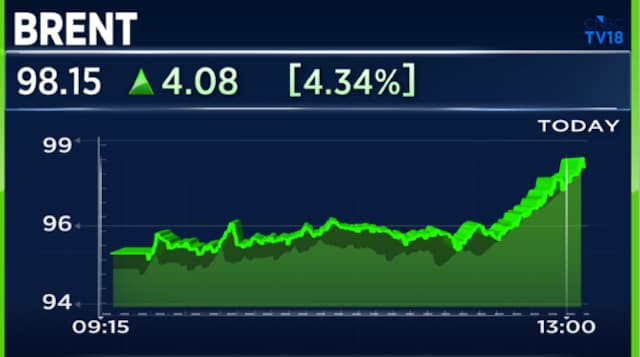
With that, Brent has touched a six-week high, while US benchmark West Texas Intermediate (WTI) was trading close to $89.50 a barrel.
Brent inching closer to the psychologically important $100-a-barrel mark is once again reviving concerns over inflation, fuel costs and the impact on oil-importing economies like India.
Dalal Street feels the heat
The surge in crude prices has added to the pressure on equity markets, especially on Dalal Street.
The Nifty 50 index fell over 180 points intraday, slipping towards the 23,800 mark, as investors reacted to the fresh spike in geopolitical risks.
Among the worst hit were oil marketing companies (OMCs), which typically come under pressure when crude prices rise sharply. Higher crude prices can squeeze their marketing margins if retail fuel prices are not increased proportionately.
Shares of Indian Oil Corporation fell over 2%, while HPCL declined 2.5% and BPCL slipped nearly 1%.
What’s driving the rally in oil?
The latest leg of the rally comes as tensions in West Asia continue to escalate.
Besides the ongoing conflict involving the US and Iran, the crisis has now spread to the other side of the Persian Gulf.
Most recently, the Houthis in Yemen reportedly attacked Saudi Arabia-based oil tankers in the Red Sea, further jeopardising the oil market. The attack came just a day after the militant group announced a blockade of the Bab el-Mandeb Strait, one of the world’s busiest maritime chokepoints through which a significant share of global oil and LNG shipments pass. Any disruption here raises fears of supply bottlenecks and higher transportation costs.
LNG supply concerns add to the uncertainty
Adding to concerns, QatarEnergy, according to a Bloomberg report, is preparing to further extend force majeure on liquefied natural gas (LNG) shipments through mid-October. The move could prolong the supply disruption that has already unsettled the global gas market amid the conflict in the Middle East.
The company had informed certain customers in Asia and Europe in June that some cargoes would be cancelled through August and September. If the force majeure is extended again, buyers in Europe and Asia could be forced to compete more aggressively for limited LNG supplies, as countries replenish inventories ahead of winter while heatwaves continue to support demand in several regions.
With both oil and LNG supplies facing uncertainty, energy markets are increasingly pricing in the risk of prolonged disruptions rather than treating the conflict as a short-lived event.
Also Read: Oil prices jump after Houthis attack two Saudi Arabian tankers in the Red Sea
(Edited by : Prashant)
First Published: Jul 23, 2026 1:54 PM IST