
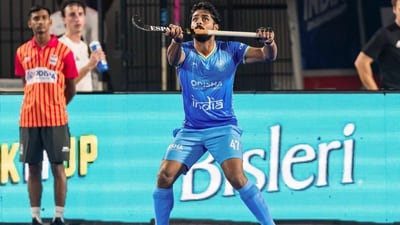
As the Netherlands and Belgium prepare to host the 2026 FIH Hockey World Cup, India arrives with a men’s team that finished ninth in 2023 and a women’s team that ranked ninth in 2022. For the nation of Dhyan Chand and eight men’s Olympic champions between 1928 and 1980, the most decorated side in the history of the Olympics, neither result is anything to celebrate on paper. Yet both mark a country climbing back from decades in the wilderness; for Indian hockey has enjoyed three distinct eras of success, failure, and hope.
India’s men were there from the very beginning. At the inaugural World Cup in Barcelona in 1971, they went one step further, reaching the final against hosts Netherlands, leading twice through a Surjit Singh brace, only to lose on penalty strokes after the match finished 2-2. The women’s team, playing its first World Cup in France in 1974, beat eventual champions Netherlands in the group stage and reached the semi-finals before finishing fourth, a result that gave the sport a real boost back home. Then came Kuala Lumpur, 1975. The men’s team beat Pakistan 2-1 in the final, Surjit Singh equalising before Ashok Kumar struck the winner in the 51st minute to give India its first Hockey World Cup title.
Also Read: Men’s and Women’s Hockey World Cup 2026: Teams, Full India schedule, streaming and format explained
But that also remains India’s only World Cup title. That’s the paradox defining Indian hockey — for all their Olympic pedigree, they have never come close to replicating that at the World Cup. Three medals in the men’s competition, plus a fourth-place finish for the women, all within one decade, signalled a continuity of their Olympic dominance, but that false dawn quickly lapsed, and nothing since has come close. Pakistan, by contrast, have won the World Cup four times, while Australia, Germany and the Netherlands have three apiece.
India’s men came sixth in 1978, fifth in 1982 (their best finish since the title), then bottomed out at 12th and last in London in 1986. The 1990s and 2000s offered little relief: ninth in 1998, tenth in 2002, eleventh in 2006. They never actually missed a World Cup; along with Germany, Spain and the Netherlands, they remain one of only four nations to have competed at every single edition of the tournament. But that full-attendance prize is just a consolation.
The women’s team, meanwhile, has barely had a seat at the World Cup table for the better part of three decades. Between 1986 and 1998, they failed to qualify for three consecutive World Cups. Their last finish before that drought? 11th in 1983, second-last. Did they finish first afterwards? 12th, winless, last-place in Utrecht in 1998. They missed out on qualification again in 2002 and in 2014.
Rebuilding, one World Cup at a time
The dissolution of the Indian Hockey Federation due to a bribery scandal over team selection in 2008 saw the newly formed Hockey India bring in sweeping administrative reform and foreign coaching expertise — Roelant Oltmans, Terry Walsh, Michael Nobbs, and later Graham Reid and Craig Fulton for the men, and Sjoerd Marijne, Harendra Singh and Janneke Schopman for the women’s side. The Hockey India League, launched in 2013, gave Indian players regular exposure to foreign professionals and franchise-level intensity. And from 2018, the Odisha state government began sponsoring both national teams outright.
The last three men’s World Cups have seen the Indian teams reap the rewards of that recovery in real time. In 2014 at The Hague, a rebuilding side under Walsh and captain Sardar Singh limped to ninth place, but the tournament is now remembered as the low point before the climb: within months, India had won Asian Games gold and qualified directly for the Rio Olympics. In 2018, India topped their pool and reached the quarter-finals for the first time in years, before losing late on to eventual silver medallists, the Netherlands. It remains India’s best World Cup finish, sixth, since the 1970s. In 2023, hosting again in Bhubaneswar and Rourkela, India lost to New Zealand 5-4 in a marathon shootout, and eventually finished ninth.
The women’s team followed a parallel arc. Missing the 2014 World Cup after a semi-final qualifying loss to South Korea, they returned in 2018 under Rani Rampal and, for the first time since 1978, reached the quarter-finals, falling to Ireland on penalty strokes to finish 8th, their best result since the 1970s. That side carried forward into the Tokyo Olympics in 2021, where India reached an Olympic semi-final for the first time ever and finished fourth, lifting the team to a career-high eighth in the world rankings. But they struggled to follow that up, and finished the 2022 World Cup in ninth place, just like the men’s team.
Sixth, eighth and ninth-place finishes look unremarkable next to Pakistan’s four titles or Australia’s three. But set against the 11th-, 12th-, and last-place finishes that filled the decades after 1980 for both the men and the women, they represent a hard-won floor that Indian hockey no longer regularly falls beneath. Whether 2026 delivers the country’s second World Cup medal remains to be seen. But the teams that arrive in the Netherlands and Belgium are unrecognisable, in structure and support, from the ones that limped through the turn of the millennium.