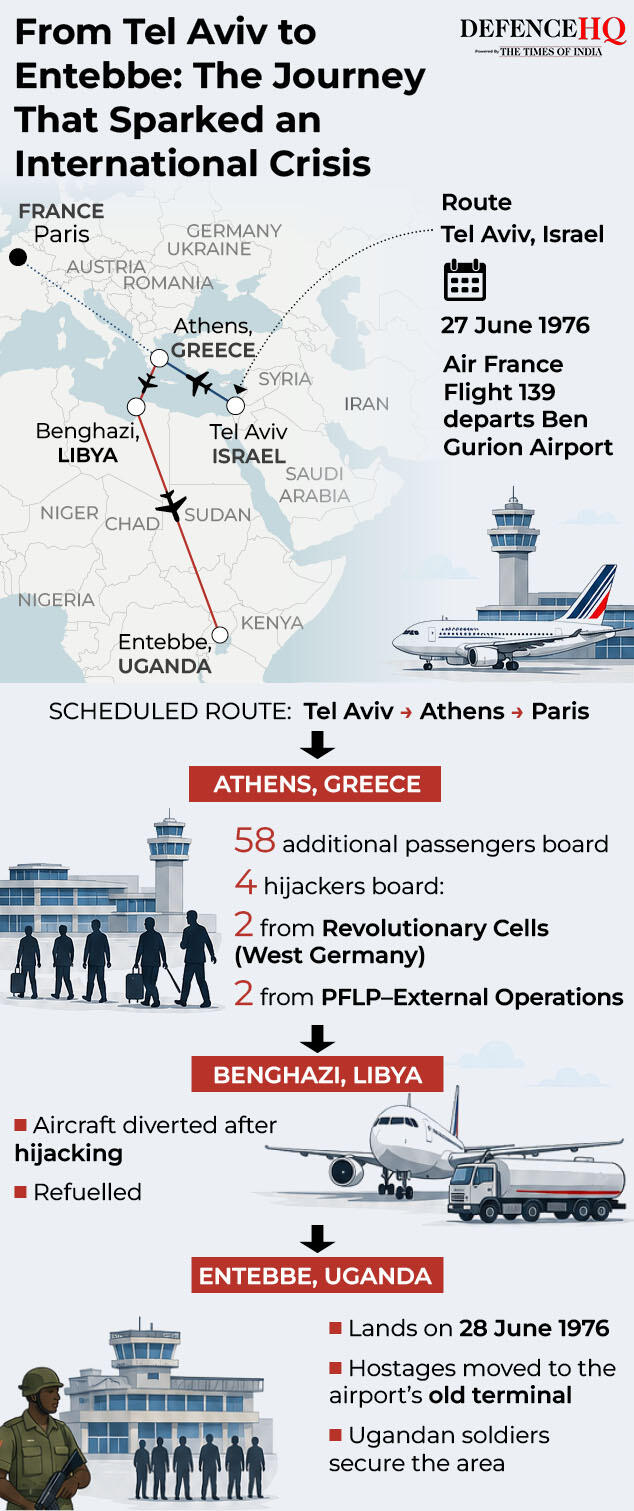
In the darkness, a black Mercedes-Benz and escort vehicles moved across the tarmac of Uganda’s Entebbe Airport. Moments earlier, Israeli Air Force C-130 Hercules aircraft had landed after a long flight from Israel, carrying commandos tasked with freeing hostages held thousands of kilometres away from home.Ahead of them was a guarded airport terminal. Behind them was a plan built on speed, surprise and intelligence gathered over several tense days. Within the next hour, the operation would either rescue more than 100 hostages or end in a major failure.The raid, officially codenamed Operation Thunderbolt and later also known as Operation Yonatan, remains one of the most studied hostage-rescue missions in military history. But it also triggered a diplomatic dispute, with Uganda accusing Israel of violating its sovereignty and Israel arguing that it had acted to rescue its citizens and other hostages from a hijacked aircraft.The episode has returned to focus after newly declassified Israeli records shed fresh light on how the country’s leaders debated diplomacy and military action before ordering the raid.The hijackingThe crisis began on June 27, 1976, when Air France Flight 139 left Tel Aviv’s Ben Gurion Airport for Paris, with a scheduled stopover in Athens. The Airbus A300 was carrying passengers from several nationalities, including Israelis, French citizens, Americans and other Europeans, along with the Air France crew.During the stopover in Athens, 58 more passengers boarded the aircraft. Among them were four hijackers carrying concealed weapons and grenades.Two of them, Wilfried Böse and Brigitte Kuhlmann, were members of the West German militant group Revolutionary Cells. The other two, Jayel al-Arja and Fayez Abdul-Rahim Jaber, belonged to the Popular Front for the Liberation of Palestine-External Operations, or PFLP-EO.Soon after take-off from Athens, the four hijackers seized control of the aircraft and forced Captain Michel Bacos to change course. The flight was first diverted to Benghazi in Libya, then ruled by Muammar Gaddafi. The aircraft remained there for several hours for refuelling before taking off again.On June 28, more than 24 hours after leaving Tel Aviv, Flight 139 landed at Entebbe International Airport in Uganda. Armed accomplices were waiting on the ground, and Ugandan security personnel were also present at the airport.The hijackers demanded the release of 53 prisoners, including 40 Palestinian and pro-Palestinian militants held in Israeli prisons and 13 others held in different countries. They set a deadline of July 1 for Israel to comply.
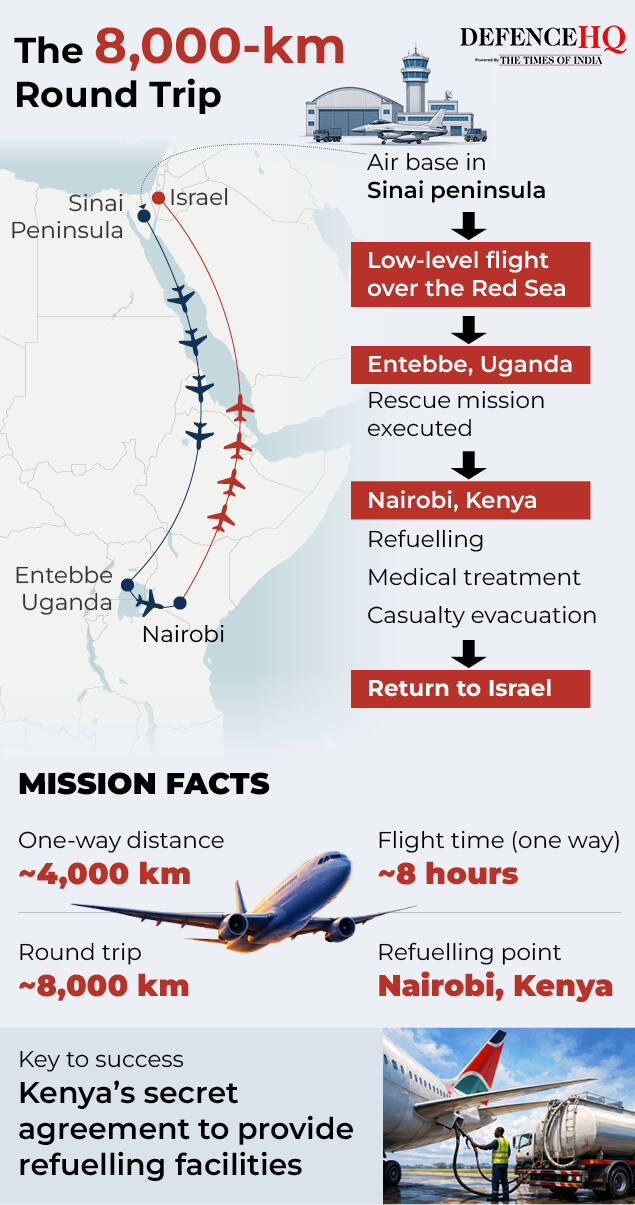
Israel’s dilemmaIn Jerusalem, former Prime Minister of Israel Yitzhak Rabin, the military leadership were faced with a difficult choice: negotiate with the hijackers or attempt a long-range rescue operation at an airport nearly 4,000 kilometres away.Newly released Israeli records, reported by AP, suggest that the government pursued both tracks for several days. Officials used diplomacy to buy time while the military studied whether a rescue operation could be carried out.As negotiations continued, the hijackers began releasing some passengers. On June 30, they freed 48 hostages, most of them non-Israelis, who were flown to Paris. A day later, after Israel agreed to enter negotiations, the deadline was extended to July 4 and around 100 more non-Israeli captives were released.But 106 people remained at Entebbe, including Israeli passengers, several dual nationals and the Air France crew.Planning the raidWhile diplomats kept talks alive, Israel’s military began planning a rescue attempt. The Israel Defence Forces, led by Chief of Staff Mordechai Gur, assigned the elite Sayeret Matkal unit, commanded by Lt Col Yonatan Netanyahu, to examine whether a raid could succeed.Israeli planners gathered intelligence on Entebbe Airport, including the layout of the old terminal where the hostages were being held. They also relied on accounts from released passengers, who provided details about the position of the hostages, the hijackers and Ugandan troops.The challenge was not just the assault itself. Entebbe was far from Israel, and the aircraft needed a refuelling arrangement to complete the mission. Kenya’s decision to allow Israeli aircraft to refuel in Nairobi became crucial to the operation.
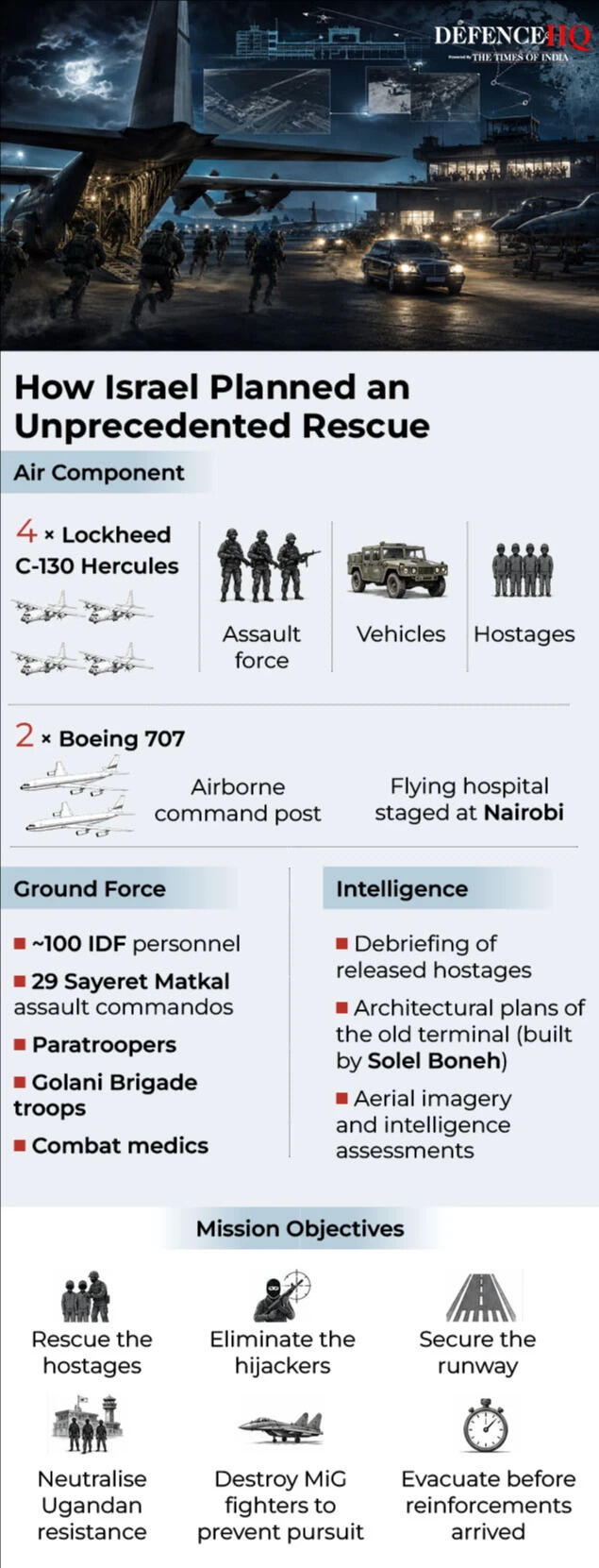
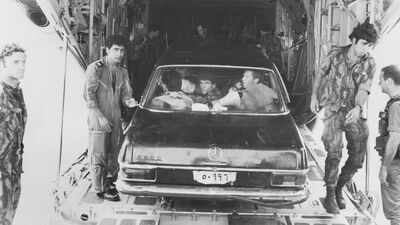
The force was flown in C-130 Hercules transport aircraft, supported by Boeing 707 aircraft, including one configured for command and control and another carrying medical personnel. The ground force included assault, security and support elements. One detachment was tasked with destroying Ugandan fighter aircraft parked at Entebbe to reduce the risk of pursuit.The assault team carried vehicles, including a black Mercedes-Benz, as part of a deception plan intended to make the convoy resemble one used by Ugandan President Idi Amin.The flight to EntebbeAfter the Israeli cabinet approved the mission, the rescue force assembled for final briefings. The aircraft then headed south over the Red Sea, flying at low altitude for parts of the journey to reduce the risk of detection.After several hours in the air, the Hercules formation approached Entebbe shortly before midnight on July 3. The runway lights were still on, allowing the first aircraft to land.
As the first C-130 reached the runway, vehicles rolled out and moved towards the old terminal, where the hostages were being held.The deception did not last long. As the convoy neared the terminal, Ugandan guards became suspicious. Israeli commandos opened fire, ending any chance of a silent approach. With surprise partly compromised, the assault team moved quickly towards the terminal.The assaultAs the commandos entered the old terminal, they shouted warnings in Hebrew and English, telling the hostages to get down. Captain Bacos is also reported to have warned passengers in French to take cover.The warnings were meant to prevent hostages from being mistaken for hijackers in the confusion. Most dropped to the floor, but the sudden gunfire and shouting created panic.
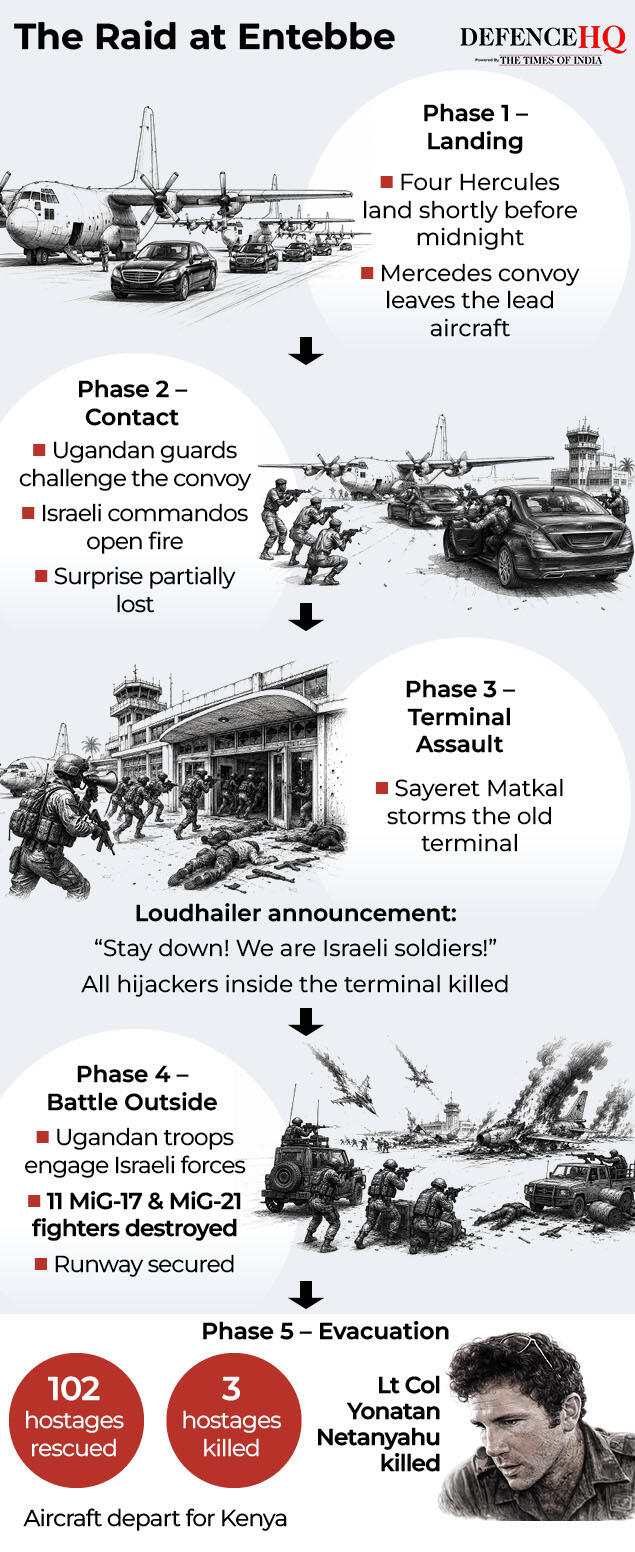
Within minutes, the hijackers present at the terminal were killed. Three hostages were also killed during the firefight.Outside the terminal, Israeli troops fought Ugandan soldiers and moved to secure the runway and aircraft. Another team destroyed several Ugandan MiG fighter jets parked at the airport to prevent them from being used against the departing Israeli aircraft.During the evacuation, Yonatan Netanyahu was shot by Ugandan fire. He was taken back towards the aircraft, but died of his wounds. He was the only Israeli commando killed in the operation.As the hostages were rushed to the waiting aircraft, Israeli troops continued exchanging fire with Ugandan forces. Less than an hour after the first aircraft landed, the Israeli planes took off from Entebbe.After the raidThe operation rescued 102 hostages. Three hostages were killed during the raid. Another hostage, Dora Bloch, a British-Israeli woman who had been taken to hospital in Kampala after falling ill before the raid, was not in the terminal during the rescue. She was later killed by Ugandan security personnel.
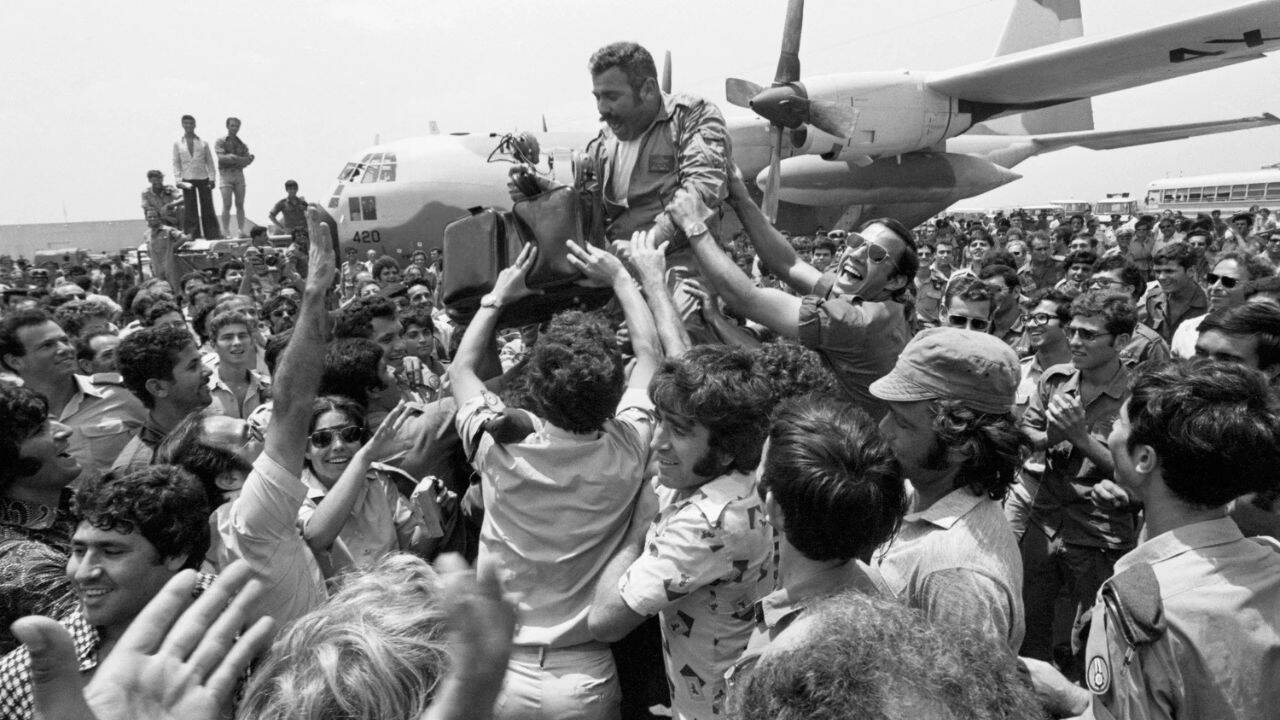
Photo credit: History extra
The Israeli aircraft flew to Nairobi, Kenya, where the rescued hostages received medical attention and the planes refuelled before continuing to Israel.The raid was later renamed Operation Yonatan in memory of Yonatan Netanyahu.Diplomatic falloutThe military operation ended at Entebbe, but the political argument continued at the United Nations. Uganda accused Israel of violating its sovereignty and sought international condemnation. Several African and Arab states also criticised the raid as an unauthorised military action on another country’s territory.
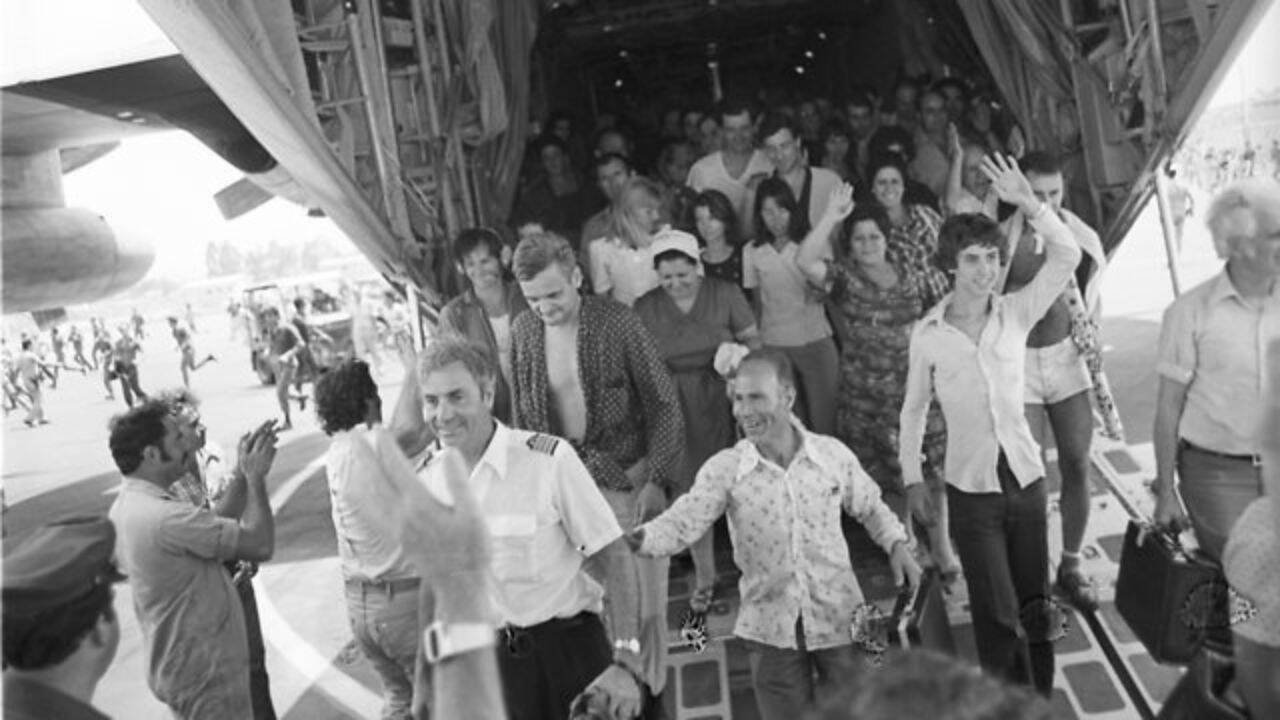
Photo credit: David Rubinger
Israel defended the operation as a necessary rescue mission after a hijacking and hostage crisis. Its supporters argued that the raid saved lives. Critics said the operation raised serious questions about the use of force inside another sovereign state.The UN debate reflected that tension: the need to save hostages on one side, and the principle of territorial sovereignty on the other.Half a century later, Operation Entebbe remains a major case study in long-range special operations, hostage rescue, intelligence gathering and crisis decision-making. It is remembered not only for the hostages it saved, but also for the legal and diplomatic questions it raised.