
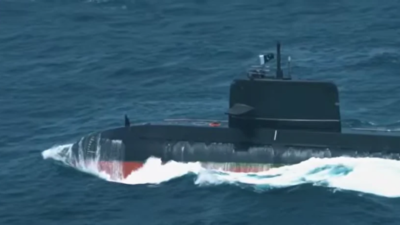
Even as India’s long-delayed P-75(I) project for six new-generation submarines continues to hang fire, Pakistan on Sunday announced that its newly inducted Chinese-built AIP submarine had successfully test-fired an anti-ship cruise missile in the North Arabian Sea. Sources in the Indian defence establishment identified the missile as the Chinese YJ-18, assessed to be derived from the Russian Klub family, with some variants claiming a strike range of up to 540 km.The test comes just 12 days after a Pakistani naval vessel and an Indian warship collided in the North Arabian Sea on September 15. India had lodged a strong protest, holding that PNS Hunain approached the Indian warship at high speed and manoeuvred unsafely. Islamabad disputed the account. The Indian warship continued its mission, while PNS Hunain was forced to return to port.Hangor, the first of eight submarines Pakistan is acquiring from China, was commissioned at Sanya at the end of April and arrived in Karachi in June. Four of the eight are being built in China and four in Karachi. Crucially, the submarine is fitted with Air Independent Propulsion, which allows it to remain submerged for two to three weeks at a stretch instead of surfacing every few days to recharge batteries, making it significantly harder to detect and hunt.Submarines armed with cruise missiles add long-range strike capability to one of the hardest platforms to detect in naval warfare. Unlike torpedoes, cruise missiles let a submarine engage targets well beyond the immediate maritime battlespace, including, in some configurations, targets deep inland. The combination of stealth, mobility and long-range missiles allows submarines to approach contested waters covertly and strike without exposing their position, a template the US Navy has long used with Tomahawk-armed Virginia-class submarines.India’s own undersea fleet, by comparison, is under strain. The Navy currently operates 16 conventional diesel-electric submarines across the Kalvari, Sindhughosh and Shishumar classes. Four Sindhughosh-class boats have already been retired, while the Shishumar class has gone through a mid-life upgrade meant to extend service by roughly a decade. Only the six Kalvari-class submarines, based on the French Scorpène design, are expected to receive a DRDO-developed indigenous AIP system in the coming years. The Navy’s original plan to field 24 conventional submarines by 2030 has slipped considerably, partly due to delays in the P-75(I) programme, a roughly Rs 70,000 crore tender for six to nine Type-214 submarines with AIP, though Mazagon Dock and Germany’s TKMS have now cleared technical evaluation.On the nuclear side, India operates three Arihant-class submarines with a fourth undergoing trials, carrying K-4 and K-5 missiles as the sea-based leg of India’s nuclear triad. Work is underway on the larger S5-class submarines, expected to carry K-6 missiles with ranges beyond 5,000 km. The Navy is also pursuing Project-76, featuring a modified indigenous AIP system, alongside Project-77 for indigenous nuclear attack submarines and a separate lease of a Russian nuclear attack submarine, though all remain years from fruition. Despite Pakistan’s latest test, the Indian Navy continues to hold overwhelming numerical superiority over its neighbour in this domain.